I Casali del Buontempo
Buggiano - Via Bugianpiccolo snc Snc
Book now
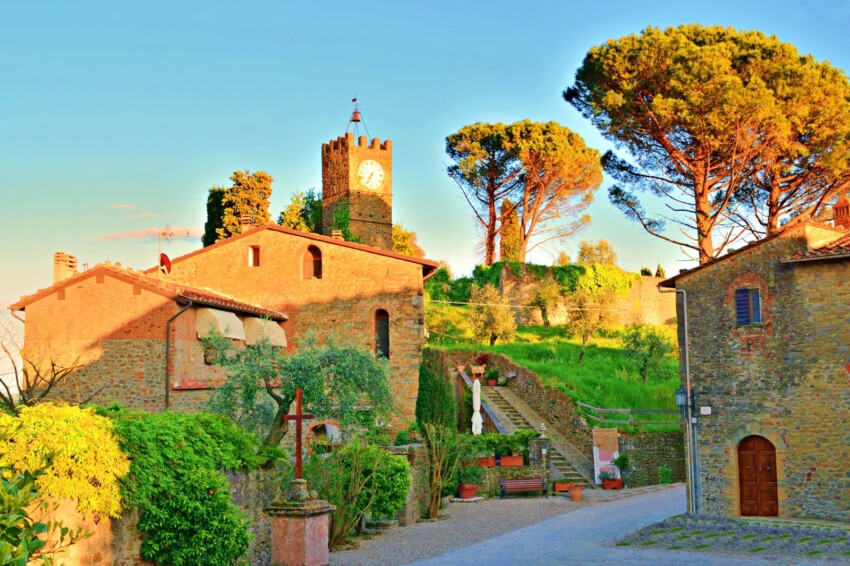
Buggiano is one of the oldest communes in the Valdinievole. The territory, originally inhabited by the Ligurians, then the Etruscans, and finally the Romans, has always held great strategic importance because its hills commanded the vital road connecting Florence with Lucca. Following the Roman era, the Lombards left traces detectable in certain place names. Buggiano also had its own dynasty of rulers who continued the feudal system, the Lombardi of Maona, whose founder Sigifredo appears in a parchment dating from 991. However, as early as 1191, a document mentions the podestà and consuls, which testify to the emergence of the first forms of municipal autonomy.
The people of Buggiano, as good Tuscans, fought numerous internal conflicts and battles with neighbouring territories. The area was contested between Florence and Lucca, and in 1315, in the woodland of S. Maria, the Battle of Montecatini was fought between the Ghibelline forces of Lucca led by Uguccione della Foggiola and the Guelph militias of Florence.
From 1339 onwards, Buggiano and all of the Valdinievole came under Florence’s rule. The Florentine lily was added to the town’s coat of arms, and shortly after, the Florentine Republic imposed new Statutes on Buggiano.
In the modern era, the Buggiano territory gained importance as an economic centre (agricultural production, sericulture and livestock farming), with commercial flows directed mainly towards Livorno through important trade routes and waterways that extended from the Padule di Fucecchio to the Arno.
It was especially Borgo a Buggiano that acquired a distinctly mercantile character, whilst the ancient castles of Buggiano, Colle and Stignano began to decline. This process was confirmed at institutional level when, in 1775, following the Riforma delle Comunità implemented by Pietro Leopoldo, Grand Duke of Tuscany, the municipal seat was transferred to the Borgo, followed shortly after by the offices of the chancellor and podestà. The small hamlet of Ponte Buggianesi at the foot of the Padule, which had grown with the expansion of lowland agricultural activities and the land reclamation works undertaken by the Lorraine dynasty, gained municipal autonomy in 1883. Borgo a Buggiano continued to expand throughout the 19th and 20th centuries with the strengthening of commercial activities (boasting a famous livestock and silk market) and the emergence of the first manufacturing industries.
The modern, industrious Borgo a Buggiano is the centre of civic and administrative life. The sturdy walls that once surrounded it and its three gates were demolished in the second half of the 19th century, but its historic centre remains rich in monuments of historical and artistic merit.
The most important is the Church of S. Pietro Apostolo, which has recently been proclaimed a Sanctuary of the Holy Crucifix. Originally the oratory of the adjoining Hospital, it appears in 1260 as the “Church of S. Pietro”; in 1592 it was elevated to Pievania (parish church). It has undergone numerous transformations, the most radical in 1771, when it assumed its present appearance and dimensions. The lower part of the façade is in the Romanesque style. Inside, one can admire the Crucifix, sculpted by an unknown artist in the 13th century, which on 18 August 1399 “wept blood”: a miracle that continues to be celebrated solemnly in accordance with a decision made by the Municipal Council just eight months after the event.
The church is enhanced by panels by 16th-century artists, among whom Bronzino stands out with his Martyrdom of S. Agata; four canvases painted in 1772 by the eccentric lay Capuchin friar Fra Felice da Sambuca, which depict episodes from the life of S. Pietro, the patron saint of the church; six 17th and 18th-century canvases and a notable organ, restored by the celebrated Tronci brothers from Pistoia. Adjacent to the church is a rich Museum of sacred furnishings.
Also significant is the Church Famedio of S. Marta. Incorporated into the S. Benedetto monastery, now the seat of the Municipality, built in the early 16th century, it assumed its present appearance in 1775. Proclaimed a War Memorial, it offers its measured decoration and its canvases, among which are some particularly fine works by Alessandro Bardelli da Uzzano (early 18th century) and Alberigo Carlini (18th century).
The structure of the Oratory of S. Antonio dates back to the 18th century and was entrusted to the homonymous Confraternity: the oratory recalls the extremely crowded livestock market that was held in the adjacent square, still known as Piazza del Mercato Bestiame, for centuries and until a few decades ago. The urban centre is further enriched by fine 18th-century palatial residences, including the Palazzo Carozzi Sannini.
Along the via Lucchese, almost at the western entrance to the Borgo, a shrine with a 14th-century Madonna was transformed into what is now the Oratory of the Giglio, a place of heartfelt devotion that was granted indulgences by Pope Alexander VIII, who extended a plenary indulgence to visitors for seven years.
In an area of woodland origin, from which it takes its name, on the eastern outskirts of the Borgo stands the Church of S. Maria in Selva and the adjoining Convent of the Augustinians. Erected between 1261 and 1275 in Gothic style, it was enlarged and rebuilt between 1643 and 1648. The interior consists of a single nave with the upper part of the walls completely frescoed in the first half of the 18th century by the Florentine Niccolò Nannetti (the Apotheosis of the Madonna is particularly noteworthy). It also preserves remnants of 14th-century frescoes.
The Convent features a beautiful cloister known as the “Brunelleschi” cloister and an artistic façade of the Chapter House.
In the outlying areas, several notable villas remain: Delle Lame, La Magnana and Villa Perosi (which was inhabited by the celebrated Don Lorenzo Perosi, who composed some of his most famous sacred works here).
Until 1775 the seat of the Municipality and the Podestà’s office, it is a veritable open-air treasure that has remained intact in its medieval appearance. In its enchanting small square, at the summit of the hill, stands the 13th-century Palazzo Pretorio, with its façade studded with the coats of arms of the successive Podestà; inside, 15th-century frescoes are preserved. Some rooms house the Municipality’s historical archive. In the main hall, the people’s representatives assembled, and there was a period when those absent were fined in grains of pepper, the black gold of the Middle Ages. Beside it is the Church of S. Niccolao, dating from 1038, in the Romanesque style; it has three naves and possesses a rich artistic heritage (a precious 13th-century Baptismal Font and a beautiful 13th-century ambo, plus 16th-century paintings by G. Brina, from the school of A. Del Castagno and Bicci di Lorenzo). The sacred furnishings preserved in the Parish Museum are exceptional. Adjacent to the church is the ancient Abbey with a beautiful cloister.
Further up in the castle there are notable remains of the Rocca. Two gates, remnants of tower houses, the former Convent of S. Scolastica, the Oratory of S. Martino and the 18th-century Villa Sermolli complete the monumental heritage.
Just a few kilometres from Montecatini Terme and near Borgo a Buggiano stands the splendid Villa Bellavista.
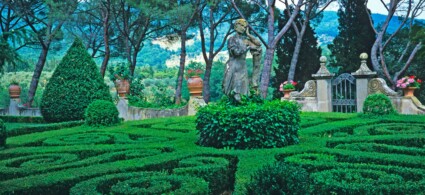
In 1673, the Marquis Francesco Feroni purchased from Grand Duke Cosimo III de’ Medici a farm with 45 tenant farms situated on a small hillock that perhaps originated from the reclamation of an area of the Padule di Fucecchio. Here he had built a structure of great harmony, complete with gardens and a family chapel. A majestic avenue, enriched with statues and various ornamental vases and embellished with a large central basin, runs in front of the villa.
Villa Bellavista has experienced varying fortunes throughout its history: during World War II it also served as a hospital. Today it is owned by the Ministry of the Interior, which has assigned it to the National Assistance Opera for Firefighters. In the ground floor rooms, an original Regional Historical Museum of the Firefighters’ Service has been set up.
To see all the facilities and book accommodation in Buggiano use the form below, entering the dates of your stay.
 Hotel
Hotel  Budget accommodations
  Apartments
  Family Hotel
  Luxury Hotel
  Resorts