Collodi is famous for lending its name as a pen name to Carlo Lorenzini, the author of Pinocchio. But it is also a splendid village whose origins date back to the twelfth century.
The ancient village of Collodi, in the province of Lucca but just a stone’s throw from the border with Pistoia, presents itself as a veritable “waterfall” of small houses clinging to the steep slopes of a hill, arranged on either side of two triangles that meet at their vertices. At the base of the upper triangle stands the Antica Rocca, while at the lower one sits the magnificent Villa Garzoni, which appears to support the entire village.
In 2004, the Touring Club Italia awarded Collodi the prestigious Orange Flag quality tourism and environmental mark, qualifying it as one of the locations where respect for the environment, authenticity and a culture of hospitality are among the most carefully maintained and genuine.
Among Collodi’s main attractions is certainly the Pinocchio Monumental Park, a large open-air museum and place of relaxation for visitors of all ages, in honour of the world’s most famous puppet: a place of play and imagination for the young, and a cultural enrichment experience of high artistic value that rightfully ranks among contemporary art heritage for art enthusiasts.
As many know, Collodi is the pen name of Carlo Lorenzini, a famous Florentine writer who wrote the children’s novel The Adventures of Pinocchio: The Story of a Puppet, known to all simply as Pinocchio. It was here that the author spent much of his childhood, as his maternal grandfather’s house was located in the town. This indelible bond with the village has meant that today it is associated with and identified by Pinocchio, a book from which comics, magazines and animated films have since been created.
Things to do in Collodi
Collodi today concentrates its activities around three main tourist attractions: Villa Garzoni, the Garzoni Garden and Pinocchio Park. Of course, it’s also worth exploring the historic village, known as Collodi Castello.
Particularly from April to October, Collodi welcomes thousands of visitors from all over Italy and abroad. If you’re in the area around 24 August, don’t miss the celebrations for the town’s patron saint; throughout the week a funfair is also set up, which adds even more to the festive atmosphere.
Pinocchio Park
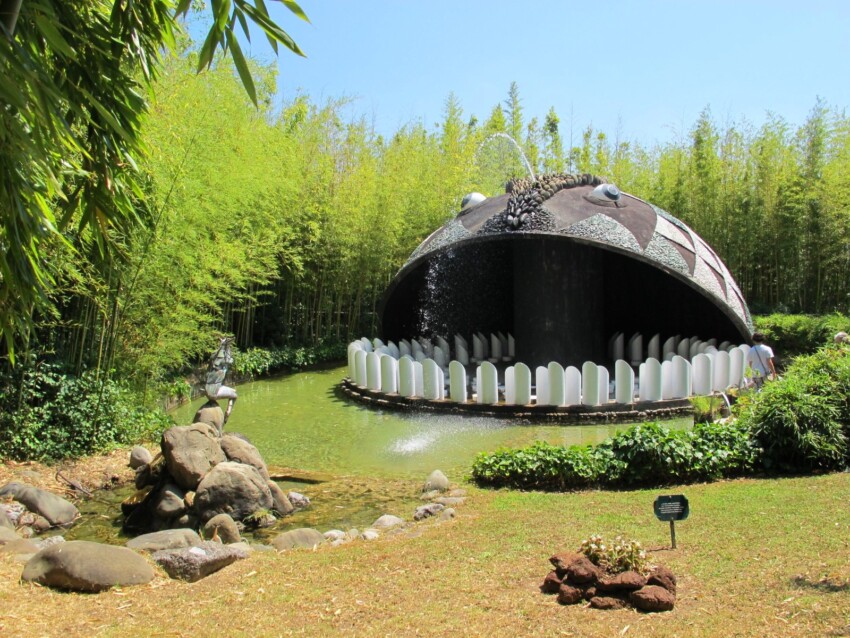
The Pinocchio Park, opened in 1956, is not a typical amusement park, but rather the precious collective creation of highly talented artists. The literary route, marked by mosaics, buildings and sculptures set amidst greenery, is born from the union of art and nature: the path is winding, the lush vegetation ensures that each stage arrives surprising and unexpected, and the plants themselves contribute to creating the atmosphere and episodes of the Pinocchio adventures story.
The park itself is a place of constantly renewed cultural activities yet never forgetful of its roots: art exhibitions and illustrations inspired by children’s literature and the Pinocchio story are held, puppet-making workshops and performances of puppets, marionettes and storytellers.
The idea of creating a monumental complex dedicated to Pinocchio came from the mayor of Pescia, Professor Rolando Anzilotti, who in 1951 established the Committee for the Pinocchio Monument and invited major artists to compete. As many as 84 sculptors responded: joint winners were Emilio Greco with Pinocchio and the Fairy and Venturino Venturini with the Mosaic Square. In 1956 the famous bronze group, which symbolically depicts Pinocchio’s metamorphosis, and the extraordinary mosaics depicting the main episodes of his adventures were inaugurated, in a space designed by architects Renato Baldi and Lionello De Luigi.
The splendid Villa Garzoni stands at the foot of the village of Collodi, almost as if to support its weight. The earliest reliable information about the villa, designed by Luccan architect Ottaviano Diodati with the participation of the owner, Marquis Romano Garzoni, dates back to the first half of the 17th century. The “beautiful villa of Collodi”, also described in those years by painter Georg Christoph Martini, achieved great fame among contemporaries.
Behind the villa, an impressive building designed by Filippo Juvarra rises over a green space. This building, of a vivid red colour, can be considered one of the most significant expressions of Baroque architecture in Tuscany. The villa is not open to the public, but its imposing mass can be admired from a distance because of its elevated position overlooking the surrounding landscape.
Garzoni Garden
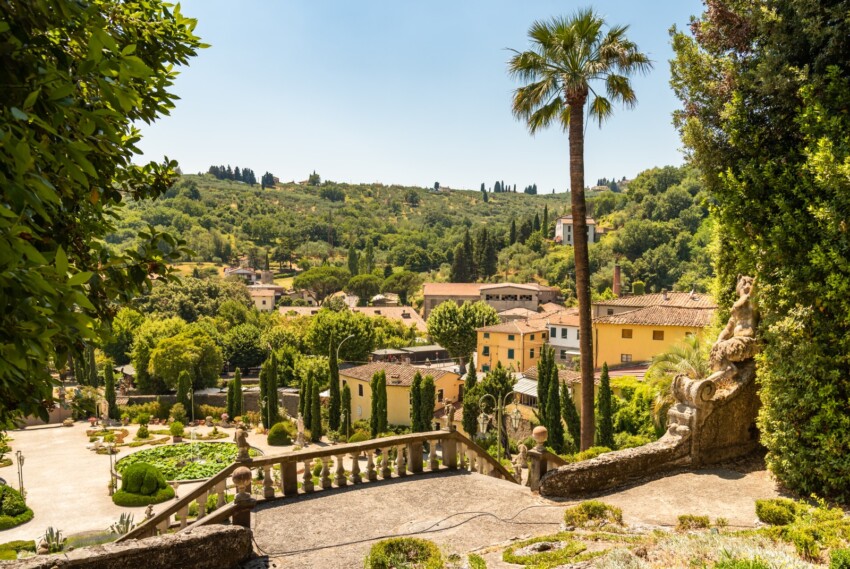
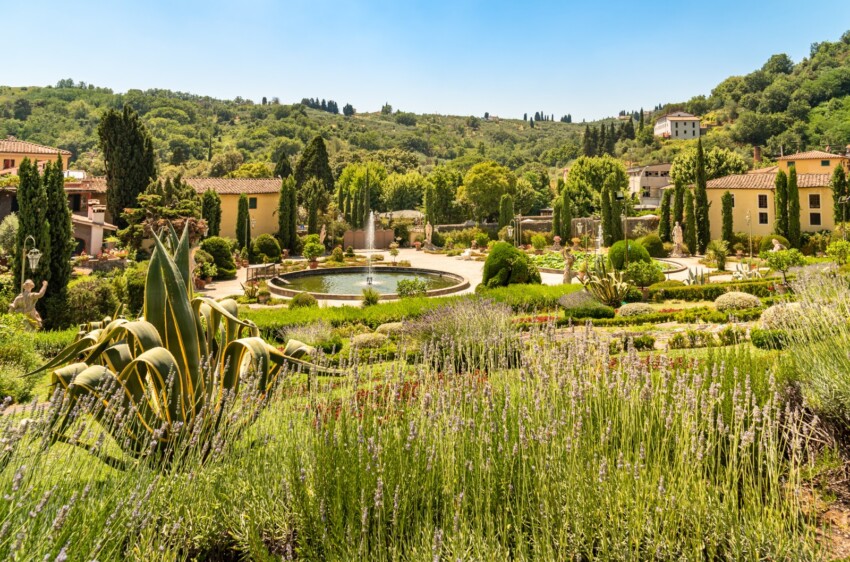
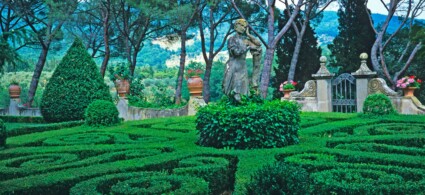
The Garzoni Villa Garden in Collodi is one of the most beautiful in Italy. A synthesis of Renaissance geometry and early Baroque spectacle, it was designed in the 18th century by Luccan architect Ottaviano Diodati.
Laid out on terraced levels, it is characterised by a majestic double-flight staircase and a complex hydraulic system that in past centuries created water features. The light and joyful atmosphere of the villa reached its peak in the bathing pavilion, or Bagnetti, where ladies and gentlemen could indulge in playful glances amidst water sprays, mirrors and green labyrinths.
It’s an absolutely unforgettable experience to lose yourself amongst the wonders of this place of imagination: grottos, theatres carved from box hedges, statues representing mythological beings, satyrs, female figures, peacock aviaries, bamboo forests.
Don’t miss the butterfly house, a space where butterflies are free to fly in beautiful exotic gardens where natural biological control systems are guaranteed. The Amazonian, Neotropical, Afrotropical and Indo-Australian environments have been recreated with respect, first and foremost, for the butterflies’ own requirements.
During the summer season, the Garzoni Villa Garden hosts events and concerts that further enhance the pleasantness of the place.
Collodi Castello
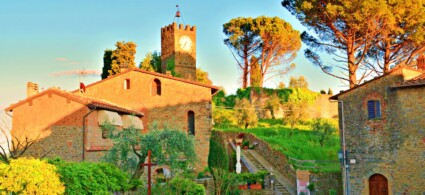
The ancient village of Collodi, known as Collodi Castello, is strategically positioned on the top of a hill, though it had the misfortune of being situated in the border area between Luccan and Florentine territory, and was therefore contested from 1329 to 1442. After it was conquered by the Republic of Lucca, it took on its present appearance.
Even today it can only be accessed on foot: it’s a cascade of small houses clinging to a steep hillside: the ancient Rocca at the top, the magnificent Villa Garzoni at the bottom.
Along the narrow cobbled streets, the houses retain their medieval layout, and you’ll find remains of fortifications and, at the top of the village, the Pieve di San Bartolomeo, dating from the 13th century, which houses important works of art including a 16th-century panel with the Virgin Enthroned, attributed by some to Raphael’s school, a 15th-century wooden sculpture of the Virgin and Child, a terracotta from the same period depicting Saint Lucy, and a wooden sculpture of Saint Bartholomew from the school of Jacopo della Quercia.
Via della Fiaba
The Via della Fiaba is a route designed for those who love walking. It winds through the gentle hills between Pescia and Collodi surrounding the two villages, and takes its name from the fact that the route is dotted with original artistic installations that evoke the world of the young and immerse us in the fairy-tale atmosphere of Pinocchio.
From the city of Pescia you can start from the ancient San Michele Monastery and take via della Cappella, which climbs and winds into the countryside until you reach a medieval bridge that crosses the Dilezza stream. In about an hour and a half, perhaps two, depending on the pace you wish to maintain, you’ll reach Villa Garzoni and Collodi.
Pieve di San Bartolomeo
The Pieve di San Bartolomeo in Collodi is a place with an old-world charm. You reach it by climbing steep paths and staircases because it’s located right at the top of the village of Collodi. Greatly loved by the inhabitants of Collodi, it houses several works inside including a venerated crucifix by Luccan sculptor Guglielmo Santi. Most notably, it houses a precious organ created in 1762 by master craftsman Michelangelo Crudeli, who had settled in nearby Lucca just a few years earlier. With this magnificent musical instrument, capable of producing a pure sound and equipped with concert stops with unique characteristics, Collodi becomes part of the prestigious route of historic organs present in our province.
The Italian Music Academy for Organ in Pistoia keeps the tradition of organ music alive today through initiatives, concerts, courses and publications. At the Pieve di San Bartolomeo you can attend some of these special concerts and listen to the sought-after sound of its ancient organ.
Where to stay in Collodi
Collodi is very small, and therefore there aren’t many accommodation options. In the historic village there are a handful of apartments for rent, beautifully restored and housed within ancient medieval palaces. Here the appeal of Pinocchio is so strong that some of them are named after characters from the fairy tale itself.
There are also other accommodation options in the nearby villages of San Gennaro and Petrognano, also mostly apartments or small bed and breakfasts.
For a wider range of choices, we recommend staying in Pescia, a town of almost 20,000 inhabitants located just a few kilometres away, where the range is much wider and more varied: there are also some hotels, some of which are beautiful and equipped with swimming pools.
We offer best rates If you find it cheaper we refund the price difference.
Free cancellation Most properties allow cancellation without penalty.
We're available 24 hours a day For any problem call Booking.com.
Collodi is located roughly halfway between Lucca and Pistoia; it can be reached in approximately 20-25 minutes from either centre of the two Tuscan provinces, travelling along the road that connects them, which is called via Pesciatina if coming from Lucca or via Lucchese if coming from Pistoia.
Getting there from the other provinces of Tuscany is quite straightforward, as both Lucca and Pistoia are well served by the A11 Firenze-Mare motorway. The nearest motorway exit to the centre of Collodi is Chiesina Uzzanese, which is only 10 kilometres from the historic village.
As for distances, from Florence the journey to Collodi is about 70 kilometres and takes 50 minutes. For those arriving from coastal Tuscan cities such as Pisa or Livorno, the travel time is roughly equivalent, but in terms of kilometres it’s slightly shorter.
From inland provinces such as Siena and Arezzo, however, the journey is considerably longer: around an hour and a half, with a distance to cover ranging between 120 and 150 kilometres.
If you’re travelling by public transport, you’ll first need to take the train to Pescia, which is on the regional railway line Firenze-Prato-Viareggio. Once off the train, you can take the E6 bus to the via Pesciatina Dogana stop and then walk for about 30 minutes – uphill – to Collodi Castello. Alternatively, it’s considerably more convenient to call a taxi from Pescia railway station, although it will cost you a bit more.
Collodi Weather
What's the weather at Collodi? Below are the temperatures and the weather forecast at Collodi for the next few days.
Tuesday 4
23°
34°
Wednesday 5
22°
39°
Thursday 6
22°
38°
Friday 7
22°
36°
Saturday 8
22°
35°
Sunday 9
21°
37°
Where is located Collodi
Collodi lies in the province of Lucca, but just a short distance from Pescia, which is situated in the province of Pistoia: it therefore sits on the border between these two Tuscan provinces.
 Hotel
Hotel  Budget accommodations
  Apartments
  Family Hotel
  Luxury Hotel
  Resorts