Bellavista Hotel & Osteria
Lamporecchio - Via Montalbano 61
Book now
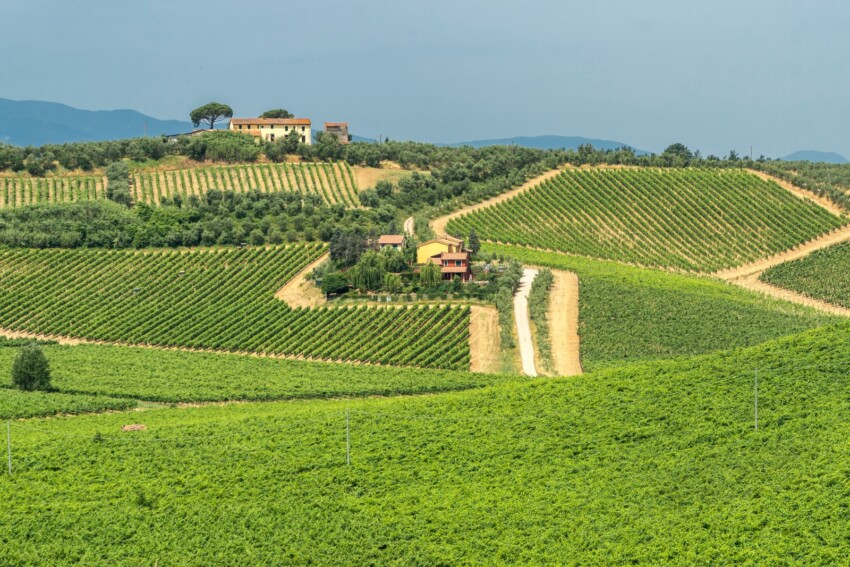
In the province of Pistoia, Lamporecchio sits between two of Tuscany’s natural jewels: the Padule di Fucecchio wetland and the gentle hills of Montalbano. It enjoys a happy central location: from Lamporecchio you can easily reach particularly appealing towns and cities including Vinci, Montecatini Terme, Pistoia, Lucca, Florence and Pisa. The silvery shimmer of olive foliage and the warm chromatic range of vineyards, present both along the hillside terraces and in the flat areas, create the most typical colours of a landscape still largely surrounded by the green hills of Montalbano, its eastern edges brushed by the Valdinievole.
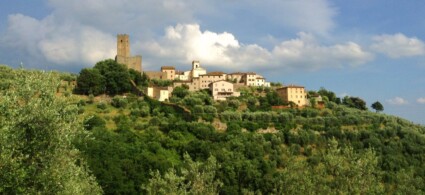
The oldest part of the town, with its medieval hamlets, towers and suggestive churches—simple and understated, inviting quiet reflection and prayer—is spread across the slopes of Montalbano, while the flat area saw the development, especially from the early 20th century onwards, of the modern part of town, stretching alongside the provincial road that continues towards Empoli.
Modern though it is, Lamporecchio has deep roots in a past of which numerous traces still remain in the hill areas. It was inhabited since Roman times, as is evident from place names (Giugnano, Papiano, Porciano, Orbignano…) and their typical land tenure suffixes. While little concrete historical documentation survives from that distant era, medieval testimony is abundant and significant: from the Vitoni tower at Collececioli to the towers of Porciano, and the simple, evocative churches of Orbignano, Porciano and San Baronto.
The church of Santa Maria Assunta in Orbignano preserves numerous artistic treasures: extensive fragments of 13th and 14th-century frescoes from the Pistoia school, a refined white marble relief depicting the “Madonna and Child” in the Donatellian manner, and a strikingly painted 14th-century oak statue representing the Madonna del Pruno, particularly cherished by the people of Orbignano.
At Porciano, set against a truly remarkable landscape, stand two towers and the ancient church of San Giorgio, dating from the 13th century. The small, intimate sacred building features fine wooden roof trusses and serves as a kind of casket for important works of art. Notable is the harmonious 16th-century painting on the right altar, created by Gerino da Pistoia, depicting “The Madonna and Child between Saint Anthony Abbot and Saint Nicholas of Bari”.
San Baronto church was damaged and destroyed at the end of the Second World War, but has been skilfully reconstructed using the original materials wherever possible and following the design of the previous building with its simple, essential Romanesque forms. Ancient and evocative is the crypt, supported by a forest of small columns with pre-Romanesque capitals dating probably from the 9th century, containing a white and green marble tomb where, according to tradition, the founding saints Baronto and Desiderio are buried.
As testimony to later historical periods, we note the Della Robbia panel in the church of Santo Stefano, created between 1524 and 1525 by Giovanni Della Robbia and artists of his school, as a gesture of thanks from the inhabitants of Lamporecchio to the Virgin Mary for their deliverance from a plague epidemic.
Always a land of natural abundance, Lamporecchio boasts wine and olive oil of excellent quality. Renowned and appreciated since antiquity, Lamporecchio is celebrated by Francesco Redi, a 17th-century scientist and writer, in his “Bacchus in Tuscany”, where he praises the wine produced in these lands, speaking of “Topaz pressed in Lamporecchio“. Montalbano oil, with its characteristic taste and colour, is produced with artisanal care from selected olives harvested in the Montalbano groves, planted with the typical Tuscan olive varieties: leccio, moraiolo and frantoio. And finally, as a sweet finale, the brigidini.
This small crisp sweet, this “special plaything”, as food writer Artusi called it in his celebrated volume “The Science of Cooking and the Art of Eating Well” (1891), with its extremely distinctive shape, colour and flavour, is truly what sets Lamporecchio apart. It’s an emblem, in fact, such that whenever Lamporecchio is mentioned, one immediately thinks of these particular sweets: small, fragrant golden wafers made essentially of eggs, sugar, anise and flour “as needed” (to borrow the phrase so beloved of recipe books). Various theories surround the name “brigidini”, but it seems fairly well founded that it derives from the “brigidine”—nuns of a local convent devoted to Saint Brigid, the great Swedish saint of the 14th century, an tireless traveller and devout pilgrim who visited Tuscany several times. These nuns, traditionally responsible for preparing communion wafers, invented the recipe for these sweets around the mid-16th century; they naturally had the shape of wafers and were made by pressing the dough between special heated iron plates of circular form.
The success of these sweets of monastic origin was soon truly remarkable. They were greatly loved and spread throughout the Pistoia area, yet found their true home in Lamporecchio: “all brigidini come from Lamporecchio“, declares an old Tuscan proverb, somewhat peremptorily. And who could argue? When everything was simpler, less complicated and elaborate, less artificial and contrived, brigidini were humble sweets, modest “morsels” of substance that delighted all at fairs, village festivals and patron saint celebrations, alongside nougat, hazelnut strands, brittle and the even more mythical, legendary “mangiaebevi”. They were transported in characteristic wicker baskets, later lined with waxed paper; later still, the baskets became zinc to keep the brigidini crisp and fragrant for a good length of time.
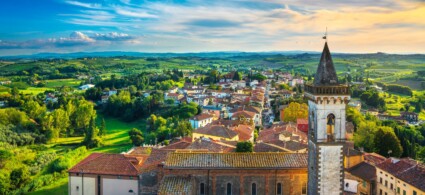
Built in Neo-Renaissance style to plans by architect Bernardini between 1900 and 1921, on the site of a 14th-century church of smaller proportions (to which the low bell tower on the right, with its crenellations and pointed roof, belongs), which had itself replaced the ancient fortified parish church (plebs de Sancto Stephano de Cerbaria, already mentioned in Otto III’s charter of 25 February 998), located higher up; the façade was erected later, between 1940 and 1942. The pieve was elevated to a prepositura by Bishop Debernardi on 3 April 1937.
The layout is monumental, with three naves, a transept and dome set over the crossing. Inside are numerous works worthy of attention: on the altar of the right arm of the transept is a polychrome glazed terracotta panel of the Visitation, attributable to Giovanni della Robbia or his workshop, featuring figures of the Virgin and Saint Elizabeth, Saint Sebastian, Saint Roch, the dove of the Holy Spirit and two angels, Saint Stephen, Saint Peter, Saint Paul and Saint John the Baptist, the Annunciation, and the Redeemer between two adoring angels. From the previous church are preserved some serena stone altars, one on the second of the right nave bearing the Rospigliosi coat of arms; there is a 17th-century wooden Crucifix, the baptismal font niche decorated with Rococo stuccos. We can admire several paintings: Christ Crucified among Saints James, Jerome, Anthony Abbot and Francis (second half of the 17th century), Madonna and Child with Saints Francis, Stephen, John the Evangelist and Lucy (first half of the 18th century); in the sacristy there is a serena stone lavabo with triangular pediment dated 1536.
Adjacent to the church, on the right, is the Confraternity, whose apse preserves a pleasant cycle of 18th-century frescoes consisting of allegorical monochrome representations of Charity and Faith, figures of the Virgin, Saint John the Baptist and Saint John the Evangelist, and scenes depicting the martyrdom of both saints. On the right wall is mounted a marble plaque, a “memorial” of the confirmation administered in the church of Lamporecchio by Giulio Rospigliosi in 1653, before he became Pope Clement IX; returning from Spain where he had been ambassador, he had stopped at the nearby family property at Spicchio.
At Spicchio, a locality just above Lamporecchio towards San Baronto, stands Villa Rospigliosi. The Rospigliosi family, originally from Milan, arrived in the area around 1215 and began acquiring properties, which steadily increased over the years. The villa was built by Giulio Rospigliosi (Pope Clement IX) during his papacy (1667/1669), though work was completed after his death, around 1675. The villa remained Rospigliosi property until the 1930s, when it passed to a property company; today the complex is managed by a group of hoteliers who use the spaces for ceremonies, congresses and conferences. The villa’s design is attributed to Bernini, and the work was supervised by his most faithful and representative pupil, Mattia de Rossi. The villa remains in its original integrity today, save for the replacement in 1793 of the balustrade with statuary crowning the central body with the current hipped roof, and the blocking in 1829 of 14 windows replaced by as many false shutters. The structure consists of three parallelepipeds: a central, taller section and two side wings, each three storeys high.
Access to the villa is from the village of Spicchio, but the main entrance is from Lamporecchio, formed by a long avenue lined with centuries-old holm oaks, Turkey oaks, cypress, maritime pines and enormous stone pines. Reaching the top, you encounter two stone gates topped with the papal coat of arms in marble. The interior comprises grand salons all frescoed. The villa’s spacious garden is characterised by a vast lawn with a basin at its centre. Before the villa stands the family chapel, dedicated to Saints Simon and Jude, completed in 1679 to plans by Mattia de Rossi. It is an elliptical space set within a rectangle and preceded by a pronao with triangular pediment. The fresco decoration in the dome is attributed to Alessandro Gherardini and depicts Saint Simon, the Archangel Michael, the Guardian Angel and the Trinity; there are also busts of the apostles Peter, Paul, James and John with medallions of saints’ stories; above the high altar is an Immaculate, a marble statue by Francesco Pozzi. The villa and park are open to visitors by appointment (0573/803432).
Also in the municipality of Lamporecchio, on the road from San Baronto to Vinci, are two splendid hamlets. Starting from San Baronto, the first is Papiano, notable for Villa Papiano, called “Dell’Americana” as it was owned by an American lady in the 1800s. In the 16th century it belonged to the Torrigiani family, and the villa draws on Renaissance architectural formulas (for example, the loggias with round arches); it’s worth noting that in the early 20th century it housed an embroidery school for local girls.
In past centuries, positioned in a narrow valley floor along the Rimaggio river, stood a mill, developed on three levels, accessible by stairs, now used as an agricultural store. Continuing towards Vinci, we reach Porciano, whose settlement developed around two towers assignable to the first half of the 13th century; these probably formed part, together with the tower at Colleccioli and the castle of Montefiore, of an integrated defensive system guarding the roads below connecting the two sides of Montalbano.
The brigidini rightly has a festival dedicated to it, held during the annual Lamporecchio Summer Fair, which is fittingly called the “August Fair and Brigidini Festival”. An annual appointment with entertainment, music, games and shows, it represents the natural evolution of a much older fair, the livestock market, which was particularly significant and important when the town’s economy was based essentially on traditional farming and livestock raising.
Currently the fair, held along the town’s main street on the first Tuesday of August and the immediately following Wednesday (with the so-called “fierino”), represents a joyous, colourful occasion for entertainment, maintaining over the years an undiminished strong appeal to neighbouring towns as well.
To see all the facilities and book accommodation in Lamporecchio use the form below, entering the dates of your stay.
 Hotel
Hotel 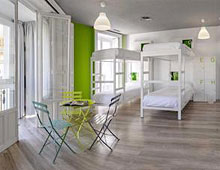 Budget accommodations
  Apartments
  Family Hotel
 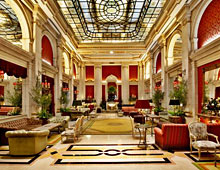 Luxury Hotel
 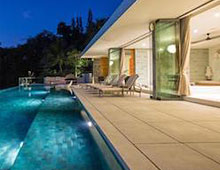 Resorts