Grotta Giusti Thermal Spa Resort Tuscany, Autograph Collection
Monsummano - Via Grotta Giusti 1411
Book now
A strategic crossroads location, dominating the Padule di Fucecchio and Valdinievole valley, the hilltop of Monsummano Alto was fortified from at least the 11th century with a defensive system that was enlarged and expanded over time, eventually encompassing the entire hilltop during the late medieval period.
The castle of Montesommano is first documented in 1005, when it was under the control of the abbey of Sant’Antimo in Val d’Orcia and was partly ceded to Ildebrando degli Aldobrandeschi. Following various changes of ownership, in 1218 the castle was sold to the city of Lucca, although the castle’s inhabitants had already constituted themselves as a rural commune with their own magistracies some years earlier. The hilltop of Monsummano overlooks that of Montevettolini, a medieval village that was also subjected to Florentine rule.
Founded around the 12th century and placed under the city of Pistoia in 1227, the castle of Montevettolini constituted itself as a free commune during the 13th century, becoming a refuge for Florentine and Lucchese exiles during the fierce struggles between Guelphs and Ghibellines, until it surrendered to Uguccione della Faggiola following the Guelph defeat at Montecatini in 1315. Under Lucca’s dominion until the death of Castruccio Castracani, Montevettolini and Monsummano joined the Valdinievole League in 1328 against Florence, a city to which they were forced to submit after suffering the siege of Gherardino Spinola, the new lord of Lucca.
Entry into the Florentine sphere allowed the castle of Montevettolini a vibrant and prosperous life, animated in part by the activities of twelve confraternities in the town, and it became even more flourishing when the earliest Medici grand dukes chose it as a hunting lodge, which favoured it at the expense of the Castle of Monsummano, already in marked decline since the late 14th century. Inclusion in the Florentine district, conversely, stifled the development of the Monsummano community, which from the late 14th century onwards, having taken the form of a rural village, underwent progressive decline, also brought about by the marshiness of the surrounding terrain and the consequent interruption of thoroughfares.
The founding of Monsummano, at the foot of the homonymous hill, is likewise linked to Grand Duke Ferdinando and his trusted architect. Indeed, following the miraculous events that occurred in the final decades of the 16th century, among which the sudden emergence of a spring at the site of a miraculous image of the Virgin venerated in a shrine, in 1602 the Grand Duke commissioned Mechini with the construction of a great sanctuary in honour of the Madonna known as della Fontenuova.
In 1775 Pietro Leopoldo established the Community of the Two Lands, administratively unifying the territories of Montevettolini, the by then declining castle of Monsummano and the main town, Monsummano Terme, which was undergoing continuous expansion.
The 19th century represents another important chapter in the history of Monsummano owing to the presence of two notable figures in the political and literary world: the poet Giuseppe GIUSTI (1809-1850), whose birthplace, with furnishings and neoclassical decorations, has recently been restored and converted into a museum, and Ferdinando MARTINI (1841-1928), a writer and politician, whose villa, known as Villa di Renatico, currently hosts exhibitions and conferences.
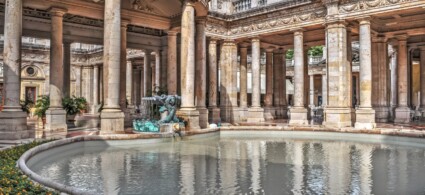
Dating to the mid-19th century is also the discovery of the Thermal Caves with their particular therapeutic properties: naturally heated caves, today flanked by modern thermal spas.
The Church of San Nicolao, in its present form dating from the early decades of the 13th century, has a simple and austere layout, with a single nave, an elevated presbytery, timber truss ceiling and a semicircular apse, hidden externally by a later construction. The walls are of exposed stone and the façade shows signs of later alterations in its upper section.
A flight of steps leads to the central entrance portal, framed by robust jambs and lintel, upon which is set the pointed arch of the lunette. High up, just below the roof slopes, a small central oculus opens.
Inside, two Baroque altars are set against each other on the side walls of the nave, and there are several artworks present.
The church body is flanked to the south by a quadrangular bell tower of later design, set upon a full round arch that gives access, by way of a barrel-vaulted gallery, to a natural terrace overlooking the valley, where the side entrance door of the church opens.
The residence in Monsummano where Giuseppe Giusti was born on 13 May 1809 and spent his earliest childhood years – the family moved to Montecatini in 1815 – was built between 1791 and 1793 at the initiative of the poet’s paternal grandfather, Giuseppe, a wealthy landowner and politically influential figure in the government of Pietro Leopoldo.
Inspired in its volumes and external layout by a generically late Rococo taste, tempered within the sober divisions typical of Tuscan tradition, it displays, in the prominent decorative emphasis of the family coat of arms above the balcony at the centre of the façade, the intention to build a residence befitting the family’s position of social prominence within the town and their recently acquired noble status.
The interior wall decoration follows criteria of propriety and bourgeois representativeness in keeping with the family’s standing, developing themes suited to the use of the various rooms: ideal landscapes framed within a false loggia in the entrance hall on the ground floor, mythological subjects and grotesque decorations, with profusions of festoons of flowers and fruit, in the various reception rooms, sacred themes in the prayer room and bedroom, rural “views” in the small sitting rooms and antechambers.
Acquired by the State in 1972 and restored, Casa Giusti is now a museum.
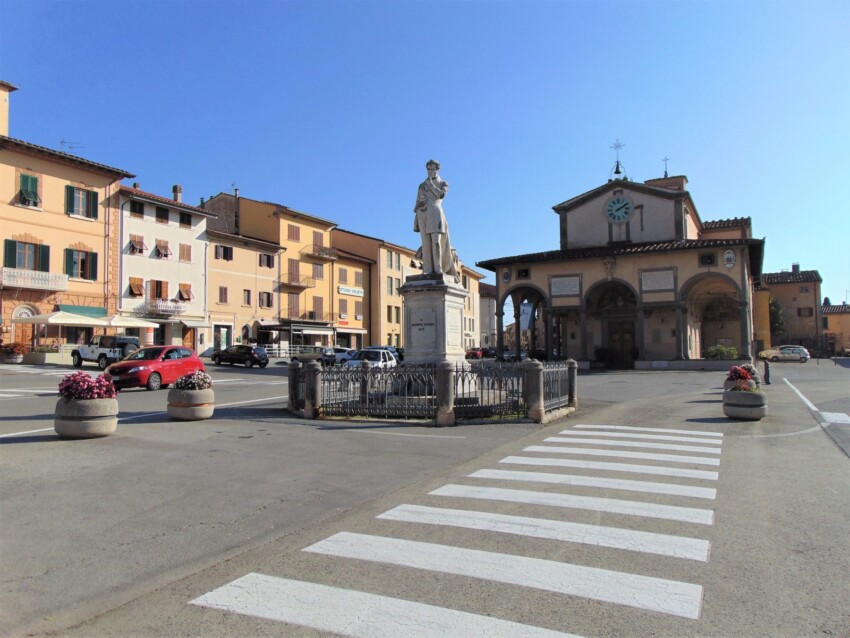
Founded in 1602 at the behest of Grand Duke Ferdinando I de’ Medici, the basilica of the Madonna della Fontenuova constitutes the historical and urban heart of Monsummano Terme. The Sanctuary stands on the site of an ancient shrine, now incorporated into the high altar, which bears the image of the Virgin and Child with four Saints, to which various miraculous events were attributed.
Grand Duke Ferdinando of Tuscany decreed the construction of the temple at the place where the miraculous spring had emerged, entrusting the project to architect Gherardo Mechini, already engaged in the work of the Medici Villa of Montevettolini. On 30 December of that same year the Grand Prince Cosimo laid the cornerstone of the Sanctuary.
As with the villa, the direction of the building works was entrusted to Domenico Marcacci, who completed the construction of the edifice in 1605.
The Basilica was consecrated in 1616, but the decoration of the interiors continued for much longer, as attested by the Opera Registers, which record all expenses for the works. The building, of rare elegance and compositional sobriety, is of great interest for its stylistic unity and the harmonious continuity between the architectural structure and the precious decorative apparatus.
Of traditional Latin cross plan, with a single nave, the church is surrounded on three sides by a portico, from which one ascends, by means of a steep staircase, to the spring.
The building asserts itself over the space of the great surrounding piazza with its structure articulated according to rigorous classical geometric modules, but updated in its plastic decoration to the language of late Mannerism and Baroque, as evidenced by the volutes of the capitals and the mouldings of the portals.
Under the arcade, fourteen lunettes painted by the Florentine Giovanni Mannozzi da Sangiovanni narrate the history of the Sanctuary and the miracles of the Virgin of the Fontenuova: they were executed between 1630 and 1633, when the painter took refuge in the Valdinievole to escape the plague raging in Florence.
The central lunette of the façade, above the entrance, was painted in 1606 by the Sienese Ventura Salimbeni with the allegories of Faith and Hope, whilst to complete the theological virtues a marble portrait of the Grand Duchess Cristina was placed at the centre of the lunette, which Leonardo, son of Domenico Marcacci, represented in the guise of Charity.
The beautiful entrance portal was carved by the Pistoia woodcarver Giovanni Desideri, also the author of the wooden ceiling of the church, which reveals itself inside to be a veritable treasure trove of artistic gems.
Built around 1887 by architect Vivarelli for Ferdinando Martini, a journalist, writer and statesman, according to an eclectic taste typical of the end of the century, the villa presents itself as an elegant square block, articulated over two storeys, surrounded by a vast park connected to the raised ground level by five sets of stairs.
Inside are elegant rooms with coffered ceilings decorated with polychrome ceramic roundels.
The surrounding park contains numerous specimens of fine ornamental plants and very rare essences such as sequoias, camphor laurels, weeping pines and Atlas cedars.
The villa, after being purchased by the Municipal Administration in 1981 and following careful restoration, was inaugurated on 26 June 1988 by Giovanni Spadolini, then President of the Senate.
The Villa has over these years assumed its definitive configuration as a Museum of Contemporary Art and 20th-Century Art through the programming and realisation of the majority of projects overseen by the Cultural Affairs Department.
The Medici villa of Montevettolini is located at the northern extremity of the hill, not far from the church of S. Michele Arcangelo, the rectory and the town square.
The villa was built by Grand Duke Ferdinando I, with its realisation entrusted to Gherardo Mechini, appointed in May of that same year “Architect to His Highness” and already master builder in service to the Grand Duchy since 1581; it was realised between the end of the 16th century and the first two decades of the 17th century. The building throughout the subsequent period remained largely unchanged in its overall appearance and maintained its austere character, presenting an imposing and severe physiognomy that has the aspect of a fortress; it is rendered in white with simple stone cornering and the profiles of doors and windows made with blocks of smooth or rusticated pietra serena.
It was built incorporating some pre-existing structures of the village’s defensive system. To the new construction, in fact, the fortress and one of the six towers of the walls were annexed: that of the Cantone gate. These structures were largely dismantled and part of the material was reused in the construction of the new building.
The fortress and tower were joined by a two-storey building body, in addition to the ground floor, the first storey of which is almost entirely occupied by a vast reception hall. The left side of the building, that in which the tower has been incorporated, is higher by one storey because it sits on a slope of the terrain; on this side just below the roof line small windows and openings similar to gun turrets alternate with a very tight rhythm. Along the entire perimeter of the palace at the top floor there is a rather regular succession of square windows with stone frames and small loopholes below them, the same linear rhythm is repeated for the larger openings of the principal floor, whilst on the ground floor windows and doors are opened without respect for this division.
The fortress aspect of the palace is emphasised by four corner turrets, also equipped with loopholes and gun turrets.
In the locality of Le Case stands the Medici Farm, the “Casa Grande” that was part of the possessions of the grand ducal villa of Montevettolini. Over time the estate was subject to continuous interventions relating to the expansion of the farms, land reclamation works, the construction and restoration of rural buildings and annexes, and the diversified exploitation of the land, which modified the appearance of the territory several times.
In 1650 two-thirds of the Medici property of Montevettolini, including the farm building, were purchased by the Florentine Bartolomei family. The Bartolomeis, investing considerable capital, promoted its agricultural development, transforming the farm into one of the most profitable in the Valdinievole.
In the 18th century administrative management was transferred to the plain where new buildings were constructed, in the locality called Le Case Nuove, intended for various uses.
In the first half of the 19th century, under Marchese Ferdinando Bartolomei, the grand ducal building of the Cases, appropriately restored, became a cutting-edge farm where the farming techniques that were revolutionising Tuscan agriculture were tested.
In addition to intervening in cultivation with the use of new machinery, Bartolomei created within the farm a Lombard-style dairy with Swiss milk cows for the production of butter and cheese.
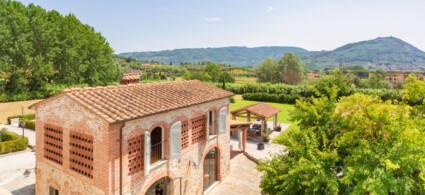
Today the vast complex, still distinguished by the Medici coat of arms, has been completely restored by the Borghese princely family, its current owners, and is managed for events and ceremonies, functioning as a congress, exhibition and fine dining centre.
The Church has a sloped timber covering made of laminated beams with increasing height towards the altar; at the level of the presbytery the covering undergoes a rise to allow for the insertion of windows and to emphasise the importance of the altar area through the passage of natural light.
The Church offers us two opposing internal side views: one bare and compact side, characterised by three pilasters that extend to the roof beams, ready to accommodate works of art; the opposite side appears characterised by three arches supported by columns that open onto a side nave that acts as an entrance filter to the three chapels. The succession of the three chapels evokes the sacramental path: Baptism, Confession and Communion; the first chapel housing the baptismal font has smaller dimensions and height compared to the last, which houses the Blessed Sacrament, this to emphasise the importance and succession of the sacramental path.
On 15 December 2002 the statue of the church’s patron “Cristo Redentore” by Jorio Vivarelli was placed in the presbytery. A bronze sculpture standing 4 metres tall.
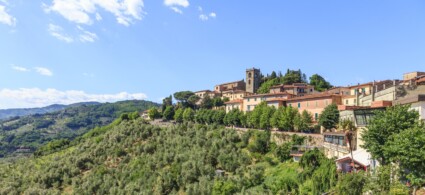
The hill of Monsummano rises at the northern foot of Montalbano, with its truncated cone shape rising approximately 340 metres above sea level, where the Nievole stream flows out onto the plain. A strategic crossroads location, dominating the Padule di Fucecchio and Valdinievole valley, the hilltop of Monsummano Alto was fortified from at least the 11th century with a defensive system that was enlarged and expanded over time, eventually encompassing the entire hilltop during the late medieval period.
The castle of Montesommano is first mentioned in documents from 1005, when it was under the jurisdiction of Sant’Antimo abbey in Val d’Orcia and was partly ceded to Ildebrando degli Aldobrandeschi. After various changes of ownership, in 1218 the castle was sold to the Municipality of Lucca, though the castle’s inhabitants had already formed their own rural commune with their own magistrates some years earlier. In 1328, following the death of Castruccio Castracani, Monsummano joined with Montevettolini and eleven other castles in the Valdinievole League against Florence, to which it was forced to submit a year later. It then welcomed, in 1331, the first podestà imposed by the dominant city, as established by the new statute. Subsequently, whilst Florentine rule continued to send its own podestà to administer justice in the castle, it undertook to maintain the rights sanctioned by the statutes, which are preserved in the Municipal Archive in the 1372 edition. Belonging to the Florentine district stifled the development of the Monsummano community, which from the late 14th century, configured as a rural settlement, entered a progressive decline, also determined by the marshalling of the lands surrounding the hill and the resulting interruption of road routes. From the early 17th century onwards, at the foot of the Monsummano hill, a new settlement grew up around the Sanctuary of Madonna della Fontenuova, which became Monsummano Terme. As the main town of the Community of the Two Lands, which also included the castle of Montevettolini, the new centre soon assumed all the economic and administrative functions of the territory. Of the ancient castle on the hill, what remains today are the ruins of the elliptical ring of walls, which encircled it for a perimeter of approximately two kilometres, and two of the three access gates: the “Nostra Donna” gate, to the north-west, and the one known as the “Mercato” or “Porticciola” gate, which overlooks, almost intact, the Montevettolini hill. Of the numerous towers with which the castle was equipped, there remains, at the western extremity of the city walls, a sturdy pentagonal tower, now in ruins, which is among the most imposing in the entire province. Access to its interior was possible only through a small opening located approximately 7 metres above ground, reached by a wooden ladder, probably retractable.
In its present form, the tower structure, partially restored in the early 20th century, can be dated to the early 14th century. The best-preserved building in the settlement is the Church of San Nicolao, overlooking the ancient communal square, founded in the 11th century and included in the plebs of Neure (or de Montecatino), within the medieval diocese of Lucca. The church, in its present form dating from the first decades of the 13th century, has a simple and austere layout, with a single nave with raised presbytery, timber-roof covering and a semicircular apse, hidden on the outside by a later construction. The masonry is in exposed stone and the façade shows signs of subsequent alterations at the top. A flight of steps leads to the central entrance portal, framed by heavy jambs and lintel, upon which rests the pointed arch of the lunette. Near the top, just below the roof eaves, a small central oculus opens. Inside, two Baroque altars are placed against the lateral walls of the nave, one opposite the other. At the left altar, a fine 17th-century Annunciation of Tuscan school is regrettably in poor condition, as are the small panels depicting Scenes from the Life of Christ and Mary, linked to the mysteries of the Rosary, which frame, on the opposite altar, the niche containing a statue of the Virgin. The most interesting work preserved in the church is the large wooden Crucifix, datable to the 14th-15th centuries, which dominates the nave from the centre of the presbytery, in a display case placed above the high altar. The church body is flanked to the south by a quadrangular bell tower, of later construction, set upon a round arch, which provides access, through a barrel-vaulted gallery, to a natural terrace overlooking the valley, where the church’s side door opens. In this space, to the north, is the ancient Church of San Sebastiano, in front of which recent excavations have brought to light the foundations of two buildings, where fragments of pottery from various periods have been found. Partially hidden by the woodland surrounding the central castle nucleus, there are remains to the west of a convent and in the eastern area, near the tower, the ruins of the ancient Hospital of San Bartolomeo.
On the north-western slopes of Montalbano, just over four kilometres from the centre of Monsummano Terme, stands the village of Montevettolini, perched on the hilltop, at 187 metres above sea level.
Founded around the 12th century, the castle quickly enjoyed a vibrant and prosperous life, animated by the activity of twelve confraternities in the village, and became even more prosperous when the early Medici grand dukes chose Montevettolini as a hunting lodge.
At the end of the 16th century, Ferdinando I commissioned Gherardo Mechini and Domenico Marcacci to construct the imposing villa, today owned by the Borghese princes, which dominates the village from the western extremity of the city walls.
During the years when it was frequented by the Medici court, the village was enriched with sumptuous aristocratic residences, many of which preserve remarkable works of art. Notable are the houses of the Mimbelli, Tonini, Bardelli, Barbacci and Bargellini families. The latter, in particular, is said to have boasted frescoes, now lost, by Giovanni Mannozzi da San Giovanni, executed when the painter, having fled the plague raging in Florence, was painting the lunettes in the portico of the nearby Sanctuary of Madonna della Fontenuova at Monsummano Terme.
In the urban fabric of the village, traces of its original medieval layout can still be identified, recognizable in the square “island” on the western side of the church square, directly opposite the ancient Municipal Palace.
Of the last and most extensive city walls, of which only a few remains survive today, we have records from 1366, when, by order of the Florentine Signoria, the walls were restored and equipped with battlements. Repeatedly repaired over the centuries, they were largely demolished from 1607 onwards to construct a bypass road.
The castle was defended by six towers, five of square plan and one octagonal, known as “dello Sprone” or “delle Murina”, to the west, just below the village. Three gates provided access to the village: the “del Montaletto” gate, destroyed in 1830, the “del Vicino” gate, to the north, also called “del Malvicino” and later “dei Barbacci”, the only one still standing intact, and the “del Cantone” gate, which was incorporated into the Medici villa. The fortress that once dominated the village from above suffered the same fate.
In the village there were two oratories, that of San Francesco, to the west of the church, near which a hospital was established during the 1348 plague, and that of Corpus Domini, in Piazza Bargellini, now home to the village’s Philharmonic Society, founded in 1863.
The building of the ancient Municipal Palace, which from the 13th century represented the political and administrative power of the castle, retains the charm of its glorious past intact. On the façade are affixed the crests of the podestà, in stone and glazed ceramic, whilst on the ground floor, the loggia that opened onto the street has been sealed on the left, and the access door to the ancient guard tower incorporated into the building on the right.
Medieval towers were also used for the church bell tower. The oldest one, demolished in 1729, was incorporated within the church building, whilst the current bell tower, built in the 15th century by adapting another guard tower, is attached to the presbytery and set upon a barrel-vaulted gallery that leads from the street known as Via del Portone into Piazza Bargellini.
On the site of the village church stood, from the 12th century onwards, a chapel dedicated to San Michele, dependent on the plebs of San Giovanni Battista and San Lorenzo at Vaiano. Enlarged over the centuries with the addition of two side naves and an external loggia, the church was elevated to plebs status following the suppression of the Vaiano plebs in 1449, when it also took the dedication to San Lorenzo.
The present appearance of the church is due to the restructuring carried out by Vittorio Anastagi from 1733 onwards, when the church building was raised in height and covered with vaulting. Inside, the precious high altar in polychrome marble was installed, a work by Bartolomeo Moisé da Seravezza, whilst the walls were enriched with stucco decorations and frescoes signed in 1740 by Felice Balsan, a modest painter originally from the island of Malta. The church preserves numerous works of art.
From the Montevettolini hilltop begin the Trekking Routes along the connecting paths between the Valdinievole and Montalbano castles. The trails marked by the C.A.I. offer nature lovers pleasant walks through the lush Mediterranean vegetation, with essential stops to admire the enchanting views that open onto the valley and towards the Apennines.
Descending from the village towards the east, a visit to the 17th-century Oratory of Madonna della Neve is recommended, where a fresco of the Madonna and Child with Saints is preserved, a work by a 15th-century master close to Gentile da Fabriano. At the oratory, one can attend, every year in August, the “Festa della Madonna della Neve”, a festival for which relatives and friends are invited to Montevettolini.
The most evocative event of the entire Valdinievole is celebrated at Montevettolini every three years on Good Friday, with the Procession of the Dead Christ, which since the 16th century has retraced the stages of Christ’s Passion and his climb to Calvary.
Another solemn costumed procession, known as “Ringraziamento” (Thanksgiving), takes place on the Tuesday following Easter.
The magical medieval atmosphere breathed in through the village streets, the scenic and architectural beauty invite you to spend pleasant stays at Montevettolini.
To see all the facilities and book accommodation in Monsummano Terme use the form below, entering the dates of your stay.
 Hotel
Hotel 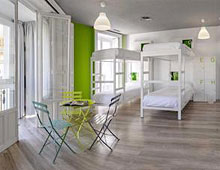 Budget accommodations
  Apartments
  Family Hotel
 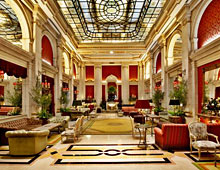 Luxury Hotel
 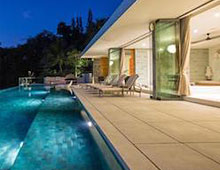 Resorts