Hotel Manzoni Wellness&Spa
Montecatini Terme - Viale Manzoni 28
Book now
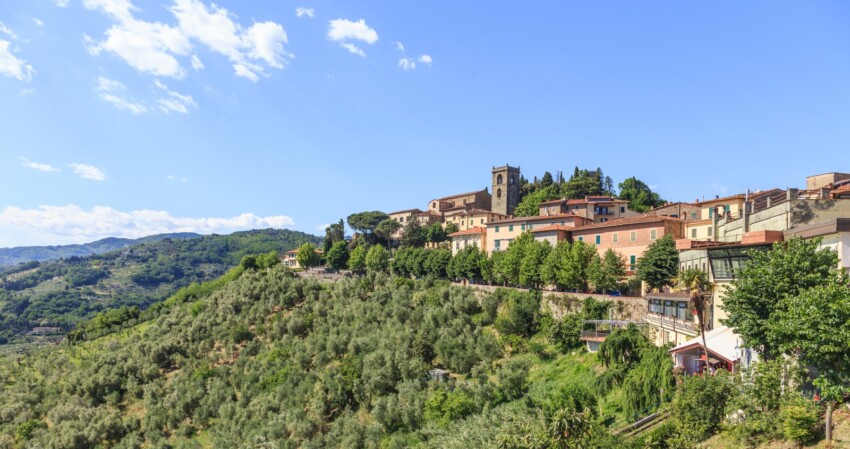
Montecatini Alto is the historic heart of Montecatini Terme. Although administratively it represents only a fraction of the town, it holds fundamental importance both for the area’s history and because its medieval character perfectly complements the lower town, which is far more recent and today ranks among Italy’s most significant spa resorts.
Located in the province of Pistoia, and not far from Lucca, Montecatini Alto is not as famous as its counterpart Montecatini Terme, but it certainly deserves a visit: reaching the summit of the hill on which it perches, you’ll find a charming historic village awaiting you, and the fact that it’s accessible via a picturesque funicular railway undoubtedly adds to its appeal.
Once you arrive, a walk along the town walls rewards you with magnificent views across the entire Valdinievole valley: from the turreted plateau of Serravalle to Monsummano, the wetlands of Fucecchio marshes, the Cerbaie hills, the Montecarlo ridge as far as the imposing Pisani mountains, then Pescia (somewhat hidden) and in the distance, beyond low hills, the Lucca plain. To the north, the foothills of the Pistoia Mountains form a crown with the charming villages of upper Valdinievole: Massa and Cozzile, Marliana, and Casore al Monte.
Montecatini Alto is a small village full of discoveries. Today, the splendid walk that encircles the entire village follows the impressive circuit of the town walls, though all the gates have long since disappeared except for one at the Borgo, positioned at the lower northern entrance to the village. After completing the circuit of the walls, venture into the village itself and visit its principal monuments and attractions.
The Church and Convent of Santa Maria a Ripa stand near the Borgo Gate, in the quarter formerly known as Ripa. The church, built in Romanesque style, dates from the 12th century; the convent was founded later (15th-16th centuries) by a group of local women who embraced the Rule of Saint Augustine.
Today the convent and recently restored church are home to a community of Benedictine nuns. Inside, the single nave displays a fine stone altar from the Romanesque church, fragments of frescoes depicting two Evangelists on the presbytery vault, a vestibule with an organ, and the choir of the nuns dating from the late 17th century.
The seat of the present Propositura dates back at least to the 11th century and has undergone several modifications, the first being a complete reconstruction in the second half of the following century. Further work was carried out in the late Middle Ages, but its current appearance is largely due to radical transformation in the second half of the 18th century by architect Zannoni, which involved widening the side aisles, raising the roof, and extending the apse westward. More recently (1962), new decorations were added and portions of columns from the original Romanesque church were brought to light.
Inside, note the white marble baptismal font from 1580 and its matching cover carved from walnut wood, along with altars dedicated to Saint Anthony and Saint Joseph in pietra serena, gifts from the Broccardi family and the municipality. The 17th-century confessionals are also worthy of attention, adorned with floral garlands carved in pietra serena. Among the sacred artworks, the Martyrdom of Saint Barbara (Montecatini’s Patroness, celebrated on 4 December) attributed to Cosimo Gamberucci, a pupil of Santi di Tito, and the Madonna and Two Saints, a 15th-century fresco attributed to the school of Perugino, stand out.
The Palazzo di Giustizia dates back to the medieval period; during the 16th century the building was completely restructured and enlarged; subsequent modifications further transformed its appearance, though it retained its outline and the coats of arms displayed on the facade.
The Palazzo Podestarile displays typical architectural features of the 17th-18th centuries such as the window frames and portal cornice in pietra serena; it once housed the residence of the Podestà, the official appointed by the Florentine government. The old parlascio (the loggia) once hosted public assemblies and markets; the upper floor, completely renovated along with the facade in the 1920s, was converted into a theatre, the Teatro dei Risorti.
They formed part of the ancient defensive system of the castle and stand at the summit of the two heights that compose Montecatini’s hill. What is now called la Rocca, a few metres from the Church of San Pietro, was referred to in ancient documents as the “Rocca del Castello Vecchio” or “Tramontana” to distinguish it from the “Rocca del Carmine” or “Castelnuovo” situated on the opposite height.
Its present appearance, with the pentagonal enclosure formed by sloping walls topped by a tower at the apex, resulted from the arrangement implemented by the Florentines in the 14th century, utilising an earlier 12th-century noble residential nucleus comprising tower buildings, one of which served as the fortress’s “cassero”.
The second fortress, that of the Carmine, was probably built towards the end of the 12th century in a position commanding the plain, the Serravalle pass to Pistoia and the castles of the southern Valdinievole. Traces of its walls and gates have been lost (partly due to the construction of the church and adjacent convent), but the imposing tower survives, subsequently heightened and fitted with battlements; since the late 18th century it has borne a clock on its northern face, visible from throughout the village and still functioning today.
In the historic centre of Montecatini Alto there are several accommodation options, mostly comprising bed and breakfasts, room rentals and apartments. All are tastefully renovated, located within historic dwellings or period palaces, and run directly by private owners.
Alternatively, if you prefer to stay in a hotel, remember that in nearby Montecatini Terme you’ll have plenty of choice, with numerous hotels, most of them 3 and 4-star establishments, many featuring wellness areas, spas and indoor or outdoor swimming pools.
The red little trains Gigio and Gigia are the two funicular railways connecting Montecatini Terme with Montecatini Alto and vice versa. A truly unmissable experience that allows you to fully enjoy the beauty of the panorama. Inaugurated on 4 June 1898, the Montecatini funicular is now over 100 years old, yet it remains the principal means of transport for reaching the historic village, thanks to the vision of entrepreneur Lido Cardelli, who in 1982 modernised the infrastructure, improved its systems and safety features and put it back into operation. Today, the Cardelli family still oversees operations and management with the same original passion.
The funicular runs from 2 April to 31 October from 9.30am to 1pm and from 2.30pm to midnight, with departures at least every 30 minutes; on days of particularly high traffic, the service manager may schedule additional trips.
At the ticket office at the lower station, Via Diaz 22 or at the upper station, Via Vittorio Veneto, you can purchase one-way tickets, return tickets or group tickets. Reductions are available for children aged 6 to 10 years, whilst younger children travel free. There is also a small free car park at both stations.
For further information, you can contact telephone number 0572-766862 or 329-4059913.
For tourists, the most enjoyable way to reach Montecatini Alto is undoubtedly the funicular railway departing from Montecatini Terme in Via Armando Diaz, a short distance from the spa park.
Alternatively, you can reach Montecatini Alto by public bus U806, which departs directly opposite Montecatini Terme central station and stops in other parts of the town centre, such as Corso Matteotti, Via Toti and Via Simoncini. The entire journey takes less than 20 minutes and ends in Piazza Campioni.
For the most part, reaching Montecatini Alto involves first getting to Montecatini Terme, which is easily accessible from all areas of Tuscany as it lies along the A11 Florence-Sea motorway and has its own exit. It takes approximately 40 minutes from Florence, half an hour from Lucca, 50 minutes from Pisa, and an hour from Livorno. From the provincial capital Pistoia, Montecatini Terme is just 20 minutes away.
For those intending to make the entire journey by public transport, apart from the final leg on bus U806 or the funicular, you’ll first need to travel by train to Montecatini Terme. This journey is straightforward, as the town sits on the Florence-Lucca-Viareggio railway line; trains from Florence are affordable and very frequent; the journey from the Tuscan capital takes just over half an hour.
What's the weather at Montecatini Alto? Below are the temperatures and the weather forecast at Montecatini Alto for the next few days.
Montecatini Alto is located in the province of Pistoia and forms part of the municipality of Montecatini Terme, accessible via a steep winding road or by funicular railway.
 Hotel
Hotel  Budget accommodations
  Apartments
  Family Hotel
  Luxury Hotel
  Resorts