Hotel Manzoni Wellness&Spa
Montecatini Terme - Viale Manzoni 28
Book now
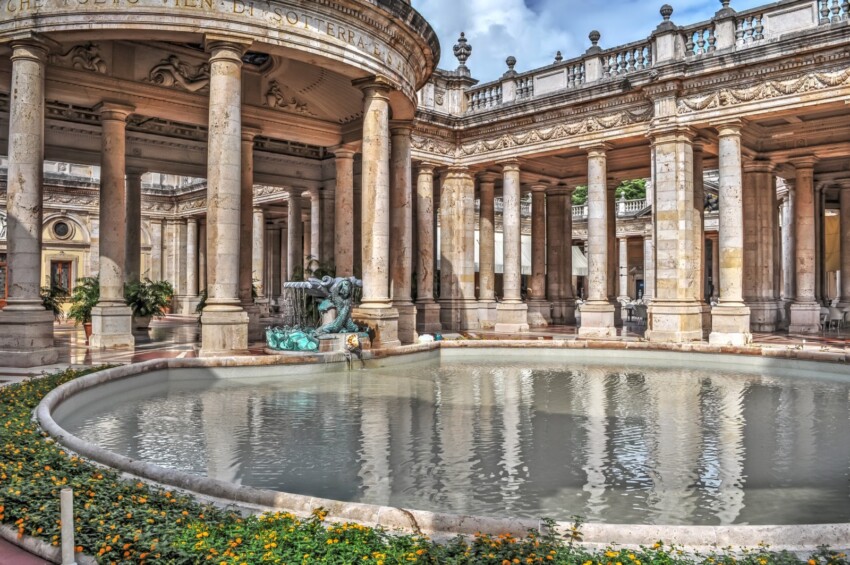
In the province of Pistoia, one of the most compelling tourist destinations is undoubtedly Montecatini Terme. This town of 20,000 inhabitants has long been synonymous with tourism, largely thanks to its thermal springs, which attracted countless visitors throughout the nineteenth century, including several illustrious figures such as Giuseppe Verdi, Ruggero Leoncavallo, Giacomo Puccini, and Vittorio Emanuele II. The most important personalities are commemorated along the Walk of Fame on the pavements of Viale Giuseppe Verdi, where circular plaques bear the principal names of those who have visited Montecatini Terme.
Today Montecatini Terme is protected by UNESCO, forming part of the world heritage site known as Great European Spa Towns, an indivisible collection of 11 European towns that developed from the Enlightenment through to the twentieth century. Much of Montecatini’s success is indeed due to its thermal baths, but even if you’re not a spa enthusiast, the town certainly merits a visit, thanks to its numerous attractions, its beautifully maintained historic centre with parks, gardens and Art Nouveau villas, and the opportunity to undertake some interesting excursions to the surrounding area.
Furthermore, Montecatini enjoys a particularly favourable position with respect to Tuscany’s major attractions: Florence, Pisa, Lucca and Versilia are all within half an hour’s drive. You can therefore base yourself in Montecatini Terme and use it as your headquarters during your holiday, not least thanks to the excellent choice of hotels, convenient access to both the motorway and railway, and generally lower prices compared to the major cities.
The thermal baths of Montecatini have a centuries-old history, with the earliest written records appearing on a document from Lucca dated 1201. In subsequent centuries they gained renown, so much so that in 1773 the Bagno Regio was constructed, the town’s first thermal establishment. The history of Montecatini’s facilities continues until 1962, the year the Redi Establishment1 was built.
The thermal spring sources are fed by 4 springs that emerge from approximately 70 metres below the surface; as they travel upwards they become enriched with mineral salts and form 4 different waters: Acqua Leopoldina, Acqua Regina, Acqua Tettuccio and Acqua Rinfresco, each of which is specific to treating distinct conditions.
Today, there are 9 thermal establishments in Montecatini, all situated at a reasonable distance from the historic centre. Among these, the most famous are the Tettuccio Thermal Baths2, with their marvellous architecture and strikingly scenic interiors conceived around the concept of Roman baths. Also noteworthy are the Excelsior Thermal Baths3, housed within the pavilion originally designed to accommodate the municipal Excelsior casino, and of course the Leopoldine Thermal Baths4, the oldest in the city, constructed in 1777 by Grand Duke of Tuscany Pietro Leopoldo.
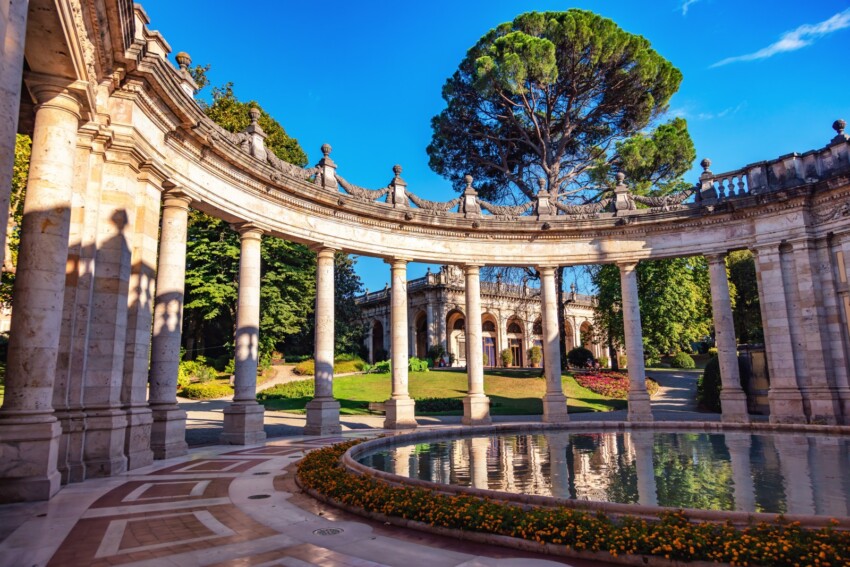
The historic centre of Montecatini Terme is compact and easily explored on foot. Here are the finest attractions in and around the town to visit before enjoying a relaxing bath at the thermal spas.
Along Viale Verdi stands the striking edifice of Montecatini Terme’s town hall. The project, signed by architect Raffaello Brizzi and engineer Luigi Righetti, resulted in the early 1900s in a richly decorated building, both externally and internally, executed by the same firm that carried out similar work at some of the city’s luxury hotels and the Excelsior casino.
The hall on the first floor of the town hall is particularly fine, with double the height of the other rooms and characterised by a projecting balcony. More importantly, visit the town hall because within some of its rooms you’ll find the MO.C.A., that is the Montecatini Contemporary Art, an exhibition space established in 2012 and dedicated to modern art. You can admire works by Joan Mirò and Pietro Annigoni, whilst in the past the MO.C.A.’s rooms have housed sculptures and paintings by Amedeo Modigliani, Adolfo Tommasi, Silvestro Lega and Giovanni Fattori.
Originally a pavilion created for the storage and trade of salt by the eponymous company, the Tamerici pavilion is a strikingly elegant Art Nouveau building, and certainly one of the most distinctive in all of Montecatini Terme.
It stands along Viale Verdi, the main street of the spa zone, outside the historic centre. Behind it sits a lovely park, largely occupied by the Nuovo Teatro Verdi. Designed by architect Giulio Bernardini, the Tamerici pavilion is renowned for its bas-reliefs, inspired by ceramics craftsmanship, and for its decorations, the work of painter and decorator Galileo Chini, one of the leading figures of Art Nouveau style in Italy, whilst the exterior cladding in stoneware panels was executed by Domenico Trentacoste.
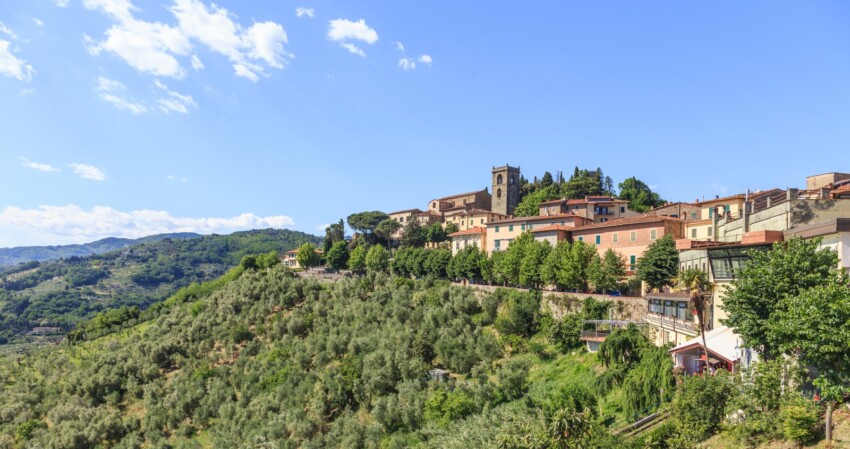
Upper Montecatini is a hamlet of Montecatini Terme. As its name suggests, it sits at a higher elevation, at the top of a hill at almost 300 metres above sea level. It’s a small village of just over 400 inhabitants, but it’s well worth a visit if only to travel on the Montecatini Terme funicular railway, which opened in 1898, a journey of just a few minutes that will take you back in time and allow you to admire the entire Montecatini valley from above.
Once you reach Upper Montecatini, visit the historic village and pause at the Church of Saints James and Philip, dating from 1746 and built in Baroque style, the convent and Church of Santa Maria a Ripa, an ancient monastic building from the sixteenth century, and the Church of San Pietro, which was originally the castle church of Montecatini.
One of the most distinctive and representative monuments in Montecatini Terme stands in Piazza del Popolo: the Church of Santa Maria Assunta, a basilica constructed in the late 1950s, designed by architect Raffaello Fagnoni, on the site of an old neoclassical church from the 1800s.
The Church of Santa Maria Assunta has a curious octagonal plan, with 4 chapels projecting from the sides of the presbytery. It’s an imposing structure, with reinforced concrete elements, but the travertine cladding gives it lift and elegance. The interior stained glass windows are particularly fine, created by painter Giorgio Scalco, and it’s worth admiring the sculpture The Crucifix, by Sauro Cavallini.
From a distance, the silhouette of the Church of Santa Maria Assunta stands out prominently, with its large dome and tall bell tower with square base, crowned at the top by a fine cross that represents one of the highest points in the town.
In the following map you can see the location of the main places of interest mentioned in this article.
The tourist zone of Montecatini Terme lies north of the railway. There are countless hotels here, almost all of excellent quality. Many were built in the 1900s to accommodate the wealthy bourgeoisie who came to the thermal baths, and they’ve maintained an atmosphere of bygone times. Others have successfully modernised themselves, and many offer wellness facilities such as indoor pools, spas, or massage areas.
To stay in Montecatini you can choose to remain in the historic centre, which is more convenient for the railway and transport links, and richer in services, shops, bars and restaurants, or head towards the spa zone, along Viale Verdi or Viale Fedeli, where many of the thermal establishments are located, within easy walking distance. Here you’ll stay in a very green area, full of parks and wide avenues for strolling, though slightly away from the centre.
Getting to Montecatini Terme is truly easy, as it lies along the A11 Florence-Seaside motorway: from the Montecatini Terme junction to the town centre takes only 5 minutes. Given its favourable position right beside the motorway, the town is comfortably accessible from all parts of Tuscany: Florence is 40 minutes away, Pisa 45 minutes, Lucca 30 minutes, Viareggio 45 minutes, Siena an hour and a half. From the provincial capital Pistoia, the journey to Montecatini takes approximately 20 minutes.
At the same time, those travelling by public transport will have no difficulty reaching Montecatini Terme. The town even has two railway stations, called Montecatini Centro and Montecatini Terme, situated just over a kilometre apart. Regional trains stop here on the Florence-Prato-Pistoia-Lucca line, ensuring a regular service in both directions. At Montecatini Terme station you’ll also find the bus station, where regional buses arrive from Florence, Pistoia and the other main Tuscan cities.
What's the weather at Montecatini Terme? Below are the temperatures and the weather forecast at Montecatini Terme for the next few days.
Montecatini Terme is located in the province of Pistoia, along the A11 Florence-Sea motorway, not far from Lucca. It borders the municipalities of Massa e Cozzile, Buggiano, Pieve a Nievole, Serravalle Pistoiese and Marliana.
 Hotel
Hotel  Budget accommodations
  Apartments
  Family Hotel
  Luxury Hotel
  Resorts