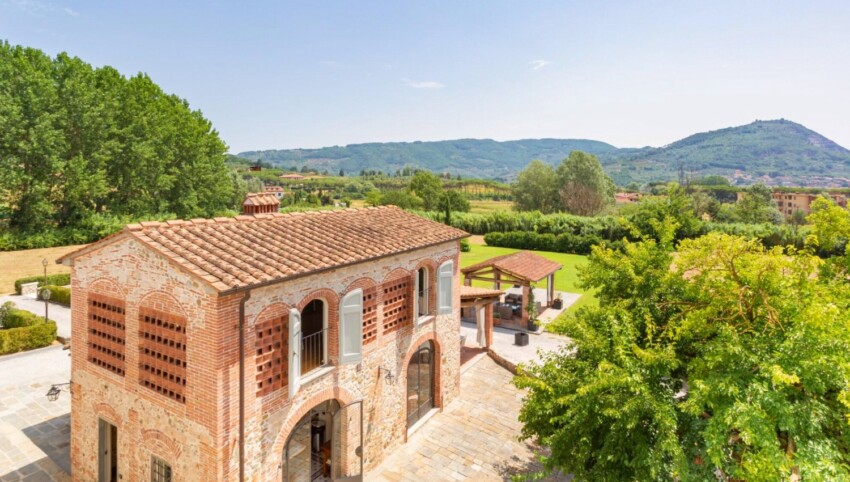
La Villa
Pieve a Nievole - Via Del Poggetto 42
Book now
The town takes its name from the pieve (parish church) of San Pietro a Neure, of ancient origins, situated on the southern slopes of Montecatini hill along the Lucca–Pistoia route on the old Via Cassia.
It is believed to have been founded by the Bishop of Lucca, Frediano, possibly before the Valdinievole was invaded by the Lombards, around 570. In any case, our first documented record of the church comes from an eighteenth-century document now held in the archiepiscopal archives of Lucca. In that document, the Bishop of Pistoia, Giovanni, committed himself with the Bishop of Lucca, Balsari, to recognise the latter’s jurisdiction over the pievis of Neure and Celle.
The importance of the pieve grew so considerably, likely due to its strategic position, that around the year 1000 at least ten chapels fell under its authority.
Following the military conflicts that affected the Valdinievole between the twelfth and fifteenth centuries, however, the archpriest and his chapter relocated to Montecatini in the church of San Michele, which would eventually assume, alongside its many other privileges, the name of the mother pieve, which would itself later be dedicated to Saint Mark.
This significant transition in the town’s history is represented symbolically in the municipal coat of arms itself, where the keys of Saint Peter, the ancient patron saint, are borne by the winged lion of the evangelist Mark.
Towards the end of the sixteenth century, the church of San Pietro began to be called San Marco, and only in 1908 was the church of Pieve a Nievole formally recognised as being rededicated to San Pietro.
From the nineteenth century onwards, thanks to a growth in agricultural activity, Pieve a Nievole experienced a second phase of expansion in which, much as in the medieval period, the route proved crucial—the road that connects Pistoia to Lucca, passing through Serravalle Pistoiese on one side and Montecatini on the other. The marketplace itself—reorganised in its present form only at the beginning of this century—is positioned along this important commercial thoroughfare. In more modern times, the tramway, railway and today the motorway have followed the same route.
The construction of the Pistoia–Lucca–Pisa railway was considered one of the most significant undertakings in nineteenth-century Tuscany. Its execution was entrusted, in December 1841, to a company established in Lucca with the participation of foreign capital as well, and its realisation, which began in 1853, took three years to complete. The arrival of the new railway line considerably accelerated the gradual migration of the population towards the foothills. Pieve had also become, alongside the Montecatini baths, the location of the railway station and thus developed into an important centre capable of attracting inhabitants from the surrounding communes. Pieve a Nievole, in the shadow of the Montecatini baths, grew in significance and by the end of the 1800s began to assert its new status, repeatedly requesting to become an independent municipality.
Since the museum collection brings together materials of different kinds and types—from archaeological finds to photographic and audio documents, from artwork to reconstructive models—an organisation by sectors has been devised, each of which, through an appropriate selection of materials and objects, functions as a dedicated Section.
Ten Sections have been realised so far, supplemented by an Entrance section (Environment and History) which serves a coordinating function.
The backbone of the museum itinerary is the clarification of the interactions between mankind and the environment and the corresponding forms of territorial organisation that have occurred throughout history and to the present day.
Villa Martini, now owned by the municipality, stands just outside the town in a locality called Renatico, on the road leading up to the castle. It was built for Ferdinando Martini around 1887 after a design by architect Cesare Spighi, reflecting the eclectic taste of late nineteenth-century Tuscany.
The villa presents itself today in its nineteenth-century aspect as a rectangular building on two floors, characterised by a double row of windows and a double-flight staircase at the entrance.
To see all the facilities and book accommodation in Pieve a Nievole use the form below, entering the dates of your stay.
 Hotel
Hotel 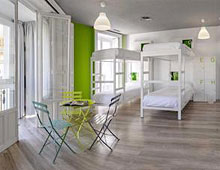 Budget accommodations
  Apartments
  Family Hotel
 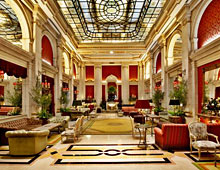 Luxury Hotel
 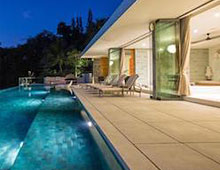 Resorts