Florence: Uffizi Timed Ticket & Masterpieces Audio App
7.148 reviews
Buy now
From 27,20€ per person
The Montagna Pistoiese is an ideal holiday destination, positioned in the upper reaches of Tuscany. With its four municipalities (San Marcello Pistoiese, Abetone, Cutigliano and Piteglio), it has successfully combined modern hotel facilities and quality services – both summer and winter – with the precious treasure of its natural resources: the tranquillity of the forests, crisp and crystalline air, genuine local produce, and the splendour of soft, ever-changing landscapes. For anyone choosing it as a holiday destination, the Pistoiese Apennines offer countless ways to spend your leisure time between sport, entertainment, culture and relaxation. Moreover, its proximity to Tuscany’s art cities (30 minutes from Pistoia, an hour from Florence and Lucca, an hour and a half from Siena) allows you to alternate relaxing days in nature with interesting cultural excursions.
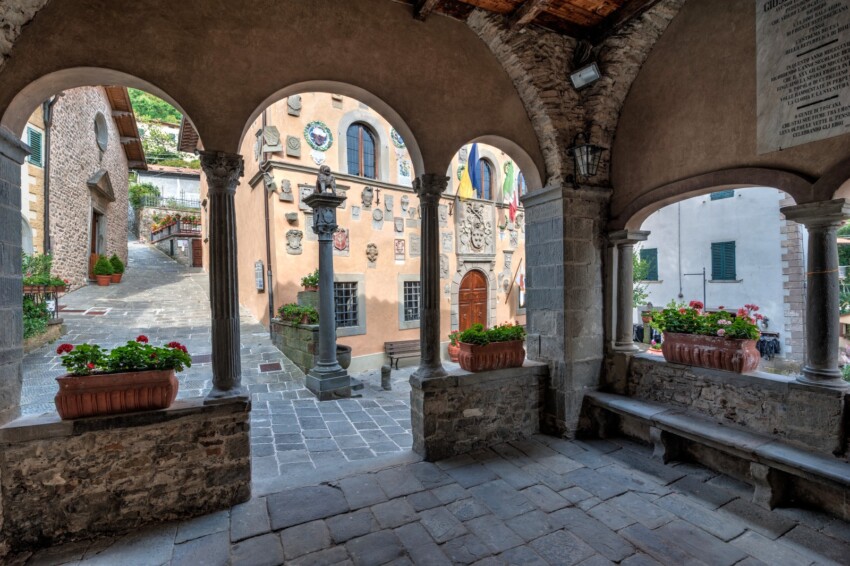
Perched on a spur near Monte Cuccola and nestled amid dense forests lies Cutigliano, a medieval village that still preserves nearly intact traces of its past. Built along an important road route, already documented in the Lombard period, which crossed the Passo della Croce Arcana heading north, Cutigliano developed after 1368 when, under Pistoia, it became the seat of the Mountain Magistrature. The village, characterised by narrow streets flanked by ancient palaces and monuments, is a prestigious summer holiday resort that completes its tourist offering with the Doganaccia ski resort, located on the Apennine ridge.
The focal point of the village is the Town Hall Square, dominated by the Palazzo Pretorio or Palace of the Captains of the Mountain, built at the end of the fourteenth century and enlarged in subsequent centuries. The passage of time on these ancient walls is documented by numerous stone and polychrome terracotta coats of arms of the Captains who held this coveted magistracy, whilst a large coat of arms of the Medici family, topped by the papal insignia of Leo X, presides over the entrance portal. Another symbol of Florentine dominance is the statue of the Marzocco placed on a stone column in the square, a copy of the original sculpture preserved in the adjacent Renaissance loggia, a building that completes the architectural decoration of this precious urban space, where you can admire a sixteenth-century fresco of the Madonna and Child. The sound of water flowing from the small stone fountain accompanies visitors to the nearby church of Madonna di Piazza, where another glazed terracotta work by Benedetto Buglioni is preserved. Fine examples of seventeenth-century Florentine painting can be seen in the church of San Bartolomeo, just outside the village.
The surroundings of Cutigliano offer the opportunity for walks and excursions of considerable environmental value, such as Lago Scaffaiolo, Melo, Pianosinatico, Pian di Novello and Sestaione, with its beautiful grand-ducal fountain that still provides refreshment to tourists crossing these ridges. Of particular interest are Pian degli Ontani, birthplace of the shepherdess poet Beatrice Bugelli, and Rivoreta, a small village home to the Ethnological Museum of the Pistoiese Apennines people.
Rising on the remains of an ancient customs house, positioned between the Duchy of Modena and the Grand Duchy of Tuscany, stands the summer and winter resort of Doganaccia at 1547–1650 metres above sea level. This location is connected to the main town by a road that winds through beech forests and via a cable car. Another cable car section links Doganaccia station to Croce Arcana.
Fiumalbo is a perfect example of a medieval village, celebrated for its artistic and architectural charm as a “HISTORIC TOWN”. The municipality’s territory presents considerable morphological variety, with altitudes ranging from 800 metres to the 2,165-metre Monte Cimone. The abundance of water ensures lush nature, from oak forests to chestnut groves and beech woods, up to meadows. The interest of the surrounding environment lies both in its intrinsic beauty and in the opportunity to gaze from natural balconies as far as the Alps and the Tyrrhenian Sea. The village’s name, situated at an altitude of 970 metres, alludes to the waters of two streams that embrace it. Its origins are very ancient: it is documented that in 1038 it was donated to the Bishop of Modena by Bonifacio of Tuscany, father of Matilda of Canossa. Fiumalbo has always had cultural and commercial relations with Tuscany, traces of which remain in the dialect and surnames of many local families. The historic centre still preserves intact medieval architecture; its urban hub is the thirteenth-century church of S. Bartolomeo, substantially modified over the centuries.
The Lima stream originates in Tuscany, on the high Pistoiese Apennines, near Abetone, and after travelling 40 km flows into the Serchio, of which it is the largest tributary. Along its course it is divided by three Enel dams into as many sections, each with different characteristics. The first stretch, from its source to the confluence with the Limestre, has very low water flow, as does the final stretch. The section from the Limestre to the Giardinetto dam has the greatest water flow and is best suited for trout fishing. Still a lively stream today, it hosts a good number of fish in its waters. Without doubt, trout is the most abundant species throughout the entire length of the stream.
The Reno river originates at Prunetta, on the Montagna Pistoiese, at 958 metres above sea level. This first stretch of the river’s life is characterised by numerous waterfalls and strong erosive action by the water, which in this way carves its own bed and forms the valley. The river has a very strong current, so the transport of boulders and debris is an important geomorphological phenomenon, as is the deposit of transported materials.
Extensive chestnut groves crown the village of Gavinana, a well-known summer resort that still preserves the structure of a medieval village in its winding narrow streets that climb to the main square and in the ancient houses built with local stone, featuring small windows and portals that in spring are adorned with colourful flowers. The village’s history is linked to a hero: Francesco Ferrucci, commander of the Florentine Republic’s militia who on 3 August 1530 led his soldiers in a fierce battle against the imperial troops.
This heroic fighter who fought until his death is commemorated by an equestrian statue in the village’s central square and the nearby Ferrucciano Museum, which preserves memories of many Italian patriots who in the Risorgimento period paid tribute to Ferrucci. In the same square, a meeting place and venue for cultural and folk events, stands the ancient pieve of Santa Maria Assunta, built in the twelfth century and transformed internally during the seventeenth century. Here two valuable sixteenth-century glazed terracotta works by Benedetto Buglioni are preserved, along with a precious nineteenth-century organ by Cesare and Luigi Tronci, celebrated organ builders, an instrument that is part, together with other historic organs kept in mountain churches, of the prestigious musical tradition of Pistoia.
Unlike other lakes, Lago Scaffaiolo, which sits at 1,800 metres altitude, is not of glacial origin: it was formed by rainwater retained by impermeable rocks in this part of the Apennines and has neither inlets nor outlets. The lake has always been a tourist destination, as evidenced by numerous documents written by illustrious figures and the presence of Roman coins found in the area. A folk belief from the past recounts that if anyone dared disturb the tranquillity of the water, a terrible storm accompanied by fog and wind would strike them. An interesting detail: the name Scaffaiolo apparently derives from “scaffa”, meaning “basin”.
Lucchio (670 metres above sea level) is a little-known but very beautiful and evocative village, particularly because it has maintained its original medieval structure intact. It is an urban settlement “clinging” to the rock, made up of tall, narrow houses very close together, topped by an ancient fortress that centuries ago represented a strategic point for controlling the communication route in the valley below. It is surrounded by taller mountains whose vegetation consists predominantly of chestnut groves. The village’s origins can be traced back to around the year 1000, and its history, as well as its population, has always been linked to the fortress. In the past the population was quite large, but after the fortress lost its defensive function, the number of inhabitants began to dwindle steadily, reaching today a total of about 60 people. During the summer season, however, the village repopulates thanks to returning emigrants and holidaying tourists.
Maresca, situated at an altitude of 790 metres above sea level, is an ancient village located in an area that in ancient times experienced Ligurian and Roman influence, came under Pistoia‘s rule a few centuries later and almost immediately fell under Florentine dominance. It is a place very popular with visitors who make long nature walks in these areas and follow trekking routes. Inside Maresca is Palazzo Rospigliosi, dating from the sixteenth century; within the palace are not only frescoes by painter Bartolomeo Valiani, but also other architectural structures of considerable artistic interest.
A small rural settlement in the high mountains situated on the same slope as the main town, Melo (1,007 metres above sea level) is a summer resort and a starting point for excursions to Libro Aperto, Lago Scaffaiolo and Corno alla Scale. This hamlet is surrounded by many farms and agriturismos offering visitors organic produce. The area is also important for the collection of wild fruits.
Monte Calvo stands at the centre of historical events that stretch back through the centuries. Already inhabited by Roman rural estates that gravitated towards nearby Bologna, it was later one of those castles to be destroyed in 1175 by Archbishop Christian of Mainz, Chancellor of Frederick I, who led the struggle against Bologna and other cities of the Lombard League. The fortification was apparently located on the hill that overlooks the church and which today bears the name Palazzo. Its church was dedicated to S. John the Baptist.
In more recent times, mention should be made of a great Italian scholar, Quirino Maiorana, who conducted his telephone experiments in a building near the church in 1931–32.
The Biogenetic Nature Reserve of Pian degli Ontani was established in 1977. It extends over approximately 500 hectares in the vicinity of Pian di Novello and Pian degli Ontani, on the right bank of the Sestaione stream, at altitudes between 1,100 and 1,800 metres. The soil is formed predominantly of sandstone, while the woodland comprises almost exclusively beech stands derived from former coppice forests from the grand-ducal period. This territory is also used to produce selected seeds for reforestation. The many paths within it, along with an extensive dirt road that in winter is used as a cross-country skiing trail, make it easily accessible; much of it is also accessible to wheelchair users. Pian degli Ontani is also known as the birthplace of Beatrice, a shepherdess poet whose verses were greatly appreciated by famous poets and intellectuals such as Tommaseo, Tigri and Lorenzo Borri.
Situated in a valley surrounded by forests of rare beauty, Pievepelago is among the main tourist centres of the Modenese Apennines. It is home to the Regional Park of Frignano and encompasses the territories of Alto Frignano up to the border with Tuscany, marked by the watershed ridge. Numerous sports facilities, dozens of hiking routes, equestrian tourism centres and winter sports facilities make it one of the most popular destinations for tourists. From a naturalistic perspective, the Tuscan-Emilian ridge area is certainly the most valuable, both in terms of geomorphology, for the glacial cirque of the Giovo-Rondinaio group, and for some stations of spontaneous flora unique to the Apennines. The greatest charm is exercised by the glacial lakes (Lago Santo, Lago Baccio and Lago Turchino), which dot the morainic amphitheatre, and by the ridge itself, consisting of a crown of mountains that reach nearly 2,000 metres, among the most beautiful and wild in the entire Apennines.
Pievepelago was subjected to the municipality of Modena, then to Montegarullo, then to the Este family. The Vandelli route, and even more the Giardini route, removed it from isolation and made it a busy marketplace. At Roccapelago, the Rocca di Obizzo da Montegarullo is particularly interesting, recently restored; on the border with the municipality of Riolunato stands the medieval Ponte della Fola on the Scoltenne, with its characteristic arched back; at Casoni, the famous Celtic huts, wildlife oasis and Lago Rovinoso; at Ponte Modino, the Oratory of Madonna dei Renacci and, on the border with Fiumalbo, the small church of San Michele, still with its Romanesque apse. Finally, there is the evocative journey along the ancient Vandelli route to the medieval village of S. Pellegrino in Alpe, skirting Alpe Sigola and Sasso Tignoso.
From the square of the characteristic village of Popiglio, take Via delle Corti. A series of narrow serena stone lanes wind through the ancient medieval village while maintaining splendid views of the Valle della Lima below. Shortly after passing through the stone arch, take Via della Veduta, which descends through a robinia wood and reaches Ponte di Castruccio over the Lima stream. By going up to the riding school you can hire horses for excursions in the surrounding area.
Straddling the border between Tuscany and Emilia-Romagna, Sambuca Pistoiese represents the meeting point of two neighbouring territories, each with their own distinct culture and traditions in this part of the Pistoia mountains. The upper valleys of the Limentra and Limentrella streams were once areas of considerable importance, crisscrossed by ancient routes such as the Via Francesca della Sambuca, which connected central-western Tuscany to the Reno valley and beyond to the cities along the Via Emilia and the Po Valley. Medieval churches, monasteries and hostels sprang up along these ancient communication routes, their memory preserved in documents and visible remains scattered across the landscape today. Walking the trails through this part of our mountains is a journey of discovery into an illustrious past, set against scenery of remarkable beauty. Sambuca castle, built from the mid-11th century as a strategic stronghold, played a crucial role in the centuries-long disputes between Bologna and Pistoia, to which it was definitively annexed only in 1775. The village has changed little over two centuries, with its houses arranged above terraced orchards facing south, a small piazza leading to the church, and the ruins of the ancient fortress perched above. The imposing truncated tower stands as a tangible reminder of the castle’s military significance, whilst remnants of the old walls are incorporated into the rector’s house and the Church of San Giacomo Maggiore, Pistoia’s patron saint, known locally as San Jacopo. As you wander through this ancient village, you find yourself immersed in a captivating space where nearly forgotten sounds return—the trickle of water from the public fountain, the chatter of people walking or pausing in the narrow streets and small squares, or the rustle of wind through the surrounding forest canopy. Another important stronghold in the defensive system of this mountainous region was Torri castle, documented from the 11th century, of which some traces remain visible. In this enchanting mountain village, characterised by narrow stone-paved streets, stands the Church of Santa Maria Assunta on a natural rise, originally medieval but now presenting its 17th and 18th-century appearance. Summer brings the village to life with cultural and folk events that unite locals and visitors in communal celebration.
San Marcello is one of the most appreciated and well-known tourist centres for summer stays since the 19th century. The village sits on a sunny hillside, surrounded by lush forests, sloping gently down towards the Limestre stream valley. The settlement, possibly of Roman origins, offers visitors evidence of centuries past, when from the 14th century onwards it vied with Cutigliano for the seat of the Mountain Captaincy. In the Romanesque church dedicated to San Marcello, modified in the 17th and 18th centuries, the relics of Santa Celestina are preserved; she is the village’s patroness and protector of the mountains, celebrated on 8 September with a major festival that culminates each year with the launch of a brilliantly coloured paper hot-air balloon built according to the designs of the Montgolfier brothers.
San Marcello offers numerous excursions along ancient roads and countless trails, immersing you in an enchanting landscape where you can rediscover the scents, tastes and sounds of nature. In addition to routes through the centuries-old Teso forest, you can reach truly unusual destinations such as the narrow suspension bridge at Mammiano, a long walkway connecting the two banks of the Lima stream, built in 1922 for workers at the Mammiano Metallurgical Company. Also not to be missed is a visit to the Astronomical Observatory, which on clear summer nights offers the chance to gaze up at the starry sky. From San Marcello Pistoiese you can easily reach other fascinating places. Maresca, a small but popular mountain resort town, hosts the International Folklore Festival each July along with “Extra d’arte”, a theatre and music event featuring street performers. Lizzano, a settlement of ancient origins, was one of the most important mountain centres between the 10th and 14th centuries. Today the village is characterised by a series of murals adorning the buildings, created between 1985 and 1990 by artists from the Donatello Group, which in a vivid palette tell the story of mountain life.
 Hotel
Hotel  Budget accommodations
  Apartments
  Family Hotel
  Luxury Hotel
  Resorts