Agriturismo Settepassi Tuscany
Ponte Buggianese - Via Gremignaio 23/27 Loc Vione
Book now
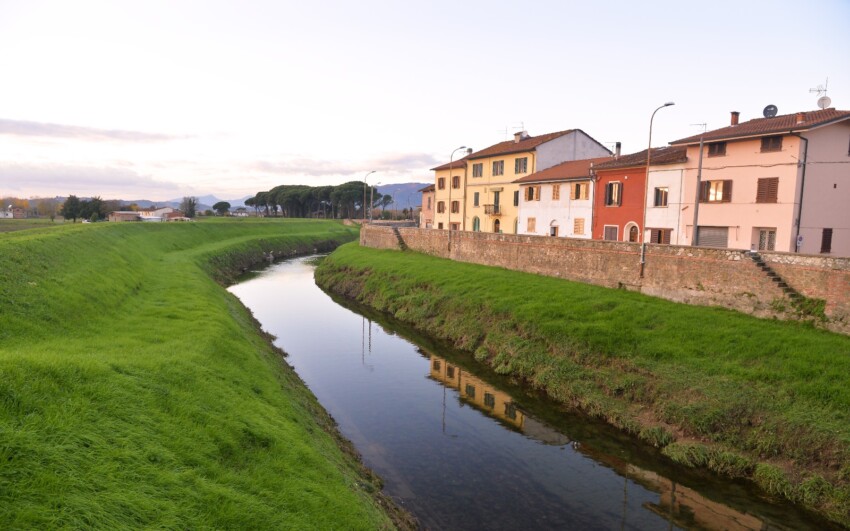
It became an autonomous municipality in 1883. At Ponte Buggianese, a visit to the Propositural Church of S. Michele Arcangelo and the Sanctuary of Maria S.S. del Buon Consiglio is well worth your time. Here, master painter Pietro Annigoni, “the painter of Queens”, frescoed 160 square metres of wall in the manner of the ancients with a Deposition and Resurrection of Christ and the Prophets Jeremiah and Isaiah. Works by Romano Stefanelli and Silvestro Pistolesi, pupils of Annigoni, include a delicate Annunciation and an intense Supper at Emmaus.
Originally a small oratory built in the early 1500s near a stream. The building, dedicated to S. Joseph, is first mentioned in a pastoral visit of 1562; by 1575 it appears abundantly described in the pastoral visit of Monsignor Castelli, who designated it as a rectory and appointed a resident priest. Due to the significant population increase, the church underwent complete architectural renovation in 1628: the structure was enlarged, the orientation of the façade was shifted from south to west as it remains today, the interior was divided into three naves and a portico of river stone was built outside. Further modifications were made in the second half of the 19th century.
Today the church is known as the “Sanctuary of the Madonna del Buon Consiglio” and features a Baroque-style façade preceded by a portico with three arches supported by stone columns. The interior, divided into three naves by four arches on each side, has a barrel vault ceiling and a presbytery crowned by a large dome. The current bell tower is not the original, which was only a modest tower at the time of the 19th-century restructuring when a new one was built to designs by engineer Cosimini. It now stands detached from the main building because in 1927 the priests’ residence was demolished to create a connecting pathway between the square and the newly built “ponte nuovo”.
The Sanctuary’s main feature of interest is the cycle of frescoes painted from 1967 onwards by Pietro Annigoni and his pupils. The cycle radically transformed the building’s interior and, due to its importance, led to its recognition in 1978 as a monumental church of considerable artistic interest by the Ministry for Cultural Heritage.
Biblical and evangelical themes succeed one another in the various paintings: “The Prophet Isaiah and Jeremiah”, “Deposition and Resurrection of Christ”, “The Last Supper” and “The Four Horsemen of the Apocalypse”, “The Pool of Bethesda”, “The Resurrection of Lazarus”, “Jesus in the Garden of Gethsemane”, “Pentecost” and others.
Alongside the nave is a room called the “annigoniani”, where all the walls have been frescoed by Master Annigoni’s pupils.
The Baptismal Font, in stone and marble, dates to the 17th century; it exemplifies the “privilege” granted to the church of Ponte by the Bishop of Pescia, Monsignor Ricci, in 1643. The decision arose because the now sizeable population faced considerable hardship reaching the church of Buggiano, the nearest place where baptisms could be held. The baptismal font was dismantled in 1973 to make way for a fresco by Master Annigoni and is currently housed in the small parish museum attached to the church, accessible during church opening hours.
The museum houses objects of local and non-local origin, including numerous sacred vestments from the 1600s-1700s, some sacred statues from the 1600s, reliquaries from the 1700s, numerous candlesticks, sacred vessels, coins, holy cards, crosses and church objects, and various ancient texts including an 1832 edition of The Betrothed. The church has recently come into possession of a distinguished relic of the Passion of the Lord: the Holy Thorn from Jesus’s crown, preserved in a precious and artistic gilded wooden reliquary from the 1700s. The museum also displays various architectural fragments (capitals, column bases and decorations) from the church itself.
Walking along the main street of the town, via Matteotti, which runs from Santuario Square to Piazza Banditori, the so-called “Ruga”, you’ll encounter various shops and characteristic refreshment spots.
This street opens onto a typical village square recently renovated and furnished with large monumental sculptures by Jorio Vivarelli, a Pistoian artist renowned worldwide for his artistic work, who has left here at Ponte Buggianese a clear and vivid example of post-modern art.
The Square, inaugurated on 19 June 1993, dedicated to those who fell in all wars, is a strong and unmistakable sign of historical memory and serene confidence in mankind’s future. The title of Vivarelli’s work, “historical parabola – the path of Resistance – the final challenge”, clearly expresses a concept that views history as a “passage from death to life”, the history of all humanity driven by the instinct for survival.
The monument consists of a bronze figure four metres tall (mankind of every era, dominated, killed, overwhelmed) from which, like an umbilical cord, the path of Resistance and hope extends, terminating a few metres away in a full three-dimensional sculpture symbolising a vessel of life. The cosmic and highly educational significance of the work should prompt total reflection on history to create humanity that has confidence in tomorrow.
Beside the square you can admire the old Elementary School building recently restored, which now houses municipal offices and the Library.
Next to the building stands a bust of Father Filippo Cecchi, an illustrious native of Ponte, a Scolopio, physicist and mathematician, researcher into electricity, meteorology and seismology, director from 1872 of the Ximenian Observatory in Arcetri and also remembered by an epitaph on the building’s façade, as well as a bust by Amalia Ciardi Duprè placed in the church.
Located in the southern part of the town, it is a place for social and recreational gatherings. It was inaugurated by the municipality on 14 December 1990 in memory of the Carabiniere Giovanni Magrini, distinguished for his military valour in war. A monument dedicated to him stands at the entrance to the square.
This small inhabited settlement is located north-east of town on the road leading to Monsummano Terme. Here stands a large church built by Grand Duke Leopold II in the mid-19th century to designs by engineer Signorini, later modified by Pietro Bernardini and opened for worship in 1857. Since 1946 it has been an independent parish dedicated to S. Leopold. It contains no particularly notable works of art, though it does house a fresco by Carlo Capecchi (1983), which deserves mention.
Leopold II had arranged for a similar church to be built at Anchione, but this construction was never completed.
The Capannone locality is an ancient fraction of the municipality, approximately 3 km away. In this place, once the site of an ancient Customs house used as a landing point for traffic across the Padule marshes, a religious building has stood for a long time, recorded in documents from 1775. The construction of a new Oratory dates to 1804, commissioned by Marquis Feroni and dedicated to S. Francis of Paola. This church is the now deconsecrated building located in the Capannone area.
However, due to the significant development of the nearby Anchione settlement, a new religious building was erected in 1978 to designs by priest-architect Marcello Peruzzi, also dedicated to S. Francis of Paola, where parish life now takes place.
To see all the facilities and book accommodation in Ponte Buggianese use the form below, entering the dates of your stay.
 Hotel
Hotel  Budget accommodations
  Apartments
  Family Hotel
  Luxury Hotel
  Resorts