Albergo Ristorante San Biagio
Montepulciano - Via San Bartolomeo 2
Book now
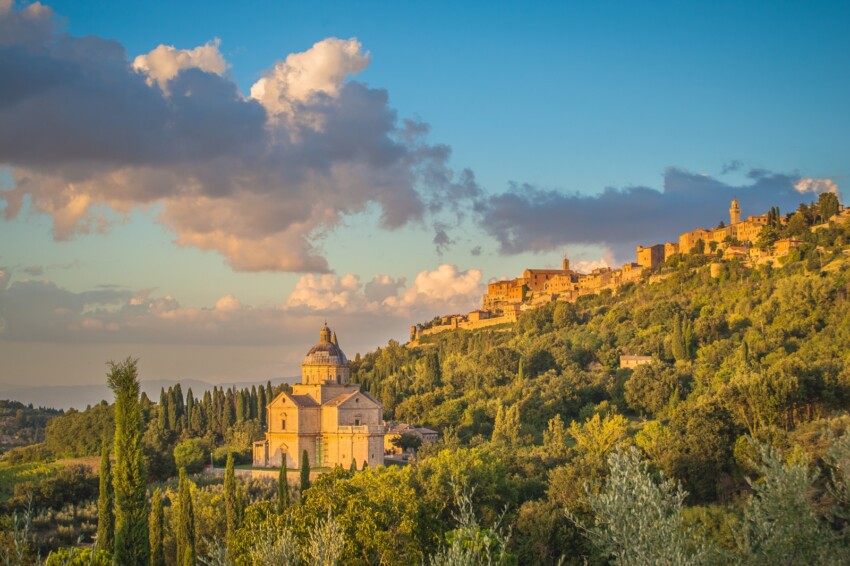
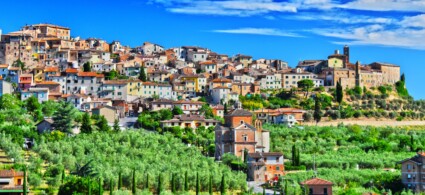
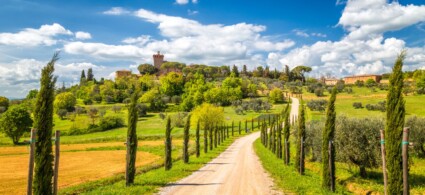
Between the Valdichiana and the Val d’Orcia, nestled in bucolic surroundings on the characteristic Sienese hills, sits the ancient village of Montepulciano, a true oasis of peace and tranquillity, set amongst stunning vistas, vineyards stretching to the horizon and all the charm of a classic Tuscan medieval village.
Visitors come to Montepulciano to unwind in the countryside, often staying in one of the numerous farm inns scattered throughout the area, but also to sample exceptional wine: this is the land where Nobile di Montepulciano is produced, a celebrated red wine with Controlled and Guaranteed Designation of Origin (DOCG) status, esteemed by connoisseurs, enthusiasts, oenologists and sommeliers across the globe.
What’s more, there’s plenty to discover in Montepulciano and its surroundings. Its favourable position straddling two of Tuscany’s most beautiful valleys makes it an excellent base for exploring the wider region, allowing you to experience the authentic Tuscan experience that captivates and enchants visitors from every corner of the world.
Montepulciano is small, but within its walls there’s plenty to explore and discover. Moreover, it’s worth taking a few short detours to visit some splendid attractions in the surrounding area.
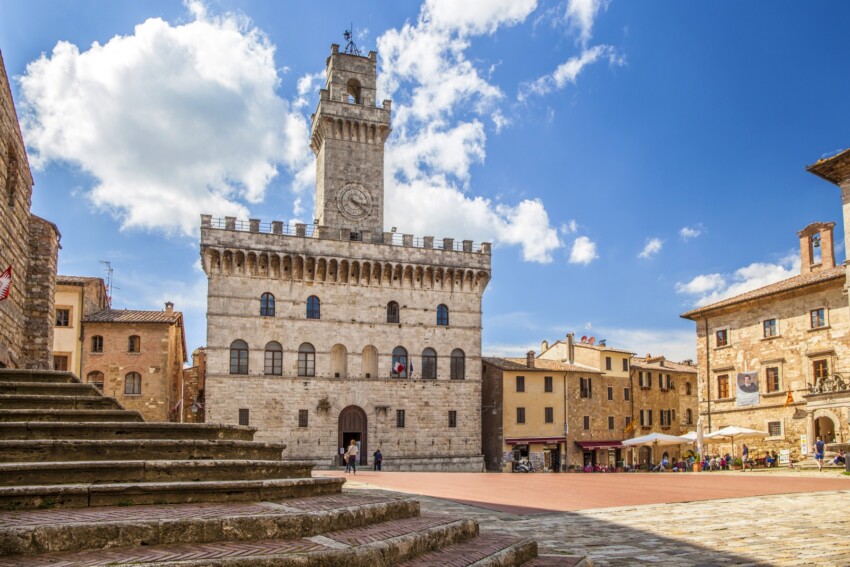
Let’s start at the heart of Montepulciano: Piazza Grande is the village’s central square, a completely pedestrianised space covering approximately 2,500 square metres. Facing onto its rectangular layout are some of the town’s most interesting and architecturally significant buildings, including the Cathedral, the Town Hall, and the noble residences of the Contucci, Nobili-Tarugi and Capitano families.
The elegant Palazzo Neri Orselli was home to the Montepulciano Civic Museum, established in 1957, one of the town’s most impressive museums. Inside there are five distinct sections, the most important of which is undoubtedly the picture gallery, which houses numerous works dating from the 17th and 18th centuries by masters of the Florentine and Bolognese schools. Among the masterpieces on display are the Madonna with Child and Two Angels by the Master of Badia a Isola, the Coronation of the Virgin by Jacopo di Mino del Pellicciaio, and a portrait attributed to Caravaggio.
Alongside the picture gallery, you can visit the other four sections: the Robbia terracottas, displaying an array of magnificent terracotta pieces, the Poliziano collection with stone artefacts from various origins, the archaeological section showcasing finds from Etruscan and Roman periods, and the studiolo, a curious and fascinating room where 16th-century furnishings and paintings are displayed.
Within the magnificent setting of Piazza Grande, one of the most distinguished buildings is certainly the Town Hall, situated on the western side of the square. It’s an elegant palace built in late Gothic-Renaissance style, its façade designed by architect Michelozzo in the Florentine manner, so much so that it closely resembles the Palazzo Vecchio.
At the centre of the façade stands the civic tower. Dating from 1440, the building comprises three levels, an internal courtyard and a crowning feature consisting of a gallery supporting a splendid Guelph crenellation.
The Montepulciano Cathedral, officially known as the Cathedral of Santa Maria Assunta, stands in Piazza Grande and was constructed at the turn of the 17th century to designs by architect Ippolito Scalza in Renaissance style.
On the exterior, you’ll admire the 15th-century bell tower, whilst the façade remains incomplete. Inside, beneath the elegant barrel vault of the central nave and the cross vaults of the side aisles, you’ll find some truly worthwhile artworks, including the Assumption triptych by Taddeo di Bartolo, positioned above the high altar.
The Funerary Monument to Bartolomeo Aragazzi in Carrara marble, another work by Michelozzo, is equally striking. The Cathedral organ dates from 1838 and features several notable characteristics, including an extended keyboard.
The Church of San Biagio, also known as the Temple of San Biagio, is situated just a few hundred metres from Montepulciano’s centre. You can reach it on foot by taking the street of the same name, which slopes downwards from the town centre, or by car via the SP146 road, then turning right onto Viale della Rimembranza, lined with elegant cypresses.
The church is exceptionally beautiful and was designed by Antonio da Sangallo the Elder, who drew inspiration from the basilica of Santa Maria delle Carceri in Prato, designed by his brother Giuliano.
Externally, the church’s façade is divided into two sections: the lower part features a fine entrance portal, whilst the upper section contains a window and five rectangular panels. Inside, with a Greek cross plan, you’ll admire the high altar dating from the late 16th century and various frescoes, including the Madonna of San Biagio, considered miraculous.
Finally, you cannot leave Montepulciano’s centre without visiting the Medici Fortress, originally constructed in the 1200s but destroyed and rebuilt numerous times throughout its history, as it constantly sat at the heart of conflicts between Siena and Florence. Its present-day appearance dates from 1885, when it was restored by the Sienese Augusto Corbi.
Much of the interior now serves as an exhibition space, whilst other areas house an American university.
For a day of complete relaxation in a unique setting, we recommend visiting the Montepulciano Thermal Baths. Located in the Sant’Albino area, they date from the second half of the 1500s. Their waters are rich in carbon dioxide and possess numerous beneficial properties for both adults and children.
Below Montepulciano, not far from the Tuscany-Umbria border, lies Lake Montepulciano, which together with surrounding areas forms the Lake Montepulciano Nature Reserve, covering some 470 hectares. It’s reached from the town centre by following the SP17 and SP326 roads heading east for approximately 15 kilometres; the lake is beautifully peaceful, with a small beach and several viewpoints. The shoreline isn’t always accessible, with some stretches of reed beds and unspoilt vegetation.
The Bravìo delle Botti is Montepulciano’s version of the Palio, involving 8 districts of the Sienese town, held on the last Sunday of August, with the competition consisting of rolling barrels weighing approximately 80 kg each.
The word “Bravìo” derives from the Italian “Bravium” and denotes the prize awarded to the winning district, consisting of a painted cloth bearing the iconographic image of the town’s patron saint, Saint John the Baptist, in whose honour the event is held.
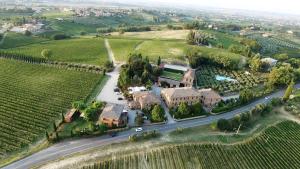
If you want to stay in Montepulciano’s centre, expect to find plenty of apartments and B&Bs, alongside small hotels predominantly run as family businesses in typical Tuscan style. Throughout the surrounding countryside there are numerous farm inns, immersed in storybook scenery, with vineyard rows, gentle slopes and breathtaking views across the countryside. Farm inns are among the most common accommodation types in this area, available in every category and budget range.
Montepulciano is accessible from both north and south via the A1 motorway, exiting at the Valdichiana junction, approximately one hour from Florence and two and a half hours from Rome. From the exit, it’s about 16 kilometres, a journey taking just over 20 minutes, along the provincial roads SP327 and SP135 heading southwards.
For those travelling by public transport, Montepulciano’s centre is not directly accessible by train as it has no railway station. The nearest station is located in the Montepulciano Stazione area, approximately 10 kilometres away, where regional trains serve routes to and from Siena and Chiusi-Chianciano Terme.
What's the weather at Montepulciano? Below are the temperatures and the weather forecast at Montepulciano for the next few days.
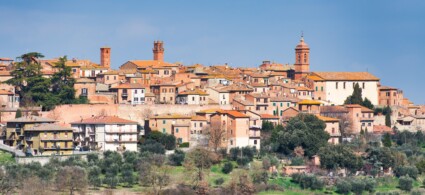
Montepulciano sits on a hilltop, nestled between the Val d'Orcia and Valdichiana valleys. To the east it borders Umbria, whilst the other boundaries are shared with Torrita di Siena to the north, Pienza to the west, and Chianciano Terme and Chiusi to the south.
 Hotel
Hotel 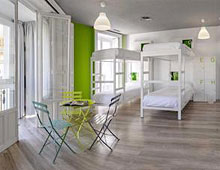 Budget accommodations
  Apartments
  Family Hotel
 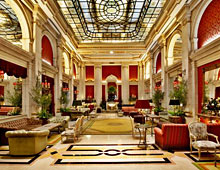 Luxury Hotel
 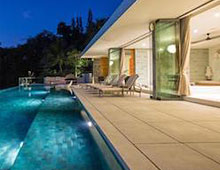 Resorts