Art Hotel Museo
Prato - Viale Della Repubblica 289
Book now
There are many monuments to visit and admire in Prato and throughout its Province. In the heart of the city, within fourteenth-century walls, almost all of Prato’s principal monuments are gathered together, linked to the most important museums and set within an environment rich in ancient structures, full of interest and references to Prato‘s history. This creates a historic centre that functions almost as a vast open-air “museum”, arranged along an ideal artistic route to explore on foot. So if you fancy a stroll, the Passeggiata d’Arte is at your disposal: a pedestrian itinerary that will guide you through the streets of Prato’s historic centre, taking you to visit the most important monuments and museums.
Created at the end of the thirteenth century at the intersection of two main thoroughfares, Piazza del Comune forms the ideal and geometric centre of the city, as well as its political heart with the Palazzo del Comune (or dei Priori) and the Palazzo del Popolo (Palazzo Pretorio). From its origins, the square was home to the grain market and butchers’ stalls, but it also hosted the city’s most important public events.
The square is closed on its northern side by the Palazzo Comunale, comprising several buildings of different origins and sizes. Its late eighteenth-century appearance is due to the work of Prato architect G. Valentini (1791). The shorter wing of the palace served as a residence for municipal magistrates from the early fourteenth century onwards.
Inside, there are several frescoes by Pietro da Miniato from the late fourteenth century, and you can admire furnishings and wooden inlays dating from the sixteenth to the nineteenth century, as well as an extensive collection of paintings: the Quadreria.
Facing the long side of the portico stands the imposing mass of the Palazzo Pretorio, restructured in 1284 and formerly belonging to the Pipini family. It served as the seat of republican government and the law courts (built where there was once an open space called “lo Sciampio” and later “il Cantone” or “platea filiorum Pipini”).
The octagonal basin with small corner shells was remade in 1789.
The original by Tacca, with its elegant cup-shaped bowl adorned with marine motifs and topped with baby Bacchus, is preserved in the atrium of the nearby Palazzo Comunale. A twentieth-century copy stands at the centre of the square.
The Palazzo Pretorio, an imposing medieval building, is one of the finest public palaces in central Italy. Its structure, partly composed of red bricks typical of the thirteenth century and partly of white alberese stone from the late Gothic period, decorated with elegant bifora windows, testifies to numerous enlargements across different eras. In the second half of the fourteenth century, the brick section was probably raised to the level of the palace, and a turret was built at the corner, now demolished. An external staircase (remade in the sixteenth century) and a clock completed the building, which housed foreign magistrates.
Like the public palaces of other medieval towns in central and northern Italy, the Palazzo Pretorio was adorned with family crests of podestà and vicars, mostly in stone, but also in marble and terracotta, arranged along the external walls facing the square.
Dating from the sixteenth century is the small gable bell tower together with the crenellated moulding on the northern façade. The ground-floor portal leads into vast rooms, some of which are frescoed (Bettino di Corsino, 1307; Pietro and Antonio di Miniato, 1425), while the external staircase leads to the first floor.
Since 1912 it has housed the Museo Civico, currently closed for restoration work.
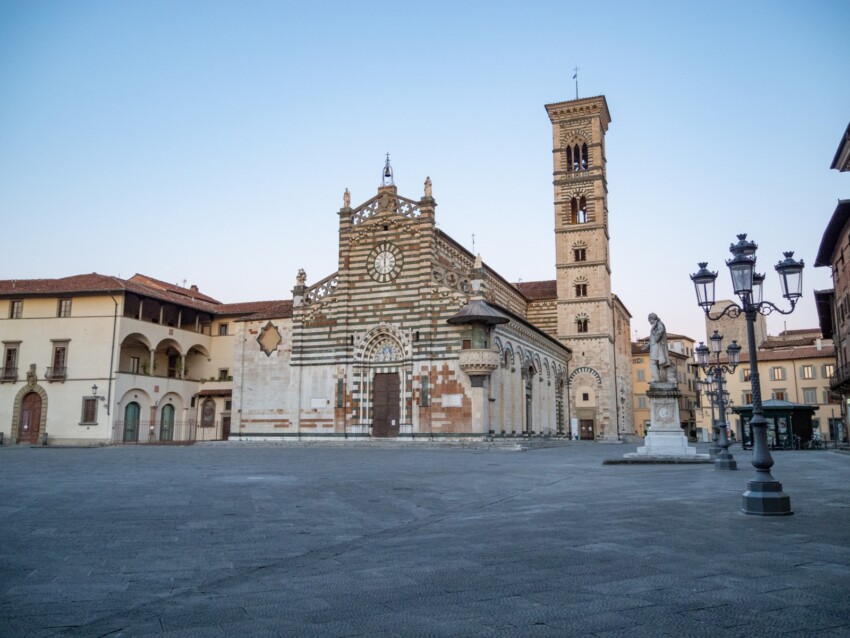
The spacious Piazza del Duomo has developed in many ways in its current form in relation to the Cathedral Basilica of Santo Stefano, and it allows you to admire the various parts of the building from numerous and different viewpoints.
The site where the cathedral stands has probably served as a place of worship since ancient times, as testified by finds discovered in 1975 during some restoration work on the cathedral, dating back to the period between the Copper Age and the Bronze Age. Nevertheless, the first document attesting to the existence of the religious building is a written document from 994 that confirms its elevation to a baptismal parish church of Borgo al Cornio, the Roman settlement developed by the Lombards, which gave rise to the present-day city of Prato and represents an element of continuity with the development of Villanovan and Etruscan settlements in the Prato area.
The parish church of Santo Stefano developed in parallel with the city and was already enriched architecturally in the twelfth century with expansion work that continued into the thirteenth century with the intervention, in 1211, of master Guidetto, master mason of Lucca cathedral.
The bell tower, designed by Guidetto himself, was built in the thirteenth century and completed with the final order of trifora windows around 1356. During these same years, the reworking of the transept, begun in 1317, was being completed.
Between 1386 and 1390, the Cappella della Sacra Cintola was built, and in 1386 construction of the current façade began, superimposed on the older one, leaving a gap between them so as to create a corridor for access to the external pulpit, a work by Donatello and Michelozzo.
The façade – created with skilful use of the two-tone effect of alberese and serpentino (known as green marble of Prato and found in countless churches and buildings throughout Tuscany), its elevation is divided into three zones by pilaster strips (pillars incorporated into a wall so as to project outward) resting on a cornice in serpentino and alberese that continues also on the right flank. The sloping lines of the three naves are completed by rampant arches topped by quadrilobe rose windows in sandstone.
The clock was built in 1457 (the current one dates from the 1700s) in place of the rose window that was certainly envisaged in the fourteenth-century design; above the clock is a bracket that supported a cherub, a work from the 1500s, which marked the hours. At the centre of the façade is the large portal created in 1412-13: the pointed arch, decorated with a vegetal motif, is flanked by two pilasters with vases in Renaissance style. The lunette features a splendid high relief in white and blue glazed terracotta with the Madonna and Child and Saints Stephen and Lawrence, framed by cherubs, a work by Andrea della Robbia (1489).
Donatello’s Pulpit – The most interesting and distinctive element of the cathedral’s external structure is certainly Donatello’s Pulpit, commissioned to him in 1428 together with Michelozzo and completed in 1438. The structure had been designed with the ceremony of the Exposition of the Holy Girdle in mind, with particular attention to the possibility of exploiting both façades so as to serve as a connecting element between the two squares where the faithful and pilgrims gathered and continue to gather today.
The base of the pulpit is formed by the corner of the church, enriched by the bronze capital, a work by Michelozzo and Maso di Bartolomeo (1433). From the capital spring concentric bands that project progressively and are finely carved with the most varied decorations: small leaves, oak wreaths, dentils, fluting, spindles, all topped by fifteen brackets, adorned with leaves, which support the parapet with the panels carved by Donatello (those visible today are casts; the originals are preserved in the adjoining Museo dell’Opera del Duomo).
The form of the parapet recalls the structure of a small temple supported by pairs of columns that divide it into seven panels, in which panels with groups of dancing angels are inserted. The pulpit is completed by a beautiful umbrella-shaped baldachin, which serves as a covering.
The Right Flank – It assumed its current appearance in the twelfth century, with the completion of the portals and arcades; above them are hanging arches in alberese and serpentino, an ornament that also completes the external part of the central nave. The two portals are flanked by two pilasters decorated with distinctive and precious marble inlays, some in Arabian style. The first arcade on the right features an opening that provided access to an external pulpit that was probably placed here periodically on the days of the Exposition, just as the pulpit that looked out from the first arcade on the left must have been non-permanent (traces of the opening, now blocked, are still visible).
The Bell Tower – A beautiful tower structure dating from the early thirteenth century, created to a design by Guidetto; the first order, continuous with the motif of the flank, was originally open and served as a link between the square and the ancient Via di Borgo al Cornio. The final order was added in 1356 by Niccolò del Mercia, who completed the bell tower with a refined projecting structure created by the two-tone effect of the hanging arches inspired by those on the flank of the church.
The Transept – The construction of the transept, by Francesco Talenti and Lapo Ghini, master builders of Florence cathedral, followed a few years later (1368). The transept is formed by broad walls in alberese, also completed by two-tone hanging arches. The right flank has a portal flanked by two-tone motifs and an arch, also two-tone, ornaments also present in the bifora window placed above the portal.
On the rear elevation, the five chapels are lit by five single-light windows enriched with coloured stained glass.
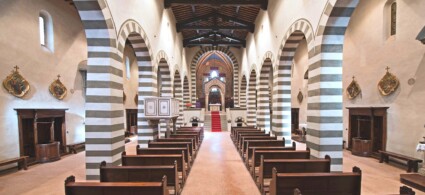
Inside, the church has a unified appearance. The floor in alberese, red marble and green serpentino with hexagonal and diamond shapes is the work of Bernardo del Basso (1542-45). On the right is the baptistery space, inside which is placed a large serpentino baptismal font made in 1596 by Domenico Lazzeri of Settignano. The baptistery space is closed by a quadrilobe wrought-iron gate made by Giovanni and Ristoro in 1348. Along the right wall is, set in an eighteenth-century painted wooden frame, a precious polychrome wooden crucifix, a work by Giovanni Pisano, made in the early 1300s.
The three naves are divided by six arcades on each side supported by sturdy columns and enhanced by serpentino cladding, while the capitals, in sandstone, are carved with vegetal motifs, volutes, rosettes, and some with figurative elements featuring human or lion heads. The rather squat appearance of the columns is due to the raising of the floor that took place in 1542-45. The fifth bay terminates on a serpentino pilaster with two semi-columns at whose base three steps rise to introduce the sixth bay. This is covered by a fourteenth-century barrel vault with ribs on the three naves; the vault of the central nave features frescoed pendentives with busts of Saints Stephen, Lawrence, John the Baptist and Jerome.
The sixth bay in turn leads to the transept ingeniously inserted into the church’s structure with a design by Giovanni Pisano from 1317, completed in 1368. The transept is covered by five tall barrel vaults that naturally conclude in the apsidal chapels. In the right wall of the right arm of the transept is a tabernacle known as the Madonna dell’Ulivo, a work by Giuliano, Giovanni and Benedetto da Maiano (1480). The tabernacle houses the Madonna and Child, a terracotta sculpture by Benedetto, which rests on a relief in white marble carved with a Pietà, a work by Giuliano and Giovanni.
Nearby is the splendid bronze candelabrum by Maso di Bartolomeo (1440).
The vaults of the transept are frescoed with roundels depicting the Evangelists (1366-68), while the soffits are decorated with busts of Saints.
The pilasters and arches are enriched with leaf capitals with, at times, figures and heads; particularly notable are the rich figured corbels that support the vaults of the five apsidal chapels, quite rare in central Tuscany.
In 1636, construction of the presbytery balustrades began: a design by Bernardino Radi of Cortona executed by Cesare Cennini. Of particular interest are the inlaid mirror panels and white marble slabs with inlays.
The first apsidal chapel on the right, the Cappella Vinaccesi, is also known as the Cappella del Crocifisso because of the presence of a splendid polychrome wooden Deposition of Christ dating from the thirteenth century, the central part that was probably originally accompanied by the Virgin and Saint John, now displayed at the Musée de Cluny in Paris. The chapel is completely frescoed with scenes of the Passion and Redemption and prophets.
Continuing, you find the Cappella dell’Assunta, decorated with precious and important Scenes of the Virgin and of Santo Stefano, a work by Paolo Uccello (1433-35). The vault features figures of Virtues: Faith, Hope, Charity and Fortitude; the soffit instead features the Saints Jerome, Dominic, Paul and Francis. On the left wall are the Scenes of Santo Stefano with The Disputation, the Stoning and Discovery of the bodies of Santo Stefano and San Lorenzo. On the right wall we find in the lunette the Birth of the Virgin, the Presentation of the Virgin at the Temple, the Marriage of the Virgin.
The Main Chapel is preceded by an altar in white marble with panels and altar frontal with inlays in polychrome marbles, a work created by the Cernini, to a design by Bernardino Radi, in 1638-40. The altar is topped by a precious bronze crucifix, a work executed by Ferdinanado Tacca in 1653. The walls of the chapel are entirely decorated by the famous cycle of frescoes with Scenes of Saints Stephen and John the Baptist, one of the most famous and significant works by Filippo Lippi. Created between 1452 and 1465, the frescoes present a monumental conception of the figures, with vaporous drapery: it was also because of these characteristics that Vasari defined Lippi as a forerunner of sixteenth-century art and of Michelangelo, who studied these frescoes on multiple occasions.
In the barrel vault are the Evangelists. The left wall instead shows the stories of Santo Stefano: in the lunette is the birth of the Saint and his substitution with a little demon by a demon; on the right part of the lunette a doe saves the little Stephen by nursing him, until she is found by a woman who entrusts him to Bishop Giuliano. The central scene shows, starting from the left, Stephen taking leave of Bishop Giuliano to begin his mission in Cilicia. The following episode shows a man describing to the Saint the dreadful condition of his demon-possessed son; Stephen frees the young man from the devil, above whom the dark shadow of the devil is visible. This is followed by the episode of the Disputation with the Saint preaching his faith before a group of sceptics. On the right we find the Stoning of the Saint, an episode that continues also on the back wall: at the sides of the stained-glass window are the Saints John, Gualberto and Alberto.
The right wall is dedicated to San Giovanni Battista. In the lunette we find the Nativity of the Baptist, in the central scene we find the group with San Giovanni who leaves his parents to retreat into the desert – the Saint in prayer – the Saint giving his blessing – the preaching of the Baptist.
These are followed by perhaps the most celebrated scenes and certainly the most elaborate: the Beheading of the Baptist, the Dance of Salome, and the Presentation of the Head to Herodias.
The beautiful stained-glass window of the central chapel was created in 1459 by Lorenzo da Pelago after a design by Lippi himself and features, in the lunette, the Madonna presenting her girdle to Saint Thomas; below are Saints John the Baptist, Stephen and Lawrence; Saints Paul, Peter and Andrew; the window concludes with three female saints.
The adjacent Manassei Chapel is also entirely frescoed with Stories of Saint Margaret and Saint James.
The following Inghirami Chapel is decorated with a fine sixteenth-century floor in polychrome marble with striking perspective effect. The lower part of the left wall is occupied by the funerary monument of Filippo Inghirami, a work by Benedetto da Maiano.
At the foot of the Balustrade, on the left wall of the transept, is the chapel of the Holy Sacrament, created in 1534–45.
Continuing along the left aisle, beneath the fifth bay we find the splendid internal pulpit in white marble with a chalice-like form. It was created between 1469 and 1473 by Mino da Fiesole after a design by Pasquino da Montepulciano.
Returning near the entrance, which occupies the final bay, we find the Chapel of the Sacred Girdle, specifically built to house the Marian relic in 1386–90 after a design by Lorenzo di Filippo. The chapel is entirely frescoed with a magnificent cycle of frescoes depicting Stories of the Virgin and the Sacred Girdle, a work by Agnolo Gaddi (second half of the 14th century) and covered by two ribbed cross-vaults with cylindrical ribs supported by precious gilded corbels. The first bay is frescoed with the Doctors of the Church, whilst the second features the Evangelists. The lunette facing the central aisle and those nearby are frescoed with the Stories of Joachim and Anne, the Virgin’s parents. The wall to the left of the altar features the Stories of the Virgin: starting from the scene beneath the lunette, the Journey to the Temple and the Marriage of the Virgin, the Annunciation and the Nativity, which includes in the Announcement to the Shepherds one of the earliest nocturnal scenes in Italian painting.
The wall behind the altar is frescoed with episodes that conclude the Stories of the Virgin, which intersect with the Stories of the Sacred Girdle. Starting from below: the Dormition of the Virgin (damaged by the opening of the reliquary cabinet), the Assumption of Mary presenting the Girdle to Saint Thomas; the lunette instead shows the Coronation of the Virgin.
The wall to the right of the altar presents the continuation of the Stories of the Girdle, beginning with the Assumption of Mary giving the girdle to Saint Thomas. To better understand the stories frescoed by Gaddi, we recommend reading the History of the Sacred Girdle. In the left lunette are Saint Thomas presenting the Girdle to a priest and the Marriage of Michele and Mary. In the right lunette we find the ship in which the young people return to Prato. In the central scene are the Return of Michele to Prato and Michele placed at the foot of the chest. The scene below shows Michele presenting the Girdle to the rector Uberto; beside it is the Procession in which the relic is carried to the church of Santo Stefano. In the lunettes we find a blessing Christ and a Madonna with Child.
In the bands bordering the scenes are inserted some prophets; the arch separating the two bays is decorated with medallions depicting the Apostles; on the pillars are Saint Lawrence and Saint Dominic; in the entrance sub-arches are busts of female saints.
At the centre of the chapel is the elegant altar in precious marbles and completed by a valuable silver step, a work created in 1745–60 by Giuseppe Cerroti. On top of the silver step is placed the splendid white marble statuette of the Madonna with Child, one of the greatest masterpieces by Giovanni Pisano.
The antependium protecting the reliquary of the Sacred Girdle consists of a bronze relief depicting the Dormition of the Virgin: created by Emilio Greco in 1983, it represents one of the finest examples of Prato’s distinctive ability to harmoniously blend ancient and contemporary art, like the particular altar created from a single block of marble placed in the transept, a work by Robert Morris (2000).
The chapel is closed by the splendid bronze grille, a Renaissance masterpiece by Maso di Bartolomeo (1442), completed by Matteo di Montepulciano (1460–68).
Through the doorway surmounted by the lunette with the Madonna and Child, you access the stairs and corridor created between the two façades and along which the route unfolds on the occasion of the ceremony of the exposition of the Sacred Girdle. At the top of the stairs you reach the fine internal terrace, created by Maso di Bartolomeo in 1435–38, which features decorations inspired by those of the External Pulpit and, on the parapet, quadrilobe rosettes, which anticipate those present on the chapel grille.
On the back wall of the terrace is placed the splendid pictorial work by Ghirlandaio the Assumption of Mary presenting the girdle to Saint Thomas, with Saint Stephen, a sainted bishop, Saint Catherine and Saint Margaret (around 1508).
Continuing along the corridor you reach the two access doors to Donatello’s Pulpit, whilst on the left we find the door that allows you to ascend the cavity created between the two walls: recently restored, it shows traces of the Romanesque façade from the early 13th century with bicoloured bands in sandstone and green marble of Prato.
The convent of San Domenico is the monumental complex that in terms of location and function holds the greatest importance in Prato’s historic centre.
The original building was probably erected from 1282 onwards and its construction continued, with various vicissitudes, until perhaps 1325, under the direction and supervision of the Dominican Friar Mazzetto, active between 1300 and 1310. The bell tower dates to 1313.
The medieval façade of the church was clad only in the lower section with sandstone and green Prato marble, whilst the upper section is in plain terracotta, with an undoubtedly striking chromatic contrast; on the side a large portal faces outward which, according to a statement by Vasari, is attributed to Giovanni Pisano.
Above the church portals are visible two coats of arms topped by the cardinal’s hat, indicating the crucial patronage role of Cardinal Niccolò Albertini, thanks to whose testamentary bequest the church was built.
In contrast with the medieval exterior is the seventeenth-century internal structure, in which the spacious aisle is articulated by ten large altar-shaped aedicules framed by niches with barrel vaults. Noteworthy are the baroque wooden cantoria in lacquered and gilded finish and the organ case above it, with large gilded angels.
Among the artworks preserved are a 14th-century Crucifix, an Annunciation by Matteo Rosselli (1578–1650), one of the major artists at the court of the Grand Duke, and the decorations of the chapels.
The expansion of the adjacent convent in the full fifteenth century dates to the construction (1478–80) of the fine Renaissance cloister, characterised by elegant Ionic columns bearing the arms of Datini, which attest to the financial intervention of the Ceppo institution.
On the east side of the cloister, next to the church, the Sacristy is the oldest in foundation, evidenced by a fourteenth-century fresco still preserved that shows a crucifix with Saint Louis of Toulouse and Cardinal N. Albertini kneeling at its feet.
The Chapter House, on the other hand, dates to the early fifteenth century and is decorated with contemporary frescoes depicting the Stories of Saint Dominic. To the south were located all the workshops, including the Infirmary.
Built in 1732 on the occasion of the beatification of Sister Caterina de’ Ricci (1522–1590), a Prato saint who lived in the nearby Dominican monastery.
Striking is the contrast between the simplicity of its exterior and the richness of the internal decorations in the baroque style, including a Madonna with Child (a fifteenth-century marble relief by Matteo Civitali) and the Miracle of the Embrace of the Crucifix by Girolamo Ticciati.
To Giuseppe Valentini (1752–1833), Grand Duke Pietro Leopoldo commissioned the transformation of the Monastery of San Niccolò into a Conservatory, for which the Prato architect designed the rear façade and, inside, the vestibule, the stairwell with central opening and the spacious reception rooms with complex decorations, such as the “Etruscan-style” room in the Aurora hall.
The oldest part of the Monastery (founded around 1321) consists of the Refectory with frescoes by Tommaso di Pietro (1490), the 15th-century Cloister, the sixteenth-century Chapter House, and the Spina Chapel (redecorated in the eighteenth century).
The church still preserves the original fourteenth-century portal, in sandstone and green serpentine, which unites Gothic elements with others still in late Romanesque taste.
In the Orto di Gosto, accessed from the Monastery cloister, there is one of the very few examples in Italy of a Scala Santa modelled on the one found in Rome, in the church of San Giovanni in Laterano.
The characteristic architectural structure of the Scala Santa is formed by an upper chapel, the Calvary, accessible via a scenic front staircase, two lateral stairways and a chapel below.
Built after a design by Florentine rationalist architect Italo Gamberini, the museum complex comprises exhibition halls, various spaces for collateral exhibitions, teaching workshops, the information and documentation centre with a library specialising in contemporary art, the auditorium, conference room, bar, open-air theatre, a garden enriched with important sculptures and the exhibition space for the Permanent Collection.
The Permanent Collection of the Pecci Museum is housed in a space opened in 1998.
It comprises works by major artists of the last 30 years representing a great variety of styles and artistic trends.
The CID/Arti Visive is the Centre’s library specialising in contemporary art, which now holds approximately 40,000 volumes.
The Centre has internationally-focused activity and offers an extensive programme of temporary exhibitions, educational activities, performances and multimedia events.
It has hosted solo exhibitions by the most important international exponents of contemporary art (Enzo Cucchi, Julian Schnabel, Mario Merz, Vito Acconci, Gilberto Zorio, Jan Fabre, Marco Bagnoli, Remo Salvadori, Costas Tsoclis, Mimmo Paladino and many others).
It has selected and presented young Italian and foreign artists.
It has featured the works of Burri and Fontana and the research of major figures in twentieth-century art, such as Joan Miró, Gerhard Richter, Yves Klein.
It has given space to various aspects of contemporary artistic research, such as installations, photography (Robert Mapplethorpe, Nobuyoshi Araki), high fashion, cinema and costume.
At the Pecci Centre courses, lectures, workshops and educational and outreach activities for adults and children are held, as well as performances and concerts, in full keeping with the interdisciplinary and multifunctional vocation that characterises the Centre.
What's the weather at Prato? Below are the temperatures and the weather forecast at Prato for the next few days.
To see all the facilities and book accommodation in Prato use the form below, entering the dates of your stay.
 Hotel
Hotel  Budget accommodations
  Apartments
  Family Hotel
  Luxury Hotel
  Resorts