Agriturismo La Fattoria di Capezzana
Carmignano - Via Capezzana 43
Book now
The territory of the Municipality of Carmignano has been inhabited since the Palaeolithic period (approximately 20,000 BC, as evidenced by red jasper finds from the “Prato lithic industry”), and from the 7th to 1st century BC it was home to the important Etruscan settlement of Artimino and other connected settlements.
Traces of Roman civilisation and the subsequent Lombard period remain in place names. In the following centuries, the organisation of the territory was completed with a series of pieve (parish churches) – the oldest being Artimino and Seano – and smaller churches, then in the 11th-12th centuries with castles (Artimino, Carmignano and Bacchereto).
During the Medieval period, Montalbano was long contested, but frequent wars and sieges did not prevent the formation of rural municipalities of Carmignano, Bacchereto and Artimino, which succumbed to Florentine conquest only in the mid-14th century through a treaty binding the said Municipality to the Municipality of Florence in forced subjection, but as the signatories of Carmignano wished to record: “To you, Magistrates of Florence, it behoves you to correct the ancient error of wanting us as your subjects by sheer force…”. Unfortunately, this final clause of the agreement was not respected on several occasions.
The only area that was never subjected to Florentine rule was the land of Montalbiolo, which remained part of the district of Prato until 1843; thanks to land concessions made to inhabitants, the area made progress in the agricultural sector. The Municipality of Carmignano, besides its scenic, historical, artistic and archaeological value, is also well known for its wine production, nowadays protected by a Controlled and Guaranteed Denomination of Origin.
Research conducted in the territory of Carmignano by the Archaeological Heritage Superintendence of Tuscany over the past thirty years has brought to light evidence of great significance, particularly concerning the occupation of the area during the Etruscan period, uncovering finds for the most part now displayed in the Etruscan Archaeological Museum and extraordinary architectural remains dating from the 7th century BC (that is, the “Orientalising” phase of Etruscan civilisation).
The settlement of Artimino developed on the gentle hillsides now occupied by the medieval village and the splendid Medici Villa “La Ferdinanda”, where the city’s acropolis was probably located. A vast necropolis was situated on the east-south-east slope of the hill, at Prato di Rosello; another must have extended near the Pieve di San Leonardo – one of the gems of Romanesque architecture in the municipal territory – whilst a large funerary mound probably stood immediately outside the city walls of the Etruscan settlement (in the north-east direction), in the Grumulo property.
Some family tombs also stood at the foot of the hill, at Comeana. The principal monument is the great mound of Montefortini, which houses two distinct chamber burials. Not far from the Montefortini mound, near the country cemetery, stands the tomb of the Boschetti.
But the summit area of the Pietramarina hill – today characterised by the presence of centuries-old hollies and holm oaks of great natural interest – was also occupied by the Etruscans from the 7th century BC onwards.
Possibly rising on a Roman rural settlement, the village was the seat of a court of the Bishop of Pistoia at least until the 10th century; a fortified structure near the present Rocca was fortified in the 12th century, when Carmignano came under the control of Pistoia (1126). The castle was occupied in 1228 by Florence, returning to Pistoia in 1242.
The rural municipality formed in the 13th century was given as a lordship in 1301 by Charles of Valois to Musciatto Franzesi, who ceded it to the Florentines (who demolished the fortress and walls again). Returning to Pistoia, in 1325 it was besieged and conquered by Castruccio Antelminelli, the Ghibelline lord of Lucca and Pistoia, until three years later Florence reclaimed the castle, annexing it to its territory in 1330, together with Bacchereto and Artimino.
The present-day settlement of Carmignano grew at the foot of the castle, developing notably from the 1600s along the main road. On a hilltop at the beginning of the town stands the imposing Villa Rasponi; the elongated manor building with a small lateral tower retains 16th-century forms. On the central square, on 29 September, the traditional Palio dei Ciuchi takes place, the liveliest and most ancient festival in the area, enriched by processions of elaborate allegorical floats from the four districts.
The church of San Michele and San Francesco was built around 1330 in a Franciscan convent founded at the beginning of the 13th century below the castle: after its suppression in 1782, the church of San Michele was transferred there. The simple façade is preceded by a loggia (1773), which also provides access to the cloister.
The interior, typically Franciscan, features a large nave with apsidal chapels; the six imposing 17th-century side altars house notable works: the celebrated Visitation (1537-38) by Pontormo, with solid figures lightened by the graceful movement of the drapery and colours endowed with intense luminosity, which occupy the foreground whilst allowing a glimpse of a steep and silent perspective like the silent exchange of glances between the figures.
Also noteworthy is the Madonna of the Rosary and Saints (1601) by Cosimo Lotti, original and rich in refined details; other interesting canvases (1631-42) are attributable to Giovan Pietro Naldini. In the presbytery chapels, restructured in the 1500s, are arranged frescoes and sinopias from 1430-40 detached from the church (with works by Andrea di Giusto and Antonio di Miniato); on the high altar stands a fine wooden Crucifix (1731).
In the cloister, with a 18th-century loggia, overlooks the oratory of the Company of San Luca, founded in 1348 on the primitive Franciscan chapel.
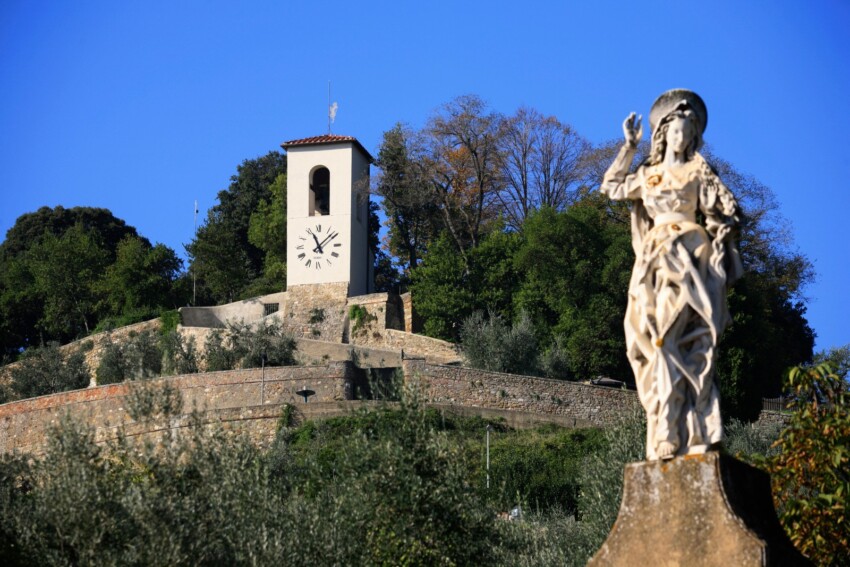
The Rocca, accessible via a scenic pedestrian route, preserves few traces of the ancient fortifications, demolished many times; the panoramic Campano tower near the park entrance is largely a reconstruction, with a small wood and 19th-century building rising on the remains of the keep.
Of the ancient castle around the rocca remain lordly complexes on a scenic ridge road: Villa della Rocca, of austere 17th-century appearance, Villa della Costa, with medieval remains, Villa Cremoncini and the interesting Villa Olmi, built around a high medieval tower, with a fine late 16th-century façade and original kneeling windows.
Among other villas in the territory, at Frigionaia there is Villa Novelli (where Augusto Novelli, author of L’acqua cheta, lived), whilst on the road to Seano, after Villa del Poggiolo, stands the remarkable Villa di Trefiano, transformed into a hunting lodge by the Rucellai in 1565-70, possibly to a design by Buontalenti.
Established in 1983 to house the numerous archaeological finds from the territory of Carmignano, relating above all to the occupation of the area during the Etruscan period, discovered as a result of research conducted mainly by the Archaeological Superintendence of Tuscany over the last thirty years, it was expanded twice, in 1987 and 1992.
The Museum Route includes: a display of materials recovered from excavations conducted in the area north of the Medici Paggeria – part of the Etruscan settlement of Artimino and including a cult area – covering a chronological span from the 7th century BC to the early Imperial Roman age (display cases 1-7); some extraordinary finds from the Etruscan necropolises of the territory: Prato di Rosello; Boschetti and Montefortini mounds, among which the well-known openwork bucchero incense burner and the splendid Grumaggio assemblage, found by chance in 1942, within which stands a great Etruscan red-figure crater (kelebe) with figures from the Dionysian procession.
Also in excellent condition of preservation is the bronze symposium service, consisting of a stamnoid situla with mobile handles, a jug with oval-decorated rim, a tray, a strainer and ladle-shaped bucket handles.
Along the walls are displayed archaic figured stelae and cippi and Hellenistic ash urns.
The second section of the Museum is dedicated to the display of a complex of Bacchereto ceramics found by chance in 1974, at the Novelleto locality.
The Museum, in collaboration with the Province of Prato, with other Museums and Volunteer Associations in the province, promotes and organises:
It also participates in the European Community Socrates project “Museums and Adult Education”.
The castle of Artimino announces itself from afar with the turreted sandstone gateway that forms its main entrance (three other towers, partly modified, are identifiable in the outer perimeter). Documented in 1026, it was besieged and captured in 1228 by the Florentines; shortly after a rural municipality arose which restored the castle’s defences, passing under Florentine rule in 1329.
The high crenellated gate-tower (of 14th-century structure, heavily modified in its upper part) leads onto a steep paved road which rises to a former oratory (in the 1300s the church of San Lorenzo). Beside it is access to the farmhouse which incorporates part of the village with a paved lane. From the castle, the imposing bulk of Villa La Ferdinanda, or Villa of the Hundred Chimneys, appears spread across the hilltop.
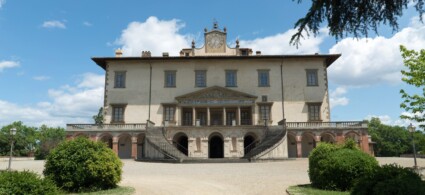
Not far from the splendid medieval village of Artimino, the Grand Duke of Tuscany Ferdinando I had built, entrusting the project to the court architect Bernardo Buontalenti (1596), in an ideal panoramic position, the villa that bears his name (also called the “hundred chimneys” because of a series of chimney pots with deliberately varied forms and styles).
The residence is characterised externally by its elegance and apparent simplicity with the scenographic double-ramp staircase (completed, based on Buontalenti’s original design, only in 1930 by Countess Carolina Maraini), the angled projections, the dentate profiles of the four corners and the front loggia flush with the façade that give it a distinctive tone, typical of the Renaissance.
Inside, the Villa comprises fifty-six rooms arranged in an extravagant layout: after the entrance hall, the vast hall of the bear is preceded by a refined little chapel, the rooms of Christina of Lorraine and the charming “bath chamber alcove”, a highly decorated small bathroom.
The frescoes of the Chapel and of the west-facing loggia are the work of Domenico Crespi, known as il Passignano.
Passed to the Lorena and then to the Maraini family, the villa is now owned by a private company that hosts conferences, ceremonies, congresses and cultural events.
Just outside the settlement of Artimino stands the church of San Leonardo, isolated in the green landscape. Documented since 998, the church has not undergone substantial transformations (apart from radical restoration in 1964-71), and preserves – unique in the Prato territory – a unified pre-Romanesque structure, datable to the second half of the 10th century.
A 16th-century loggia leans against the basilical façade, characterised by the imposing full-centre blind arch that marks the central nave, a work of Lombard craftsmen; beneath the loggia and the bell tower Etruscan cinerary urns were inserted, replaced by casts (the originals are in the Archaeological Museum).
On the left side with barely hewn sandstone fluting, with warm ochre-red hues, the imposing bell tower leans; but the most evocative part is the rear, of Lombard-Ravennate inspiration with three beautiful apses; the greater one has an original crowning with “arched” niches that create deep shadows.
The interior has naves divided by square pillars and full-centre arches with recessed voussoir; the naves are covered by ribbed vaults from the first half of the 14th century. The two altars in the counter-façade house interesting wooden statues: on the right St. Anthony Abate (from the first quarter of the 16th century), from a Robbian workshop, and opposite San Leonardo, of refined execution, close to Domenico di Niccolò “dei Cori”, from the early 1400s; another work of notable quality is a replica by Franciabigio (the Madonna of the Well, circa 1518) in polychrome terracotta, close to Giovanni della Robbia, while the central apse houses a lively panel with Crucifix between San Lorenzo and Raffaele with Tobiolo, a work from around 1560. In the left apse, finally, some frescoes remain (a blessing Christ from around 1430, close to Andrea di Giusto, is noteworthy).
Dependent on the church of Artimino and historically linked to its territory is the nearby, beautiful abbey of San Martino in Campo (220 m), founded by Benedictines in the 11th century and almost entirely rebuilt in the middle of the following century, after a collapse. Originally it was equipped with a rare cylindrical bell tower in Lombard-Ravennate style, whilst the rebuilding, particularly the apse, is inspired by Pisan prototypes.
Below the Medici villa of Artimino, on the road descending to Poggio alla Malva, there is access (guided visits only) to excavations of the Prato di Rosello necropolis, with a beautiful path through woods and meadows.
In the settlement of Poggio alla Malva (96 m), which developed from the 16th century, the church of Santo Stefano was enlarged around 1741 (when it inherited the title of the ancient parish church of the Busche, just above the Arno, by then reduced to ruins); in those years the bell tower was built. On the walls of the church are three frescoes detached from the church of the Busche, works by painters from the early 1400s; from the same church comes an interesting panel by Neri di Bicci with the Madonna, the Child and four Saints (1475-85), placed on a side altar; on the opposite side we find a beautiful Stoning of Santo Stefano by Cesare Dandini. In the presbytery, restructured in the 1700s, the high altar preserves a wooden Crucifix from the 16th century.
Seano, which has expanded considerably in recent times, boasts ancient origins: from the 10th century onwards, a manor house and parish church stood here, both declining from the 1100s as Carmignano and Bacchereto flourished. Seano nonetheless remained a thriving agricultural and craft centre, and due to its favourable position became the most populous hamlet in the municipality of Carmignano.
The church of San Pietro features a facade marked by a Neo-Romanesque renovation (1928), though the sandstone masonry of the lower section dates back to the 12th-13th centuries and continues around the rear, where an original 19th-century bell tower rises. Inside the spacious nave, adorned with monochrome figures of the Apostles (B. Valiani, circa 1836), the high altar preserves a venerated Crucifix of outstanding quality from the first half of the 15th century: the figure, taut with the agony of death, expresses a suffering sweetness in its noble countenance. Adjacent is a tabernacle display (1430-50) inspired by Michelozzo and Ghiberti. The oratory of the Confraternity of the Body of Christ features an altar painting by Domenico Frilli Croci depicting the Assumption (1617). Near Seano, along the Furba stream, the remarkable “Quinto Martini” Park-Museum was completed in 1988, honouring the artist born in Seano in 1908.
Via Baccheretana leads uphill to the farmhouse and villa of Capezzana, an ancient manor house (possibly built on an agricultural settlement documented in 804) rebuilt in the 1500s by the Medici. The complex is arranged around a spacious courtyard; to the right of the entrance stands the main building (in front of which rise four large 18th-century statues of Atlantes, from the Royal Villa of Monza), with a serene five-storey facade marked by regular rows of openings.
Just beyond the villa, the bright ashlar masonry of the 13th-century oratory of San Iacopo stands out against the green countryside. It served as the parish church until 1571 and was restored around 1920, with the upper walls and bell tower rebuilt; the apse area is well preserved.
Continuing along Via Baccheretana, beside the Furba stream, you reach the hamlet of Bacchereto, which developed at the foot of the castle. From Piazza Verdi (where an ancient hospital once stood) begins the steep climb leading to the pieve of Santa Maria Assunta, positioned dominantly; a modest rendered facade unites it with the confraternity, whilst from the rear emerges the crenellated mass of the bell tower, the only surviving remnant of the castle’s fortifications.
The Classical interior design results from work undertaken in 1835-40, featuring coffered ceilings decorated by Valinani. In the presbytery, introduced by a Serliana on Ionic columns, stands a small tabernacle in pietra serena from the early 1500s. The adjacent Confraternity of the Body of Christ displays an accomplished canvas depicting the Institution of the Eucharist, an early copy after Federico Barocci (1607).
Before the village, a road climbs the slopes of Cupolino and leads to Villa Banci, the Bacchereto farmhouse, restructured in the late 1800s but of Renaissance origins. The villa occupies three sides of a courtyard, facing which stands a late 15th-century wing; noteworthy too is the valley-facing elevation, with its corner loggetta.
Beyond the village stands Casa Toia, a sturdy 14th-15th-century structure where, according to tradition, Lucia di Zoso, Leonardo da Vinci’s maternal grandmother, resided. Along the road to Seano, some one kilometre from the village, the sole surviving example of a potter’s kiln is preserved; though modified, its structure dates to the 16th century.
The Park-Museum occupies a spacious green area near Seano, amongst the Montalbano hills.
Opened in 1988 and designed by architect Ettore Chelazzi, the park-museum houses 36 bronze statues, donated by the artist himself, set within expansive lawned areas and gravel walkways. The concept of “open space for the community” that underpins the park represents an innovative solution of considerable significance for urban planning.
The collection’s works document nearly six decades of activity by Quinto Martini, born in Seano in 1908 and died in 1990. Primarily a sculptor and painter, he was introduced to art by Ardengo Soffici, initially as a student and later as a friend. In 1927 he exhibited in the first group show alongside Morandi, Rosai, Soffici, and Maccari. He appeared at the Venice Biennale in 1934, and in 1943 mounted a solo exhibition there.
The Carmignanese Way leads to the foot of the small Montalbiolo hillock, a hamlet that from the 12th century until 1843 formed part of the Prato district. The church of San Lorenzo retains 12th-century sandstone masonry and its bell tower rises above the left side of the original transept, later altered. Inside, the high altar houses a fine canvas depicting the Madonna with Child and eight Saints from the 1600s, attributed to Simone Pignoni, whilst a side altar, near an imposing pietra serena confessional (1732), frames an original panel of San Lorenzo (1605) by Giovanni Bizzelli.
At the foot of Montalbiolo hill lie the two Fuccioli complexes, named after the Pistoian Vanni Fucci (mentioned by Dante in Canto XXIV, 121-126: “The master then asked who he was; whereupon he replied: ‘I rained down from Tuscany, not long ago, into this fierce abyss. Bestial life pleased me, not human, as befits a mule that I was; I am Vanni Fucci, beast, and Pistoia was my worthy lair'”), who resided here in 1286-87; the upper complex preserves medieval structures. On the hill stands Villa la Torre, possibly built on the ancient “Podium” of Prato, the complex where workers of lands granted by Prato were required to live.
The Carmignanese Way continues in a gentle descent and reaches La Serra on the right, a recently developed hamlet. Villa la Serra, much altered yet of 16th-century structure, boasts a vast central passage hall opening onto various rooms.
Proceeding through gently undulating countryside, the handsome Casa Boschetti is left below, with two wings raised on either side, and you follow Via Macìa to the left towards the villa-farmhouse of Le Farnete, a 14th-century residence of the Mazzinghi, extensively transformed in the 17th-18th centuries. In the chapel across the road are displayed interesting frescoes from the workshop of Domenico Ghirlandaio, detached from an oratory at Campi.
Adjacent, beyond Via di Calcinaia, lies the villa-farmhouse of Le Falene, a modest Medici property converted into a villa in the 1700s and restructured in the 20th century. On Via di Calcinaia, which separates the two villas, sits the small, well-proportioned Villa la Loggia from the 1500s; nearly opposite is an oratory built in 1702 to the proportions of the Santa Casa di Loreto and therefore called Il Loretino.
The adjacent Villa del Loretino, well protected by a tree-lined park, retains its 16th-century character, with an expansive facade enriched by a central turret and small loggia. From the villa, a private road leads towards Comeana, passing the elegant Villa la Sughera, distinguished by the broad Tuscan loggia spanning the entire piano nobile, and the ground-floor portico flanked by kneeling windows.
Comeana, renowned for sandstone quarrying, developed relatively late but was frequented by the Etruscans. Beside the cemetery and along Via Montefortini are remnants of Etruscan tumuli. Nearby, on a small rise, stands the 16th-century villa-farmhouse of Calabria (its name derived from Patarine heretics who fled from Calabria).
The church of San Michele has existed since the 13th century, featuring a modest facade with curved cornice; the Classicist bell tower (1812) separates it from the confraternity of the Blessed Sacrament. The church preserves the Neo-16th-century forms acquired during late 19th-century works; in the adjacent oratory, with late 18th-century styling, hangs a canvas with an articulated Last Supper from the early 1600s, attributable to Cosimo Lotti.
The oratory preserves the costumes for the centuries-old procession of the Dead Redeemer, held on Holy Thursday evening, a sacred dramatisation of the Passion mysteries. Beyond the road to Artimino, in a beautiful vine-planted area, after crossing the Elzana stream, appears Villa il Vivaio, set upon a vast bastioned podium; from the sturdy main wing, of late appearance, rises distinctly a medieval tower, transformed into a belvedere.
What's the weather at Carmignano? Below are the temperatures and the weather forecast at Carmignano for the next few days.
To see all the facilities and book accommodation in Carmignano use the form below, entering the dates of your stay.
 Hotel
Hotel  Budget accommodations
  Apartments
  Family Hotel
  Luxury Hotel
  Resorts