I Vivai
Montemurlo - Via Parugiano di Sopra
Book now
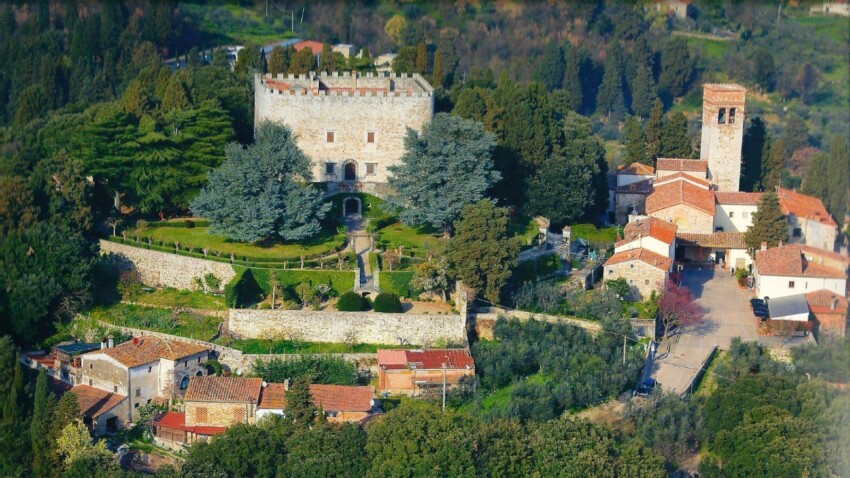
The municipal area of Montemurlo sits on the foothills of the sub-Apennine range that stretch southwards from Monte Javello towards the plain. The Agna stream forms its boundary with the municipality of Montale, whilst to the east the administrative border with Prato reaches as far as Monteferrato, renowned for its serpentine quarries known as “verde” or “nero di Prato”, used as decorative material in numerous medieval monuments and churches throughout Italy.
The area’s place names are rich in Latin heritage, though the region saw significant Etruscan settlement during that period. In Roman times, thanks to the continuation of the Cassia consular road, the first major centuriation of the Prato plain took place, thus reshaping the southern territory of Montemurlo.
A land of passage that remained so through the medieval period. From as early as 927, the Counts Guidi held dominion here, having also patronised the nearby Abbey of S. Salvatore in Agna, now within the municipality of Montale. Around 1254 the counts sold the fortress to Florence, but in 1274 Prato’s Ghibelline exiles barricaded themselves here. The alternating fortunes brought a succession of sieges, until 1324 when Castruccio Castracani, after two years, finally managed to capture Montemurlo’s fortresses.
In 1551, following the flight of anti-Medici Florentine families who had taken refuge in Montemurlo, the municipality lost the honour of having a Podestà and was first united with Montale, then subsequently with Prato. From that moment onwards, the entire history of Montemurlo has been closely tied to the fortunes of Prato, right through to the industrial development that significantly affected the municipality. Today a small town, it preserves on its hills the evocative medieval Rocca and ancient villas of prestigious architecture.
After the brief, violent rule of Alessandro de’ Medici, murdered on Epiphany in 1537, the young Cosimo de’ Medici of Cafaggiolo in the Mugello was elected Duke of Florence. This gave hope to the exiles of the anti-Medici oligarchy, who had gathered in Bologna, of inciting Pistoia to rise and to march with an army of some 4,000 soldiers; their leaders, Baccio Valori and Filippo Strozzi, preceded them with an armed band and on 26 July seized the Rocca of Montemurlo, whilst other troops positioned themselves near Parugiano.
However, the Medici forces, commanded by Alessandro Vitelli, attacked during the night and prevented the enemy army’s regrouping through diversionary tactics. The siege of the Rocca and fierce fighting marked, on 1 August, the end of the conspiracy; the leaders were executed. To commemorate the victory, Cosimo had a column placed in Piazza S. Trinita in Florence, taken from the Baths of Caracalla.
The territory of Montemurlo is scattered with villas and estates owned by wealthy merchant families since remote times. From the 14th century onwards, families such as the Pucci, Baldi, Ridolfi, Gucci, Pazzi and others invested their capital here. The same social class of owners accounts for the presence of such refined yet imposing residences.
Taking the road up via Bagnolo di sopra, one easily reaches Villa del Barone, currently undergoing restoration, situated on the slopes of Monte Javello overlooking the plain along the road to Albiano. Built in the 1500s, it is the most important of Montemurlo’s villas, both for its commanding position and its majestic proportions, at once mysterious and authoritative. It was built by Baccio Valori and repeatedly hosted celebrated figures, including the Grand Dukes of Tuscany. Within its walls, the Strozzi and Valori plotted their conspiracy against the Medici.
The magnificent sixteenth-century façade is characterised by strong rusticated corners and console-supported balconies on the first floor windows; the interiors feature festive Baroque and Neoclassical decorations. Originally a medieval fortress, enlarged into a stately residence, the villa became the marquisate of the Tempi family two centuries later; it then became the home of painter Cristiano Banti (1824-1904), who received numerous artists here and formed one of the first collections of works by the Macchiaioli school. Access to the villa is possible through the Municipal Cultural Office.
Near the Bagnolo stream we encounter the magnificent Villa Strozzi. The house retains the character given by its dual purpose: both a rich residence and a source of income for the lords who inhabited it, living here permanently until the mid-1800s and then only for summer stays. We have certain records of the Strozzi family as owners of the villa from the sixteenth century, when one of their members, Piero Strozzi, became a prominent figure in local history during the conspiracy of exiles against Cosimo de’ Medici’s power. Walking up the drive to the villa, one senses a quiet atmosphere stemming from the simplicity of the residence’s architectural layout: a regular, elongated construction with a taller central section crowned by a small tower at its centre.
Although records indicate that around 994-999 a turris Palusiano existed as property of the Counts Guidi, there is no definitive documentation of the villa’s change of ownership until the 1300s, when the Pazzi family settled permanently in Montemurlo.
In 1325 Castruccio Castracani destroyed the fortification, which was defended by forty armed men, Neri dei Pazzi and Giovanni di Redice Adimari. Of the tower and castle, once belonging to the Guidi and probably the nucleus of the settlement that would develop over the following centuries, no visible trace remains today.
A notable feature is the villa’s chapel, dating to the mid-1500s and entirely frescoed by Giovanni Stradano. The four corners of the chapel’s vault show the Creation of the World, the Creation of Man and Original Sin, the Last Judgement and Hell.
The present Villa Giamari was formerly owned by the Villani family, who oversaw the numerous surrounding estates from the 1400s onwards, when family members held the position of hospitallers of the Bigello company, which involved supervision of the Barzano Hospital. The Villani family died out in 1781 with the death of Giulia, the family’s last member. The villa’s ownership passed to the Giamari, a wealthy merchant family of Armenian origin residing in Tuscany. The new family made alterations to the building, widening the windows and adding the grand staircase leading to the main floor.
In the early 1500s Antonio di Jacopo di Urbano Popoleschi owned a chasa da ivoratte […] with 60 staiora of ploughland. The Popolesco, located in the area known as Pantano, due to its marshy nature, is a solid construction with spacious, regular volumes. Almost bare in its austere appearance, it likely dates from the early 1600s.
This villa typifies the buildings of Montemurlo, whose owners preferred to emphasise comfort and functionality in keeping with agricultural activities rather than luxury. In harmony with this understated character is the villa’s oratory, dedicated to San Francesco. On the altar hung a painting by Jacopo Vignali depicting the Adoration of the Shepherds with San Niccolò and San Francesco.
The original core appears to have been a fortress that was damaged by Castruccio Castracani when he attacked the castle of Montemurlo and destroyed houses and towers in the surrounding area. By the end of the 1500s the villa became property of the Venturi family, then the Martini until 1802.
In 1802 ownership passed to Giovanni Battista Pandolfini, cousin and adopted son of Marco Covoni, a much-respected and beloved figure, administrator of charitable institutions, whose coat of arms adorned the farmhouses belonging to the estate. After the Covoni family died out, the estate passed by inheritance to the Borghese family of Rome.
From the castle, a road climbs to the ancient Casone dei Valori (via Baronese) and from there to a small panoramic height, the Masso di Piero Strozzi, an area that was once the destination for Ascension Day processions and which held sacred significance, possibly dating back to Roman times. From via Cicignano you can reach ancient farmhouses and manor buildings, and the fine structures of the Cicignano settlement (a name of probable Etruscan origin).
Back on the old Montalese road, heading towards Montale, there is Fornacelle (from the 15th century lime and brick kilns operated there), which developed considerably from the late 19th century onwards to become the most populous district and the seat of the municipality. Before its current location, the municipality was based for many years in premises built between 1895 and 1906 as a school, a sturdy building in classical style, extended in the 1930s.
From via della Bicchieraia (which follows the Agna stream) you reach an area surrounded by coppice woodland of oak and hornbeam, where you find the Reticaia basin, an ancient Guidi holding, where a farmstead complex incorporates the apse and side of the Romanesque church of San Giusto, a parish church until 1492.
The road climbs the slopes of Monte Javello and leads, northwards, to the Fattoria di Javello (548 m), between the valleys of the Agna and Bagnolo, isolated in a wooded area. Built on the site of the court on the Poio de Jove, already in ruins in 1088, it belonged to the Guidi in the twelfth century; it was the Strozzi’s by 1325, when it was partially destroyed by the forces of Castruccio Antelminelli. The estate then passed to the Venturi and Martini families (early 1600s), eventually comprising 20 farms by 1940. The current owners are the Borghese.
The complex is arranged around a courtyard; in the upper section a medieval tower is flanked on one side by the villa and on the other by the chapel and farmhouse; the outlying farm buildings, positioned at a lower level, close the courtyard at the bottom. The modest main residence, which extends along two sides of the courtyard, displays a sober sixteenth and seventeenth-century character, as does the rear section, facing the centuries-old garden, with kneeling-style windows and a rusticated rectangular portal. The Chapel of San Bernardo has interiors frescoed in 1616 by Stefano del Bono (Madonna of the Rosary, Saints and Angels). Behind the villa looms the wooded summit of Monte Javello (931 m), reachable by footpaths, from which an extensive panorama unfolds stretching from the Prato plain to the Apennines.
Back on the Montalese road, immediately at the foot of the castle, the Church of the Sacred Heart of Jesus stands out above the surrounding buildings (built between 1938 and 1946, designed by R. Franchi), with sides articulated by apsed chapels and a robust bell tower: the spacious nave, with 1940s decorations, preserves a panel of the Deposition (Michele delle Colombe, around 1585), an organ with a nineteenth-century façade and a wooden Crucifix from the 1700s.
What's the weather at Montemurlo? Below are the temperatures and the weather forecast at Montemurlo for the next few days.
To see all the facilities and book accommodation in Montemurlo use the form below, entering the dates of your stay.
 Hotel
Hotel  Budget accommodations
  Apartments
  Family Hotel
  Luxury Hotel
  Resorts