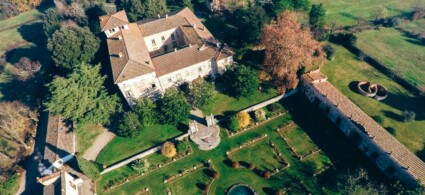
Hotel Hermitage
Poggio a Caiano - Via Ginepraia 112 - Poggio a Caiano
Book now
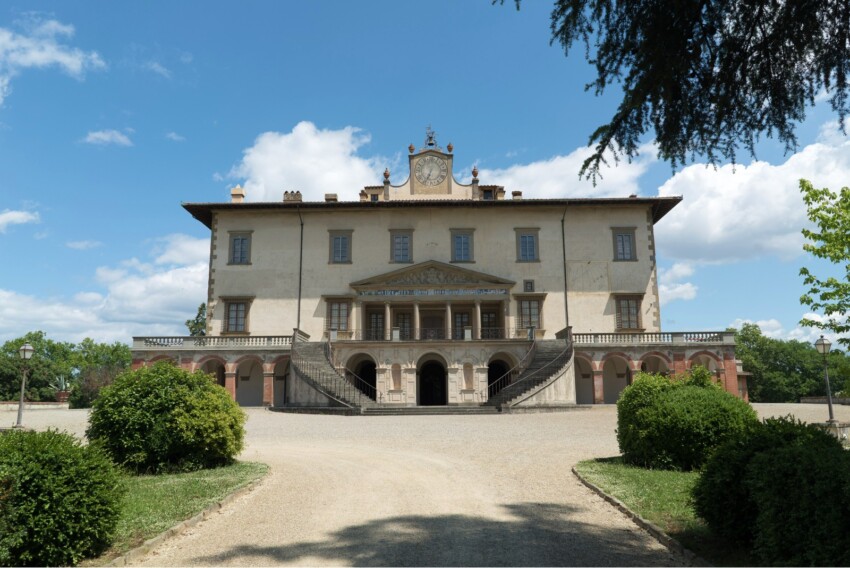
Poggio a Caiano is the smallest and youngest municipality in Prato Province. It gained administrative independence on 14 July 1962, separating from the Municipality of Carmignano, of which it had previously formed part. Whilst there are no confirmed Etruscan settlements in Poggio a Caiano itself, unlike in the neighbouring Carmignano area, it is reasonable to assume the Etruscans passed through the territory on several occasions.
What is certain, however, is that the first communities to settle here were of Roman origin, as evidenced by the place name, derived from the Latin personal name “Carius”. This term identified a wider area than the present-day municipality; ancient documents refer to the settlement of Grignano, now in Prato municipality, in the Caiano zone. This suggests that the lands to the east of present-day Via Roma were called Caiano, whilst the opposite area was identified as Piazzanese (see Pieve di S. Giusto in Piazzanese), meaning the Poggio formed part of this broader area centred on Prato. History first records Poggio a Caiano in the medieval period (12th century), when the municipal republic of Prato had a bridge built across the Ombrone stream to connect the Prato plain with the hilly Montalbano area. Alongside this construction, a heavily fortified fortress was erected on the small hill to the west of the bridge.
Always allied with Prato, which recognised its strategic importance, Poggio a Caiano became not only the gateway to Montalbano but also a busy port from which Prato’s merchandise was transported downriver to the sea. The fortress, which passed to the Cancellieri family in 1420 and was then transformed into a castle with grounds, was sold to the Strozzi family before being confiscated and passed to the Medici.
Recognising what Prato had understood years earlier, Lorenzo the Magnificent invested in these lands and especially in the Poggio villa. A pioneering example of Renaissance suburban residence, designed by Giuliano da Sangallo, the villa subsequently became the property of the Lorena, Bonaparte and Savoy families, who each enriched it with numerous works of art from various styles and periods, transforming it into an important tourist attraction.
Opposite the Medici villa “Ambra” stands the Institute of the Little Sisters of the Sacred Heart, founded in 1901 by Blessed Maria Margherita Caiani, who was born in Poggio in 1863. The nearby Propositura of Santa Maria del Rosario (1889–1903), built in sandstone blocks, features a bell tower designed by Ardengo Soffici (1938–40) and classical interiors with four elegant 17th-century altar niches.
The high altar (P. Santelli, 1903) displays a venerated wooden Crucifix from the early 16th century, and in the chapel to the left of the entrance is an altarpiece depicting the Coronation of the Virgin (1606), a late work by Alessandro Allori and his workshop. Various villas built on the remains of ancient fortified structures dot the lower slopes to the west of the town: along Via di Ginepraia stands the imposing Castellaccio, rising from a broad podium and retaining part of its 16th-century structure; beyond the tabernacle (1857) at the junction with Via di Bonistallo (where 16th-century Villa Magra now serves as a care home), a lane on the left leads to Petraia, where a ruined 16th-century palazzo remains and, within a park, the ancient Villa of Petraia, featuring Neo-Gothic alterations.
On the slopes of the small Bonistallo hill, the Barco Reale (royal hunting lodge) was created in the 16th century.
From the summit of the hill, the church of San Francesco a Bonistallo dominates the landscape, with a three-sided portico (1793), which became the parish seat in 1922.
The interior, laid out in Latin cross, displays a unified and luminous Baroque character (1760–80), with refined stucco ovals between the altars. Among the canvases, notable works include a Madonna of the Rosary (1623) by Matteo Rosselli, a Vision of Saint Francis (1777) by Fra Felice da Sambuca from Agrigento, and a Madonna and Child with Saints, in the manner of Bilivert (circa 1620). A short distance away, several columns of a portico and a bell tower mark the site of the ancient church of Santa Maria, now converted into a residence.
From Poggetto, a recently developed settlement along the main road, the ancient Via di Mastrigalla rises towards Carmignano and crosses on the left the private road leading to the commanding Villa of Cerreto (or Cerretino), a Medici property in the 16th century, where Bianca Cappello once lived. The courtyard structure, built on the remains of the medieval fortress of Torrebecchi, recalls late 15th-century military architecture, with two corner cylindrical towers; of note is a Renaissance hall.
From Poggio a Caiano, the Via Carmignanese curves around a wooded hillock crowned by the imposing Villa del Poggiale, protected by a high boundary wall and its grounds. This complex building retains an elegant 16th-century layout, with extensive plastered surfaces and a belvedere tower (another stands at the rear, overlooking the chapel).
Just beyond, the road leads left to a small settlement (which was part of the Prato district until the mid-13th century), clustered around the church of Santa Cristina in Pilli, preceded by a portico. The church, documented from 1026, was rebuilt in the 13th century and underwent several subsequent restorations.
Inside, near the presbytery (altered in the 17th and 20th centuries) remains the frame of a Renaissance pietra serena ciborium and a fine canvas depicting the Martyrdom of Saint Christina (1652) by Annibale Niccolai. On a side altar, a fresco featuring the Madonna, Christ Child, Saints and a donor by Francesco di Michele (circa 1385), with Renaissance additions, has been exposed. On an 18th-century stone confessional sits a triptych (Madonna and Child between four Saints, attributed to the “Master of 1399”), which was enlarged in 1520 with the addition of two Saints flanking the cusps and retouching of the central group. Opposite, on another 18th-century confessional, a 17th-century stone pulpit projects outward. Finally, by Quinto Martini is a Baptism of Christ painted in the 1930s.
The Medici Villa of Poggio a Caiano was commissioned by Lorenzo de’ Medici and his heirs from designs by Giuliano da Sangallo between approximately 1485 and 1520, with a probable pause from 1495 to 1513 due to the Medici exile. It remained the summer residence of the Medici family and, besides hosting numerous notable figures, was the setting for important events in their dynastic history, including celebrations for the marriages of Alessandro de’ Medici to Margaret of Austria (1536), Cosimo I to Eleonora of Toledo (1539), and Francesco I to Bianca Cappello, already his mistress (1579).
Poggio Villa was a compulsory stop for all new grand ducal brides, who received homage from the Florentine nobility here before proceeding to the city: this was the case with Joanna of Austria, first wife of Francesco I, and Christina of Lorraine, wife of Ferdinando I.
At Poggio Villa, in October 1587, Francesco I and Bianca Cappello died, one day apart, from tertian fever, although oral tradition passed down the rumour that both died from poisoning. The Villa was the preferred residence of Cosimo III’s son, Prince Ferdinando, a great patron of the arts, who made it a vibrant cultural centre.
Upon the death of “Giangastone” (1737), Ferdinando’s brother and the last Medici descendant, the Villa passed to the new Tuscan Grand Dukes, the House of Habsburg-Lorraine, who continued to use it as a summer residence or as a stopping point during their journeys to Prato or Pistoia.
With the Napoleonic conquest, Tuscany entered the French sphere of influence, first as the Kingdom of Etruria and then as part of the French Empire itself. The Villa underwent internal and external modifications (chiefly by Pasquale Poccianti) at the initiative of regent Maria Luisa of Etruria and subsequently of Elisa Baciocchi Bonaparte, Napoleon’s sister, who from 1804 was princess of Lucca and Piombino and from 1809 grand duchess of Tuscany.
Poggio Villa became one of her preferred residences and it seems that it was here that an alleged love affair between her and the celebrated violinist Niccolò Paganini took place; he gave numerous concerts in the Villa’s theatre. Following the Restoration, repairs and restoration works continued, resuming with the establishment of the Italian Kingdom and the arrival of the House of Savoy.
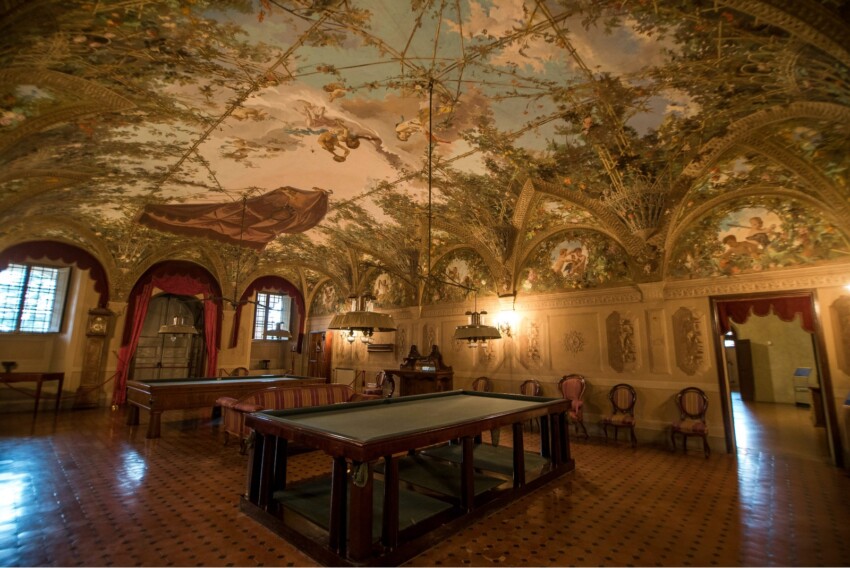
When Florence became the capital, Vittorio Emanuele II, a lover of horses and hunting, had the Villa refurbished: new stables were built, some ground-floor rooms were redecorated and the grand Leo X salon on the first floor was transformed into a billiards room. With Vittorio came to Poggio also the “fair Rosina”, namely Rosa Vercellana, a Turinese commoner and the king’s mistress and subsequently his morganatic wife.
Two fine bedrooms on the first floor, which visitors can see today, bear witness to this latest love story played out at the Villa. In 1919 the Royal Household Administration donated the Villa to the Italian State. The farmhouse at Poggio a Caiano-Tavola and the stables, which together with the Villa constituted a unified complex of great architectural value, were instead ceded, also in the immediate postwar period, to the National Opera for War Veterans and subsequently sold to private buyers.
The Medici Villa of Poggio a Caiano is the first example of Renaissance architecture that merges the teachings of the classical tradition (particularly Vitruvius) with elements characteristic of Tuscan rural manor-house architecture. The influence of Alberti is evident, from the choice of location for the Villa to its symmetry and harmonious proportions.
The introduction of a basis villae (the platform supported by arches on which the building rests) instead refers to classical models such as the Temple of Jupiter Anxur at Terracina. Giuliano da Sangallo, who conceived it and masterfully blended these elements, laid the foundation for a new architecture in which classical learning is brought to life by innovative elements, without remaining sterile imitation or mere reproduction of established models.
The exterior of the Villa has preserved the original Renaissance design of Sangallo fairly intact, except for the twin staircases leading to the terrace, erected in the early 1800s to replace the original ones. In 1807, Pasquale Poccianti designed them, conceiving “an external staircase with the convenience of passage for carriages under cover”. The curved staircases he designed were later built in the following years by Giuseppe Cacialli, replacing those by Sangallo, which, unlike the present ones, were straight and perpendicular to the Villa’s body.
The building is surrounded by a porticoed terrace. At the top of the stairs is a loggia crowned by a pediment and a barrel vault finely decorated in relief. On the right wall of the loggia is a fresco depicting the sacrifice of Laocoon by Filippino Lippi. On the architrave of the same loggia is a frieze of glazed terracotta (attributed to Sansovino) depicting mythological allegories connected to Lorenzo and his circle. However, this is a copy: the original was completed restoration in 1986 and is displayed in one of the rooms inside the Villa.
The interior of the Villa has undergone various transformations over the years that have altered its original appearance. On the ground floor you can visit the so-called apartment of Bianca Cappello (in these rooms it is possible to perceive more clearly than elsewhere the Renaissance character of the Villa), the entrance hall and the billiards room (refurbished in Savoy style when the Villa became the summer residence of Vittorio Emanuele II) and the eighteenth-century court theatre.
On the first floor is the most interesting room in the Villa: the Leo X salon, situated at the centre of the building and completed around 1513. According to Vasari, the vault decoration belongs only in part to Sangallo; the rest would be the work of Franciabigio and Cosimo Feltrini. The wall paintings (executed in two phases between 1519 and 1582) are by Andrea del Sarto, Pontormo and Franciabigio (who worked there in the first period, between 1519 and 1521) and Alessandro Allori (who worked there from 1578 until its completion).
They depict events from Roman history that allude to the glories of Medici figures. In particular, Julius Caesar receiving tribute from Egypt is shown (a fresco begun by Andrea del Sarto and completed by Allori) and Cicero’s return from exile (by Franciabigio but also completed by Allori). Allori also executed other frescoes: the consul Flaminius in the council of the Achaeans upsetting the League and Syphax, king of Numidia, receiving Scipio, the victor over Hasdrubal in Spain. In the lunettes are mythological subjects: in the right lunette Allori’s Garden of the Hesperides; in the left one the allegory of Vertumnus and Pomona, a splendid masterpiece by Pontormo restored in 1993.
Also on the first floor you can visit the entrance hall (with monochrome paintings from the early nineteenth century by Giuseppe Catani, reproducing celebratory themes relating to the Villa’s foundation) and the so-called dining room. On its ceiling is a large fresco by Antonio Domenico Gabbiani depicting Cosimo the Elder’s pacification work, father of the fatherland; the painting dates from 1698. The first floor is completed by the aforementioned bedrooms of Vittorio Emanuele II and “fair Rosina”.
In 1807 Poccianti designed, in addition to the external stairs, the internal grand staircase connecting the ground floor to the remaining floors of the building; he was also commissioned to carry out some restoration work on the upper floor of the Villa.
Adjacent to the Villa are several structures including the chapel (which houses the Pietà with Saints Cosmas and Damian, painted in 1560 by Giorgio Vasari), the kitchens (first documented in some plans from 1610) and the neoclassical lemon house (or limonaia) “with an attached water reservoir”, a work by Poccianti (circa 1825). Around the mid-sixteenth century, under Cosimo I, Niccolò Tribolo redesigned the gardens and completed the construction of the stables (1548), begun by Bartolomeo di Giovanni Lippi known as Baccio Bigio.
An overall view of the garden layout and stables following Tribolo’s work can be seen in the famous lunette by Giusto Utens from 1599. The stables, purchased by the municipality of Poggio a Caiano in the late 1970s, are located just outside the Villa’s perimeter wall, along the road to Prato.
Of great interest are the gardens surrounding the Villa, redesigned after 1811, though not entirely following the original plan developed by engineer Giuseppe Manetti at the commission of Elisa Baciocchi. This project envisaged their transformation into an English-style garden, with the creation of a small lake and a temple dedicated to Diana and further interventions in the Romantic style.
Currently, only the section of the gardens extending beyond the Villa’s rear façade, towards the Ombrone, is laid out as an English garden, with shaded avenues and characteristic corners. On the right side of the Villa, they have instead retained the appearance of an Italian garden, with a central basin and numerous lemon pots. The garden is enclosed on three sides and closed on the fourth by the aforementioned Poccianti structure. The gardens are enriched with rare plant species and some statues, such as a terracotta one depicting the capture of the nymph Ambra by Ombrone, described by Lorenzo de’ Medici in his short poem Ambra.
The Barco was the vast hunting reserve, enclosed by a wall, that the Medici owned in the Bonistallo area, not far from the Medici villa “Ambra”: the term barco derives from the Latin “parricum” and indicates an enclosed area of land.
The perimeter wall, which extended for about fifty kilometres, was two metres high and enclosed a reserve of nearly 4,000 hectares where, for the royal hunts, there was the most prized game: white fallow deer, bears, wolves, foxes and wild boar.
It also contained a more restricted hunting area called the Barchetto della Pineta, of whose wall visible sections still remain, as well as the Monumental Gate of Poggio alla Malva.
It preserves a rich tree vegetation as well as cultivations of exotic plants that in the 1930s were introduced by the Overseas Agronomic Institute.
What's the weather at Poggio a Caiano? Below are the temperatures and the weather forecast at Poggio a Caiano for the next few days.
To see all the facilities and book accommodation in Poggio a Caiano use the form below, entering the dates of your stay.
 Hotel
Hotel  Budget accommodations
  Apartments
  Family Hotel
  Luxury Hotel
  Resorts