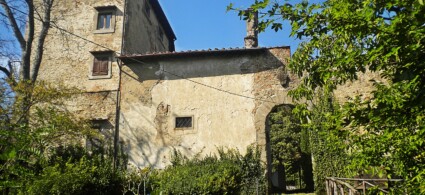
Agriturismo Il Ponticello
Vaiano - NUCLEO FABIO 6 VAIANO (PO) 59021
Book now
The municipality of Vaiano, established in 1949 when it gained independence from Prato, is situated in the Bisenzio valley north of the provincial capital, nestled on both sides of the river. To the right of the river, it occupies the western slope of the Calvana mountains, reaching the summit of Monte Maggiore.
The history of Vaiano is closely tied to Prato and to the origins and development of its Abbey. The Abbey of S. Salvatore at Vaiano was founded in 1073 by Cluniac Benedictine monks, passing to the Vallombrosans in 1090. The Abbey bears witness to considerable importance in medieval communication routes and served as the economic and cultural centre of the entire Bisenzio valley and beyond. Indeed, by 1086 the Abbey already held possessions in the Apennines in Bologna territory, assigned to a hospice on the public highway, in the parish of Pontecchio.
Marking the extreme northern boundary of the great Podesteria of Prato, Vaiano was furnished with gates and walls, and the Prato municipal republic maintained an armed garrison here in the 14th century. Economic development was further boosted by the exploitation of hydraulic power for mills, fulling mills and trip hammers, and from the early 1800s also for textile workshops.
Following the 1944 military events, as the Bisenzio Valley was a region severely damaged by Allied bombing, the settlement of Vaiano preserves no structures of particular note except the Romanesque Abbey (with its splendid 13th-century bell tower, Renaissance cloister and interesting museum) and Casa Bardazzi, a 17th- and 18th-century structure where Garibaldi was sheltered in 1849 as a fugitive after the fall of Rome.
After the Second World War, thanks to the work and commitment of all its citizens, the municipality successfully rebuilt its economic system and experienced considerable demographic growth. Within the territory, there are interesting historic villas and the “factory town” of La Briglia, built in the 1800s, unique in the Prato area.
In 1735, an imposing paper mill was built near an ancient mill, transformed in 1844 into a copper refinery (equipped with offices, shops and a chapel). Pollution from sulphurous fumes led to the foundry’s closure, transformed in 1882 by Beniamino Forti (promoter of the Trade School, later the Buzzi Institute in Prato) into a modern textile mill, which developed rapidly to become a fully integrated woollen mill, eventually employing 1,500 workers from distant areas.
For this reason, the Forti factory was equipped, by the early 1900s, with housing for workers and employees, a nursery, school, theatre, adult education college, consumer cooperative, power plant, public assistance services and other cultural, recreational and welfare facilities. Around the factory, a multifunctional urban fabric developed, creating an interesting example of a factory town, though unfortunately much degraded today, also as a result of damage suffered during the Second World War.
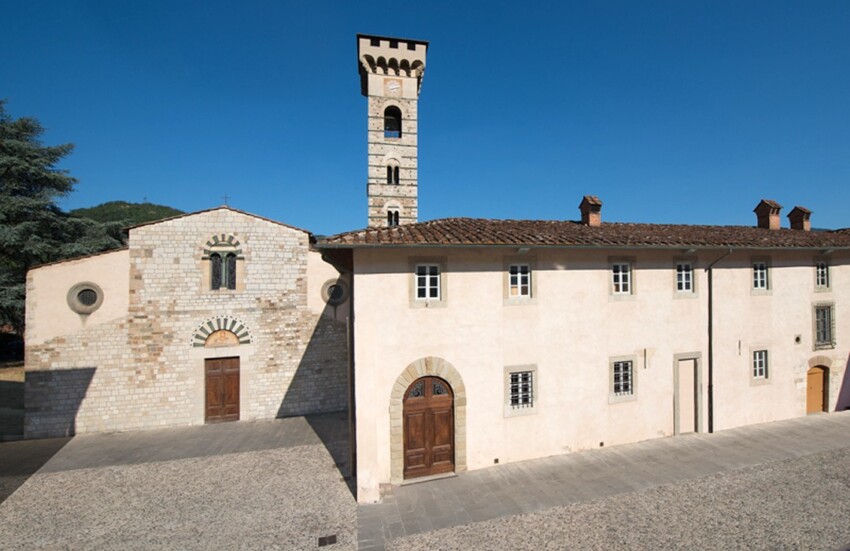
In the northern area of Vaiano‘s settlement stands the Abbey. The façade in alberese stone features a portal and bicoloured two-light windows, remade in the 1920s. From the much-altered rear section, the slender form of the tower bell tower emerges, 40 metres high, built around 1260, an important example of Prato Romanesque.
The alberese masonry, decorated with sparse courses of green serpentine, is pierced by two orders of two-light windows and the robust arches of the bell chamber, crowned by a projecting crenellated cornice from the late 14th century, equipped with defensive machicolations.
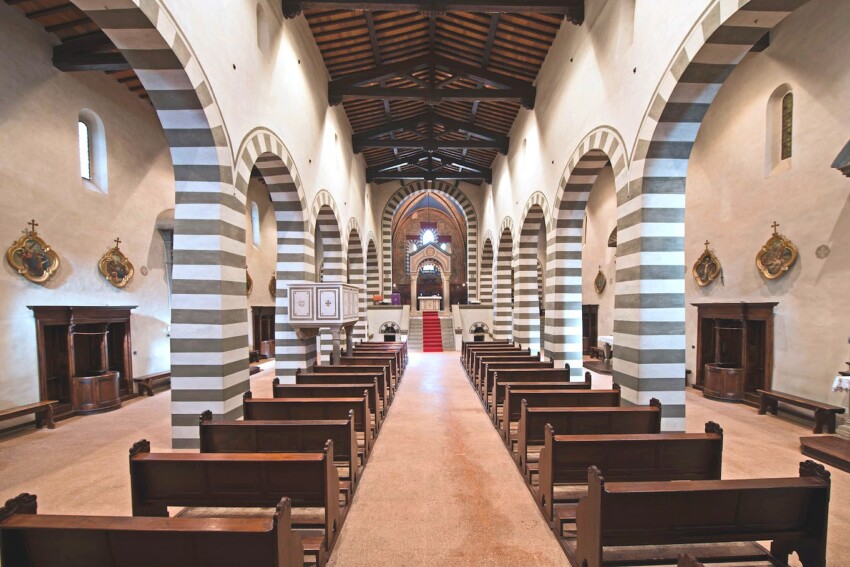
The church interior, much altered, retains references to Benedictine Romanesque in its spatial layout; the three naves, with plastered walls, are divided by round arches on irregular pillars; the presbytery is raised above a crypt (much transformed, it retains the central apse and a restored columned covering).
Two of the side altars, from the early 18th century, house notable paintings: on the left the Virgin with Child and St Francis, by Orazio Fidani (1606-1656) and opposite the Madonna with Child and Saints (1586) by Giovanni Maria Butteri, who also painted the altarpiece on the right wall of the presbytery, with the Crucifix (1580). Behind the high altar and neo-Romanesque tabernacle is preserved wooden choir stalls with walnut lectern (1695) and in the left chapel a wooden Crucifix from the early 18th century. A unified intervention of 1735-38 characterises the sacristy, with lavabo, imposing counter, benches and an altar with St Gertrude, a canvas by I. Hugfordo.
To the right of the church the ancient abbey develops, with a simple façade. A Gothic-Renaissance portal leads into rooms around the Renaissance cloister of Michelozzo taste, with double order, realised perhaps for Carlo de Medici in 1460-70. Robust Ionic columns with masonry shafts support five bays on each side. Some surrounding rooms preserve Renaissance vaults or 17th- and 18th-century decorations. In the southern wing houses the Abbey Museum, which collects furnishings and sacred items (from the 16th to the 20th century) and archaeological material from the Vaiano territory.
From the valley floor, various paths to Schignano converge on a plateau where the Mulinaccio villa stands, built at the end of the 15th century by the Sassetti, later passed from the Strozzi to the Vai family (1661-1941), who made it the centre of a vast estate. The serene eastern façade, overlooking a terraced garden, displays sober 16th-century forms; more imposing is the southern side (circa 1722), with dense openings, crowned by a central tower with volute connections.
Contemporary is the walled garden facing it, with an elegant nymphaeum. On the western side stands the oratory of S. Antonio abate, with a bright Baroque interior, decorated with faux marbles and stuccos; on the altar is a canvas with the Madonna, Child and Saints (A. Marini, 1845). The farmhouse preserves a kitchen with a 15th-century fireplace, whilst the manor section, updated in the 18th century, features rooms with 16th-century wooden ceilings and spacious barrel-vaulted cellars.
Higher up from the Mulinaccio, we find Schignano (460 m), originally inhabited mainly by woodcutters, which from the late 1800s became a summer holiday resort, thanks to its climate and abundance of vegetation and water; this led to considerable building development in the 1950s.
Near the oldest nucleus stands the church of S. Martino, which existed as early as the 12th century, restructured in 1760-70 in its current graceful Baroque guise, enriching the interiors with faux marbles and refined stuccos, also on altars and confessionals. At the back of the choir is a canvas with St Martin and the Poor, from the first half of the 18th century. Many new buildings line the road to Figline, up to the Collina pass, at the border with Prato, an important crossroads since ancient times.
Coming back down the SS 325 road past recent industrial developments, beyond the Bisenzio you reach Gabolana, where mills and fulling mills operated from the 13th century and—from 1793 to 1873—a copper foundry, later an iron works (above the settlement is Spicciano, with the 19th-century Orlandini villa).
Continuing, you reach San Gaudenzio (272 m), part of the medieval district of Prato, whose main nucleus—a fortified 13th-century farmhouse—was transformed into the Buonamici villa, completely restructured in 1580-90. The parish church was also adapted as a chapel. On a grassy square extend the two bodies of the villa, balanced by the emergence of two medieval towers (one with an unusual triangular plan) and enriched by porticoes. The villa, which hosted Galileo Galilei, preserves rooms decorated in the 18th century (music room and room of perspectives).
Continuing, you reach Sofignano, a scattered settlement arising from a Roman rural settlement, which reached its peak development in the Middle Ages, as witnessed by various buildings (among the most interesting is Casa Nera, a fortified 13th-century dwelling with an alberese tower). Notable transformations have given the parish church of Santi Vito and Modesto (documented from 1024) a modest appearance. The façade is preceded by a portico on Tuscan columns, restructured in the 1800s, which unifies the church, the confraternity of the Holy Cross and the sacristy; from the rear emerges the robust tower bell tower.
Inside, with a single nave, remain the high altar of 1798 (G. Valentini) and the lateral altars from the 18th century. Above the Parish Church is the Poggio (451 m), a medieval building transformed in the 16th century by the Buonamici, whilst descending towards Vaiano you reach Bibbiano on the right, once a fortified border zone with the Alberti fief, and from there the Calcinaia complex and the Bello villa (283 m), with medieval structure but pleasant 19th-century forms.
The Vaiano Abbey Museum was opened in 1993, as a continuation of the medieval archaeology exhibition held the year before as part of the Laurenzian Itineraries. On 29 May 1999, it reopened in a completely renewed form after careful restoration work. In the near future, the museum will be completed with a large archaeological section in which finds from excavations conducted during the restoration (still ongoing) of the architectural complex will also be displayed.
The museum currently consists of five rooms (and two smaller rooms) that were once part of the monastic refectory and the abbot’s apartment. The didactic arrangement guides visitors to understand the daily life of the abbey monks and the religious, social and economic function of the monastery in the territory: the choir and communal prayer of the monks, the refectory and monastic eating habits, the chapter house and the economic organisation of landed and manufacturing properties, the abbot’s apartment, the hospital and assistance to travellers are the themes that emerge from the exhibition path.
An aspect emphasised by the arrangement is also the illustration of popular religious sentiment and the forms in which it was expressed in the past. Following the necessary restoration work, plans are underway for a sixth room that will display some furnishings and paintings from other churches in the valley, whose artworks, guarded for centuries, are subjected to continuous theft.
The museum itinerary is organised in several thematic rooms:
An integral part of the museum visit is the visit to the monastic spaces of the architectural complex which, after a period of neglect and serious deterioration, is returning to visibility in its original form.
The restoration work, financed by various public and private bodies (including the Prato Province and Vaiano Municipality), is directed by a diocesan appointee. The Abbey of San Salvatore, which arose probably between the 9th and 10th centuries on the remains of a previous settlement, presents interesting medieval structures (the Romanesque church and the 13th-century bell tower), Renaissance period (the cloister resulting from Medici patronage) and Baroque.
On the basis of an agreement stipulated between the Municipality of Vaiano, the Diocese of Prato, the Parish of Vaiano and the Association Pro Vaiano Abbey Museum, the management and public opening of the museum are ensured by volunteers from the Association Pro Vaiano Abbey Museum.
The museum has equipped itself with an educational laboratory, within the C.D.S.E. of the Bisenzio Valley, which operates on the basis of an annual work plan to carry forward its cultural promotion work and collaboration with the school world.
The museum’s educational and cultural services include:
a) Regular activity: the museum permanently provides some cultural services for young people and adults, such as guided tours and teaching materials suited to different age and education levels.
b) Annual activity: a work plan enables the development of specific themes linked to the history and religious traditions of the territory in a non-parochial perspective.
This annual plan includes moments of in-depth exploration of these themes through exhibitions, conferences and publications.
From San Gaudenzio, you can reach Savignano (329 m), a medieval village along the Rio La Nosa stream, built on the site of a Roman rural settlement. At the entrance to the village stands Villa Buonamici, displaying the restrained architecture of the 17th and 18th centuries, though retaining medieval remains, as does the nearby Casa Bartolini, which has a 19th-century appearance. This is where Lorenzo Bartolini (1777-1850) was born, one of Italy’s greatest sculptors of the 1800s, whom some have called the Tuscan Phidias.
The medieval Church of Saints Andrea and Donato, with alberese stone structures and a 17th-18th-century choir, preserves a small Madonna del Buonconsiglio above the left-hand side altar, complete with a painted baldachin by G. Fabbroni (1711-1783).
Along the road to Isola stands a complex featuring an attractive medieval alberese stone tower: the houses at Il Poggio. Continuing along the main road, you reach La Briglia (134 m), where a barrage on the Bisenzio river, dating from the 13th century, supplied water to several mills. The settlement grew around the interesting complex of the former Forti factory, a unique example within the Prato area of a late 19th-century factory town.
The internal road, flanked by warehouses and offices (with classically-styled fronts), leads to the open space where the church and the side of the 18th-century Cartaia (paper mill) stand, later converted in the 19th century and adapted for cloth dyeing, then wool manufacturing. The symmetrical façade is topped with a small tower housing a clock, while inside, several rooms (basements and ground floors) retain ribbed vaults from the 17th and 18th centuries.
The Church of San Miniato, built in 1863, is an early example of neo-gothic architecture, with its lofty cuspidate façade, sides and polygonal apse pierced by ogival openings. The church has a Latin cross plan and is covered by slender ribbed vaults; it contains works by Mihu Vulcanescu (1970-80) and a canvas depicting the Holy Family from the late 17th century. Since 1950, the church has taken the title and parish from the ancient San Miniato a Popigliano (12th century), situated on the slopes of Poggio di Altociglio.
On small hills to the east of La Briglia, several scattered settlements were once ancient “popoli” (communities) of the Prato district: L’Isola, Maglio (with its former chapel of San Michele, now a residence, and other medieval structures) and Meretto, located further south (on a plateau already frequented during the Neolithic period). Here stands Villa Hall, built by the Strozzi family in the 16th century – as evidenced by the western façade with two tiers of loggias – and transformed in the second half of the 19th century by the Hall family, who enriched the other façades with classically-styled porticoed elements, terraces and projecting wings.
The Municipality of Vaiano comprises a series of medieval settlements along an ancient mid-slope path running beside the Calvana. San Leonardo in Collina (350 m), overlooking the Rio Buti valley, is now largely a collection of ruins dating from the 13th-14th centuries, with a partially collapsed Romanesque chapel. From here, a path reconnects with the road that climbs from Gamberame and leads to Faltugnano (307 m), situated in a fertile basin, with scattered houses of medieval origin and recent villas.
Before the church, a small lane to the right leads up to Villa Ricci (displaying 16th-17th-century features, with a dovecote tower) and Villa Organi, dating from the 13th century, with alberese stone walls and a truncated tower softened by a small loggia. The Church of San Giusto and San Clemente, with medieval walls on its façade and bell tower, preserves a 19th-century copy of The Ecstasy of Saint Catherine by Sodoma; the presbytery, dating from the 15th century, has an apse that was remade in 1912.
The road maintains its elevation and reaches Fabio (293 m), where a court and village existed in the 11th century; the present buildings, of medieval origin, were restructured in the 17th and 18th centuries. The Church of San Martino, rebuilt in the 12th century (though documented from 1086), preserves a Madonna of the Rosary on the right-hand side altar – a naive canvas from the late 17th century – and at the back of the choir a panel depicting the Assumption (c.1550) by Paolo degli Organi, a native of Prato.
Near the road to Savignano remain several complexes of medieval origin (La Villa, Casa Ferracciani, Villa Cipriani); notable towards the valley is the Torre, with a façade marked by two elongated blind arches. Even better preserved, owing to progressive depopulation, are the stone buildings of Parmigno (415 m), north of Fabio.
The two nuclei of the small village, situated on a natural terrace rich in olive trees, are now uninhabited: the small chapel of Santo Stefano, which served as the parish church until the 1700s, retains late 12th-century features and inside displays a fresco with the Madonna, the Christ Child and Saints by Antonio di Miniato (1438). The adjacent Casa Organi displays notable 13th-century structures, as does the Casacce complex further uphill.
What's the weather at Vaiano? Below are the temperatures and the weather forecast at Vaiano for the next few days.
To see all the facilities and book accommodation in Vaiano use the form below, entering the dates of your stay.
 Hotel
Hotel  Budget accommodations
  Apartments
  Family Hotel
  Luxury Hotel
  Resorts