Agriturismo Corboli
Vernio - Via delle Soda 62
Book now
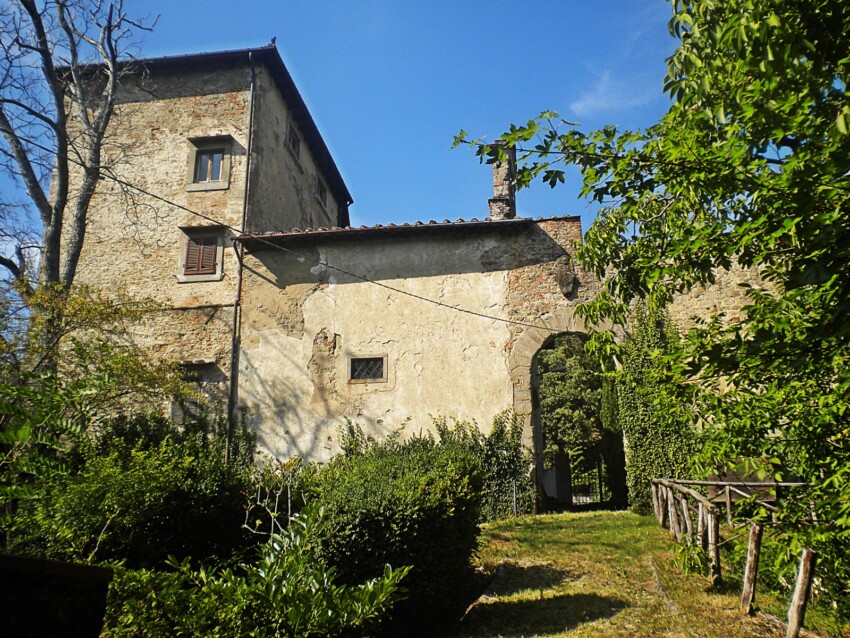
Throughout the Middle Ages, one of the principal routes connecting the Prato area to the Po Valley region climbed the narrow Bisenzio valley to the Montepiano pass, following a natural path traced by the river and already used in pre-Roman and Roman times.
Following the Lombard conquest, the upper Bisenzio and Fiumenta valleys were among the territories assigned by Emperor Berengar to the Cadolingi in 915. In the early twelfth century Vernio and Mangona passed by inheritance from the Cadolingi family to the Alberti of Prato, who significantly expanded their possessions and assumed the title of Counts of Vernio. In 1332 the territory was acquired by the Bardi, who obtained the Imperial Vicariate in 1355.
The area is also linked to the foundation and development of the Abbey of S. Maria at Montepiano, which, situated on the border with Bologna, was considered a strategically important economic, political and commercial point. The Fief of the Bardi (who in the early 1600s held meetings of their Camerata Musicale here) survived as the last remnant of the Prato feudal power until 1797, when it was annexed to the Cisalpine Republic. After 1815, with the post-Napoleonic reorganisation, it was finally united with the Grand Duchy of Tuscany.
For a time it became a podesteria (with its seat at Mercatale) and was then annexed to the royal vicariate of Prato, which administered justice, liaison offices, policing and so forth. The expansion of the Prato textile industry at the end of the 1800s and later the excavation of the great tunnel on the Prato-Bologna railway line brought about a marked economic recovery that has continued to strengthen to the present day.
Since the 1800s, the Montepiano holiday resort on the Apennine ridge has been well known, embellished with small lakes and walking paths. But Vernio also offers attractions to visitors, with the seventeenth-century San Quirico complex and recent museums.
San Quirico (278 m), which developed at the foot of the Rocca, became a residence of the Bardi counts from the mid-1600s and after 1815 was the seat of the new town council. Beyond the Fiumenta rises the monumental complex, built in 1706-30 at the behest of Ridolfo de’ Bardi, consisting of the Casone, a comital residence and later municipal palace, connected via the Gallery to the Oratory of San Niccolò (built by 1706 by G.B. Bettini), with an articulated double-flight staircase at the centre of the façade, framed by paired pilasters and topped by a pediment.
The austere façade of the Casone, with numerous openings on three storeys, bears above the central terrace an elaborate Bardi coat of arms. In the Council Chamber, with a fine coffered ceiling, among various paintings is an eighteenth-century copy of the Assumption by A. Gherardini preserved in San Niccolò in Prato.
The adjacent gallery housed the Opera Pia of San Niccolò and consists of two long superimposed halls: the lower one barrel-vaulted, the other with a wooden coffered ceiling and an elegant staircase descending into the Oratory vestibule. Here is an altar with a fine eighteenth-century canvas close in style to Conti and two remarkable holy-water basins from the early 1700s, in bronze (possibly by M. Soldani), topped by oval bas-reliefs with a bust of Ridolfo de’ Bardi and an allegory of Charity (with cherubs distilling an essence from roses).
The spacious and luminous oratory hall, of classical and severe forms, has plastered walls with wide corner bands connected to continuous entablature and a wooden ceiling with octagonal panels, redecorated in the nineteenth century. In the choir three large windows illuminate the imposing marble altar (G.B. Bettini, possibly designed by M. Soldani), topped by a concave pediment, connected to the wall with an elegant interplay of curves.
The eighteenth-century altarpiece with the Madonna, Child and San Niccolò is the work of a painter with classical leanings, close to Puglieschi; other more modest canvases ornament the Oratory, which preserves the original furnishings and the choir gallery with organ of 1699.
A vast open space to the left of the Casone is closed above by the side of the church of San Leonardo and San Quirico, with its sturdy campanile tower. Dating to the thirteenth century but completely transformed from the 1700s to 1900s, the church preserves in the left chapel a small della Robbia piece from the workshop of Benedetto Buglioni (Madonna with Child), while in the choir is an original canvas by Gregorio Pagani with the Madonna of the Rosary (1597). Beside the presbytery, beyond the large wooden Crucifix, is a notable canvas with the Transit of San Giuseppe close in style to Sagrestani, from the former oratory of San Giuseppe, which overlooks the church forecourt.
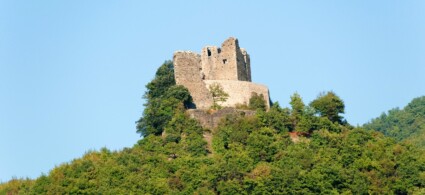
From the base of the steep street typical of the village, a path climbs to the Castle (350 m) or Rocca of Vernio (also accessible from the State road with a turning just before Sasseta), touching the southern side of the fourteenth-century walls, much altered, with a late fifteenth-century portal. Of the true rocca of the Cadolingi, later the Alberti (the Cassero with the Reccaccino tower), little remains in the upper area, though the Comital Palace and the chapel of S. Agata (built in 1556 but restructured in 1706) and the surrounding houses survive.
The Palace, built in the Renaissance period against the walls, has a broad plastered façade with nine arched windows on the first floor. The basement retains ancient structures (possibly dungeons), while on the ground floor are fifteenth-sixteenth-century kitchens. The staircase (1752) leads to the vast hall, with coffered ceiling and walls painted with views and architectural features (circa 1830). During the period of Giovanni dei Bardi (1579-92) the palace hosted meetings of the “Camerata dei Bardi”, whose experiences with “recitar cantando” (singing while acting) led to the birth of opera.
At Terrigoli, a road branches off left from the state road and climbs to a modern building (formerly an elementary school), where in recent years the Documentation Centre for the History and Ethnography of the Bisenzio Valley has set up an interesting Museum-Laboratory on the theme “From Mill to Factory through Rural Civilisation”.
The museum explores the traditional working activities of the Bisenzio valley, based on a selection of significant objects (from the nineteenth century and first half of the twentieth century) accompanied by easy-to-understand graphic diagrams, with educational laboratory and possibilities for deeper exploration through computing and audiovisual materials.
Descending towards the valley, before the cemetery, a road climbs to Poggiole (402 m), in a panoramic position, with the small Sanctuary of San Antonio Maria Pucci (1819-1892). The beloved “curatino”, born at Poggiole and canonised in 1962. The sanctuary, designed by architects Preti and Ceramico (1964-65), has a reinforced concrete structure faced in sandstone, with a spare but suggestive interior.
Continuing along the State road, having passed the entrance to the great Apennine railway tunnel (18,507 metres long – the second longest in Europe – completed in 1920-29), you reach Mercatale (269 m), the largest settlement in the Municipality of Vernio. Its favourable position at the confluence of the Fiumenta and Bisenzio rivers made it an important crossroads from ancient times, a place for fairs and markets since the Middle Ages; having become the seat of the podesteria in the 1800s, Mercatale experienced considerable industrial and commercial development from the end of that century. The former Meucci charcoal works will house the Bisenzio Park-Museum, a multipurpose facility with an exhibition route on wool processing and the transition from mill to factory.
The modern church of S. Antonio da Padova (A. Giuntoli, 1960-63), with an imposing relief of the Saviour on the façade, preserves inside a venerated wooden Crucifix from the late 1500s. Shortly beyond stood the Hospital of Santa Maria, desired by Girolamo dei Bardi in 1758, which closed in 1880 and was completely transformed.
From Mercatale you can reach Cavarzano (650 m), traditionally linked to forestry and pastoral activities. The village buildings are dominated by the large Neo-Romanesque church of San Pietro (R. Franci, 1928-30), in sandstone and brick. North of Cavarzano, along an ancient scenic ridge path was the summer pasture for livestock (Alpe di Cavarzano), between the heights of Poggio di Petto (1121 m) and Scoperta (1278 m), up to the Passo dell’Alpe di Cavarzano (1008 m).
Just south of Mercatale the old road to Camaldoli climbs to Sant’Ippolito (415 m), a summer resort locality in fertile territory, where chestnuts sit alongside olives, rich in ancient traditions (such as the “Carnevalino”, organised by the “Compagnia dell’Aringa”, for the Saturday following Ash Wednesday, with a masked procession). The ancient settlement grew up around the parish church of Saints Hippolytus and Cassian, documented from 998, which was rebuilt in the twelfth century and repeatedly restructured.
The side facing the main square preserves medieval sandstone masonry; the seventeenth-century choir connects to the robust campanile tower, with twelfth-century foundation area. The façade is preceded by a portico on pillars incorporating fifth-sixteenth-century columns. Inside, eighteenth-century work saw the replacement of the doorway, confessionals, baptismal font (1704), the elegant high altar (1706) and some side altars; the first on the right has a pleasant panel with the Deposition of Christ (1579) by Giovanni Bozzelli, while the second, imposing left altar (of 1632) hosts a contemporary Madonna of the Rosary.
In the sacristy is a lively panel with the Adoration of the Shepherds (1503) by Girolamo Ristori of Prato. On the right side of the square the eighteenth-century Oratory of the Confraternity of the Name of Jesus now houses the Tetrarca Library, founded in 1916 by Ferdinando Ricci, who spent his summers at nearby Villa Gualtieri, which has a seven-eighteenth-century appearance.
At Terricoli is located an interesting Museum-Laboratory that explores the traditional activities of the Val di Bisenzio, illustrating them with diagrams and significant objects from the nineteenth and early twentieth centuries.
Slightly further on, the village of Le Confina marks the end of the county. North of San Quirico we find Sasseta (439 m), since the Middle Ages a land of shepherds living by transhumance, which developed from the end of the 1800s. in the modern church of San Michele (N. De Majer, 1954-58) is preserved a fine panel with the Annunciation, Saints and donors (circa 1585), an early work by Empoli. Just below is the Oratory of Santa Maria della Neve, which arose in 1556, with a curious campanile.
Continuing along the State road, on the right is Luciana (529 m), with characteristic buildings along a steep street and, below, the church of San Martino, restructured in the 1800s.
From the State road, after a wooded area you reach Montepiano (700 m), on a plateau crossed by the Setta river, between the high ridges of woodland and pasture of Poggio di Petto, Scoperta, Monte Casciaio and Tronale. Remains dating to the Etruscan period confirm that the convenient Apennine pass at Montepiano was used in remote times, but the earliest certain settlements are linked to the Vallombrosan abbey.
Notable development along the State road dates instead to the end of the 1800s, when Montepiano became a fashionable health resort. Along the abbey road many villas were built (Torre Alpina, La Delfiniana, Villa Sperling) and in the 1950s an artificial lake with holiday village. Slightly further on, in a tree-lined open space is the Sun, a sculpture by Bruno Saetti (1902-1984).
The road reaches the Abbey of Santa Maria, founded around 1095 near the hermitage of Blessed Peter and enlarged by 1138. The Vallombrosan monastery, which possessed vast territories extending to the Mugello and managed a hospital, was abandoned by the monks in the sixteenth century. Restored by the Bardi, it suffered serious damage from the earthquake of 1843; since 1940 the monastery (excluding the church) has been owned by the Small Mission for the Deaf and Dumb.
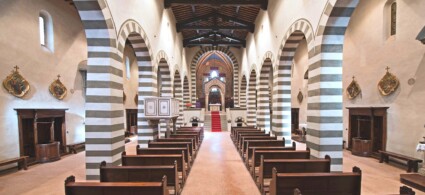
The church preserves the twelfth-century sandstone structure; the façade has an original crowning of small arches on columns and a notable portal adorned with archaising reliefs on the architrave and in the lunette above, occupied by a hieratic figure of “orante” (in prayer). Inside the tall, suggestive nave preserves on the right an important group of frescoes from 1260-80: three panels combining Lombard and Tuscan influences depicting the Nativity, the Annunciation and the Archangel Michael; adjacent are the imposing San Cristoforo, a work of the most refined Byzantine Tuscan tradition and a rigorous Madonna with Child, based on Byzantine prototypes.
Contemporary, on the opposite wall, are some fragments with Stories of Blessed Peter (one reproposed in a bas-relief of the 1700s). Other frescoes between the fourteenth and early fifteenth centuries are on the walls and on the counter-façade (attributed to Lorenzo di Niccolò, pseudo Ambrogio di Valdese, Pietro di Miniato). Below the altar is a cast of the relief by Giroldo da Como (1262), displayed in the Opera Museum of the Cathedral in Prato.
On the State road stands the parish church of Santa Maria, faced in sandstone (M. Bega, 1939-42), which was restored after the war with the addition of a portico and tower campanile; in the apse is a large mosaic with the Coronation of the Virgin (L. Tommasi, 1959).
Proceeding northwards you pass through the village, with inns and shops (the Institute of Santa Teresa, on the right, has in its chapel a fresco Virgo Cameli by Bruno Saetti); in the small square stands Casa Bartolini, an ancient customs house where sculptor Lorenzo Bartolini (1777-1850) lived. Beyond Montepiano, La Storaia (749 m) is a hamlet originally inhabited by shepherds, near the regional border.
What's the weather at Vernio? Below are the temperatures and the weather forecast at Vernio for the next few days.
To see all the facilities and book accommodation in Vernio use the form below, entering the dates of your stay.
 Hotel
Hotel  Budget accommodations
  Apartments
  Family Hotel
  Luxury Hotel
  Resorts