A magnificent shell-shaped piazza, a colour that speaks of the earth, one of Italy's most enduring traditions: this is Siena, magical and deeply moving.
A medieval village the size of a city: that’s what makes Siena an unmissable destination on any trip to Tuscany. How has it managed to preserve the splendour of its golden age, which roughly spanned from the thirteenth to the fourteenth century?
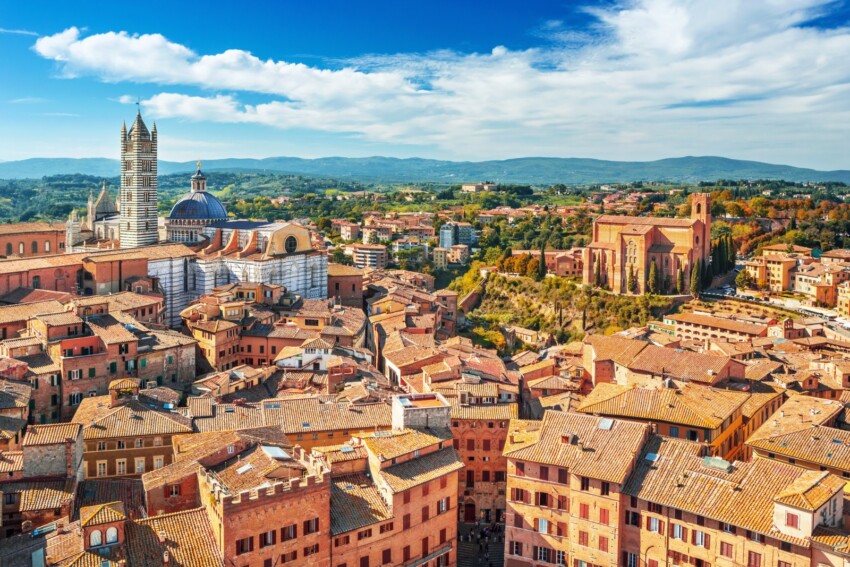
The fact that Siena escaped industrial development and remains sparsely populated has certainly helped, but the real credit goes to an architecture that adapts to the landscape, following its curves and slopes.
No small feat, that. Siena’s historic centre is a true gem, so much so that it has been designated a Unesco World Heritage Site. It is enclosed by a medieval wall, still perfectly preserved, that follows the contour of the three hills on which the city stands. These three hills are connected by three roads that intersect in a Y-shape, forming a vast amphitheatre.
And it is at this precise point that Siena’s magic unfolds, when Piazza del Campo comes into view: the magnificent, unmistakable and inimitable square where the famous Palio is held every year.
Despite being an iconic image, one that has been seen countless times on television, in magazines and travel blogs, the Campo never fails to leave visitors speechless with wonder when they gaze upon it for the first time. It opens up almost unexpectedly, and your gaze seems to expand naturally to take in the immense beauty that unfolds before you.
They say you should sit on the ground at Piazza del Campo to admire the sky, but when there’s so much beauty at ground level, why look up?
There’s so much to see in Siena: within the 7 km city walls lies an astonishing array of treasures: tower houses, elegant palaces, historic churches, fountains and even green spaces. And it’s only a short distance to other Tuscan jewels such as the Chianti region, Val d’Elsa and the Crete Senesi.
Terra di Siena is the name of a colour: the colour that will paint your emotions during a weekend in one of Tuscany’s most beautiful towns.
Things to do in Siena
The main attractions in Siena are all concentrated in Piazza del Campo: for many visitors, this square is where their Siena experience begins and ends. However, do try to spend more time here, as there are plenty of other interesting things to discover, both in the city centre and in the immediate surroundings.
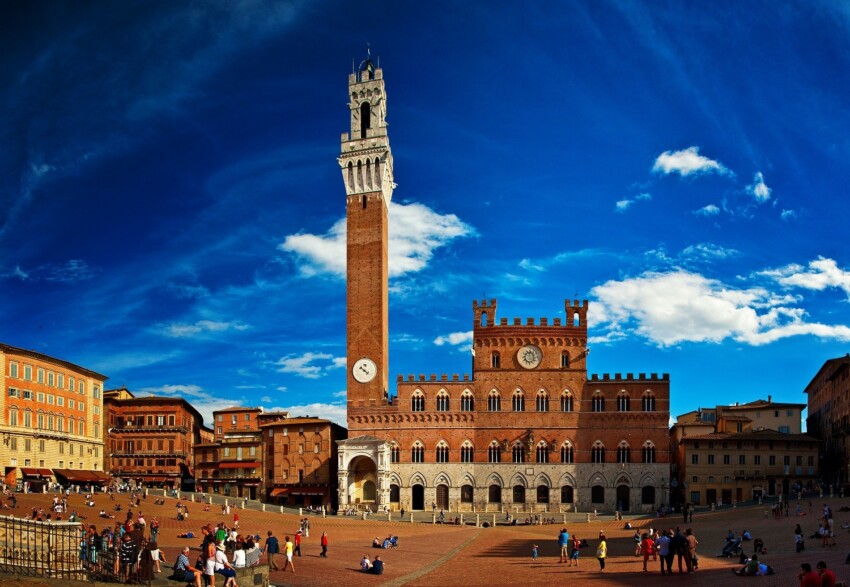
Siena’s top attraction is Piazza del Campo (also simply called “il Campo“): the beating heart of the historic centre and city life, it’s a sort of funnel where three main city streets converge. It’s rightly considered one of the world’s most beautiful squares, thanks to its unique layout and the harmony of all its architectural elements.
At first glance, the entire square resembles an enormous shell divided into nine sections with a herringbone brick pattern. This number is no coincidence – it’s a deliberate homage to the Nine, the council of magistrates who governed Siena from 1287 to 1355.
The square’s beauty is also no accident but the result of careful planning. In 1297, the city government decided that all new buildings facing the square should be constructed according to precise aesthetic criteria – twin and triple arched windows instead of balconies, for instance – to harmonise with those already standing.
The name Campo recalls the square’s past as a place of fairs and markets. Between the 13th and 14th centuries, the square took on a new function and more elegant appearance; new buildings were gradually added, and in the 15th century it was further beautified with a decorative fountain (the Fonte Gaia by Jacopo della Quercia), now replaced by a replica.
The square is overlooked by some of the most beautiful historic buildings: among these, the most famous are the Palazzo Pubblico, Torre del Mangia, Cappella di Piazza and Palazzo Sansedoni.
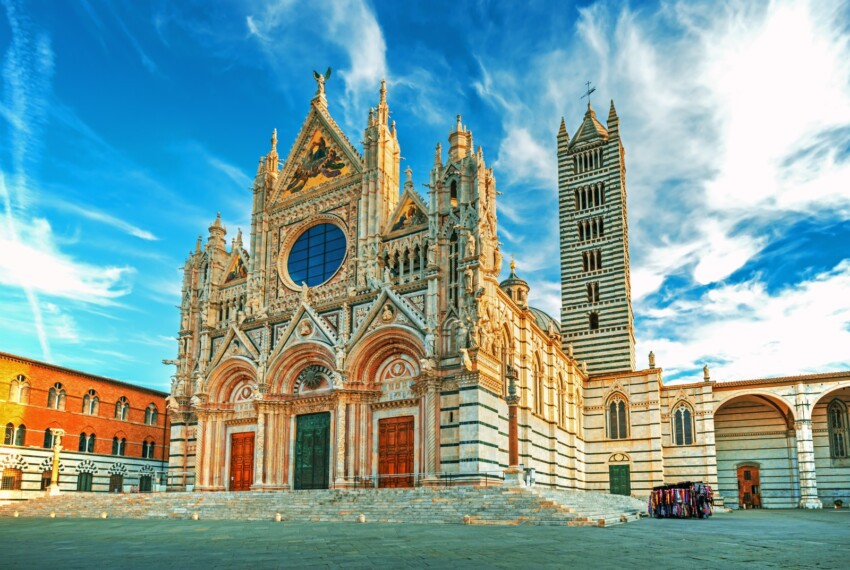
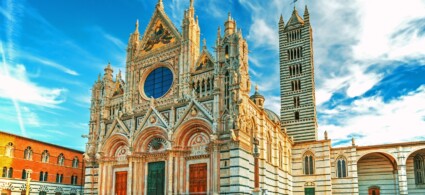
Siena’s second most important square, also heavily visited but perhaps less famous internationally than Campo, is Piazza del Duomo. Overlooking it stands the city’s most iconic religious building: the Cattedrale Metropolitana di Santa Maria Assunta, better known as the Siena Cathedral.
This is one of Italy’s finest examples of Romanesque-Gothic architecture, with an exterior façade featuring striking black and white striping and elaborate decorations. The cathedral’s magnificent external appearance merely hints at the treasures awaiting you inside.
Siena Cathedral houses priceless artistic treasures, including four statues sculpted by Michelangelo in the Cappella Piccolomini. The church’s floor is itself a work of art, decorated with stories of saints’ lives and esoteric symbols.
Take all the time you need to explore the Cathedral properly and visit all its spaces. Don’t leave the church without seeing the Libreria Piccolomini, a section created in the late 16th century along the left aisle.
It was built to house Pope Pius II’s exceptionally rich book collection, though you’ll find no volumes there today. Instead, the entire library is covered with magnificent frescoes.
An interesting fact: the Cathedral’s bell tower stands 77 metres tall, 10 metres less than the Torre del Mangia. Due to an optical effect created by the slope of the piazzas on which the two towers stand, they appear to be the same height.
Among the splendid noble palaces overlooking Piazza del Campo stands Palazzo Pubblico, the tallest building and the one most immediately associated with the square’s image. Seat of civic power since its construction through to the present day, it’s both powerful and elegant, always admired for the harmony of its elements.
Built between the 13th and 14th centuries during the city’s golden age, at the behest of the Government of Nine of the Republic of Siena, it originally consisted only of stone arches. It was later enlarged with upper storeys in red brick and crenellations added to the top.
Museo Civico
Some of the interior rooms of Palazzo Pubblico are open to visitors and house the Siena Civic Museum, an unmissable attraction for art enthusiasts.
The museum’s highlights include the Allegory of Good Government cycle by Ambrogio Lorenzetti, the Cycle of Famous Men by Taddeo di Bartolo, and the frescoes Maestà and Guidoriccio da Fogliano by Simone Martini.
The tower soaring next to the impressive Palazzo Pubblico is the Torre del Mangia: built between 1338 and 1348, it’s one of Italy’s tallest medieval civic towers. In the second half of the 17th century, a bell known by locals as Campanone or Sunto was added.
From its 87-metre height (over 100 metres if you include the lightning rod), you’ll enjoy magnificent views across Siena and the surrounding countryside. Though the reward is worth it – you’ll need to climb hundreds of steep steps.
Only the upper section is white travertine; the rest of the tower is built in red brick to harmonise with the surrounding buildings, most notably the Palazzo Pubblico to which it’s directly attached.
An interesting note: the tower’s name is short for the nickname of the first bell-ringer, Giovanni di Balduccio, a notorious spendthrift whom his fellow citizens called Mangiaguadagni (literally “earnings-eater”), later shortened to Mangia.
Cappella di Piazza
At the base of the Torre del Mangia stands a marble tabernacle known as the Cappella di Piazza. What’s unique about it is that it’s the only building protruding beyond the square’s perimeter.
Built in 1352 as an offering to the Virgin Mary following the end of the Black Plague epidemic, construction work continued for decades.
If Palazzo Pubblico represents the finest in civic architecture in Siena, Palazzo Sansedoni is the most representative example of 14th-century private architecture.
Built by a wealthy and influential Sienese family who later acquired adjoining buildings and had them aligned, the result is a single palace with a semicircular façade following the square’s curve – the same palace we see today. Originally topped with a tall tower, this was demolished by decision of the Tribunal of Biccherna; the tower base was replaced with a panoramic terrace.
The palace’s interior, richly decorated with frescoes and elegant ornamentation, was recently painstakingly restored to its former glory; a private chapel, the Cappella del Beato Ambrogio Sansedoni, still stands and hosts an annual mass in the blessed man’s memory.
The palace now houses the Fondazione Monte dei Paschi di Siena. Guided tours are available by booking only, and only for groups of at least 15 people.
Next to the Cathedral stands the Museo dell’Opera della Metropolitana, also called the Siena Cathedral Works Museum. The building was designed to serve as the right nave of the cathedral according to an expansion plan that was ultimately abandoned.
A private museum established in 1869, it houses an invaluable collection of Italian medieval and Renaissance art.
You’ll marvel at masterpieces by Duccio di Buoninsegna, Jacopo della Quercia, Benvenuto di Giovanni and other artists who shaped the course of Italian art.
A visit to Siena Cathedral isn’t complete without seeing the Baptistery of San Giovanni, a separate building located in the piazza behind the main church. Access is via a grand staircase.
The interior is equally spectacular: you’ll find artworks by Donatello, Jacopo della Quercia and Lorenzo di Pietro.
For dedicated art lovers, particularly those passionate about painting, we strongly recommend the Pinacoteca Nazionale, Siena’s most important state museum. Spread across three floors, it’s a fascinating journey through Sienese painting from the 13th to the 18th century.
Among the exhibited artists are Ambrogio Lorenzetti, Duccio di Buoninsegna, Simone Martini, Domenico Beccafumi, “Il Sodoma” Giovanni Antonio Bazzi and Francesco Vanni.
Considerable space is devoted to the Spanocchi Piccolomini Collection, which includes paintings by Italian, Flemish and German artists from the 15th and 16th centuries.
Santa Maria della Scala
10Complesso museale Santa Maria della Scala, Piazza del Duomo, 1, 53100 Siena SI, Italy
Another building that immediately catches the eye within Siena’s walls is Santa Maria della Scala, an ancient hospital founded in the early 9th century.
It remained a place of healing until the 1990s, then transformed into a remarkable museum complex, notable both for its architectural value and for the collections and temporary exhibitions housed within.
The visitor route winds through the former hospital’s rooms, corridors and chapels. Among the most important collections are the Archaeological Museum, the Children’s Art Museum and a collection of historic contrada banners.
Not to be confused with Palazzo Sansedoni in Campo, Palazzo Salimbeni is the historic seat of Monte dei Paschi di Siena, active since the 16th century. Before that, it was the noble residence of a wealthy Sienese family.
You can visit this magnificent palace’s interior on just two occasions: the day of the July Palio and the day before the August Palio. On other days of the year, you can see an interior courtyard and some ground-floor rooms.
An architectural marvel just a stone’s throw from Piazza del Campo, often overlooked by visitors, is Palazzo Chigi-Saracini. The original nucleus dates to the 13th century and was originally just a tower-house; in the 16th century and particularly in the 18th century, the palace was enlarged and embellished with decorations, artworks and fine details.
Today it’s home to the prestigious Accademia Musicale Chigiana; it’s open to the public during special events and guided tours.
An attraction you might not expect to find in Siena is the Antarctica Museum, a permanent exhibition exploring the history of exploration of the world’s coldest continent through historical documents, films, interactive displays, rock and meteorite samples, and objects used during scientific expeditions.
Medieval fountains
Walking through Siena’s historic centre or along the city walls, you’ll often come across a medieval fountain. Siena’s network of medieval fountains is an engineering marvel: 25 kilometres of galleries channel water from natural underground seepage in the countryside and transport it into the city.
Some of these fountains have been covered over and are known as “bottini” in sections with barrel vaults; they can be visited by booking in advance or during special events.
Biccherna Tablets
In medieval Siena, Biccherna was the city’s oldest and most important financial magistracy; the tablets were the covers of the account registers used by Biccherna.
The earliest ones were simple depictions of Biccherna treasurers at work or the coats of arms of officials; over time, these tablets were commissioned from increasingly refined artists and depicted ever more complex subjects. They evolved from simple covers into genuine works of art.
A permanent exhibition of 105 Biccherna tablets created from the mid-13th century to the early 18th century is displayed at the Siena State Archives.
A completely different world awaits visitors to Villa Brandi, an old manor house just outside the city.
You won’t find the splendour of the noble palaces in the city centre: it’s a rustic villa surrounded by 13 hectares of vineyards and olive groves that will introduce you to rural Tuscan life as it once was and tell many moving human stories.
Guided tours are free but available by booking only.
The Basilica of San Bernardino of the Observance is a church perched on top of Poggio della Capriola, a small hill just outside the walls. Once a hermitage for the saint, it remains today an oasis of peace and quiet, inhabited only by a small community of Franciscan monks.
A visit is recommended for the splendid views from the panoramic terrace.
Map
In the following map you can see the location of the main places of interest mentioned in this article.
Siena Opa Si Pass
The Siena Opa Si Pass is a combined ticket, valid for 3 days, allowing full access to all museum facilities within the Cathedral complex. The pass includes access to:
Siena is far from being the only Italian city to hold a palio, but it is the only one that has managed to turn it into an internationally renowned event attracting thousands of spectators year after year.
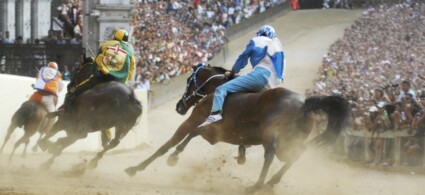
The Palio di Siena has taken place uninterrupted and according to the same rules since 1633 (with very few exceptions due to world wars and tragic events of similar magnitude). This is its magic: it is not a contrived event created to attract tourists, but a living tradition that captivates residents.
The Palio takes place twice a year, on 2 July and 16 August; in the days leading up to it, preparations are in full swing and there is already a festive atmosphere in the air.
Witnessing the horse race, the event that represents the climactic moment of the Palio, is a unique experience. However, it is worth remembering that this is an event with thousands of spectators taking place in a relatively small space. It is therefore important to research the event’s logistics carefully and take some precautions against the heat and crowds.
Please note: current safety measures prohibit children under 12 years of age from watching the Palio from the piazza.
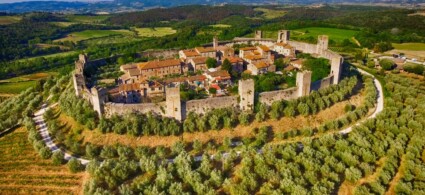
There are three main options for those wishing to stay in Siena: hotels and bed & breakfasts in the centre, accommodation outside the walls, farm stays and rural cottages in the Sienese countryside.
The majority of visitors prefer to stay in the centre to fully experience the magic of this unique city. The advantages of this option are the wide choice of hotels in all price ranges, having all the main tourist attractions within reach, and a large selection of places to eat and drink.
However, be aware: this option can be inconvenient for those travelling by car given the particular layout of medieval cities, with narrow alleys, limited parking and extensive restricted traffic zones.
Booking a hotel, apartment or guesthouse just outside the walls is an excellent compromise between convenience and proximity to points of interest for tourists, and it makes life considerably easier for those who need to park. Hotel prices are also generally lower in this area compared to the centre.
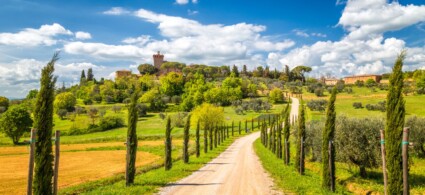
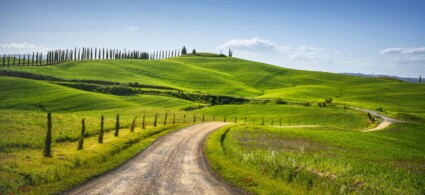
Staying in a hotel or farm stay in the surroundings of Siena is the recommended solution for those wanting to combine cultural visits with relaxation in the countryside and for those seeking a romantic getaway. A farm stay is not always synonymous with basic accommodation; some are actually luxury hotels with spas.
This third option is not recommended for those travelling by public transport as bus connections from the countryside to the city are scarce or non-existent.
We offer best rates If you find it cheaper we refund the price difference.
Free cancellation Most properties allow cancellation without penalty.
We're available 24 hours a day For any problem call Booking.com.
Want to reach Siena by plane, car, train or bus? Here is all the information you need. Let’s start with flights: the nearest airport to Siena is Florence, about 90 km away; Pisa airport is around 120 km away.
Reaching Siena by car
For those wishing to reach Siena by car, the main motorway is the A1, from which you can access two slip roads that lead to your destination.
The Siena Nord junction is located on the Florence-Siena motorway link, whilst the Siena Sud junction is on the Siena-Bettolle link (SS715). Both junctions are only a few kilometres from the historic centre.
If you are already in Tuscany, you can reach Siena from several directions via state roads and provincial roads.
Reaching Siena by public transport
Finding parking in Siena can be frustrating: for this reason, and considering that the centre is small and easily explored on foot, some tourists prefer to arrive by public transport. Unfortunately, it is not always straightforward: often at least one change is necessary and the journey can take 3-4 hours.
The easiest way for those wishing to reach Siena by public transport is to take a train or, better still, a bus from Florence.
Direct trains to Siena departing from Florence are very frequent, roughly one per hour, and the journey takes one hour and 45 minutes. Regional trains connect Siena to other locations in Tuscany, including Empoli, which is directly connected to Florence and Rome.
Siena railway station is about 2 km from Piazza del Campo. There is an escalator to help you overcome the height difference, but it is still quite a tiring walk: it’s better to take a bus, which gets you to the centre comfortably in just 5 minutes.
The bus station is located in Piazza Gramsci, which is one of the main entrances to the historic centre. It is served by regional buses to the most important towns in Tuscany and some long-distance buses.
Siena Weather
What's the weather at Siena? Below are the temperatures and the weather forecast at Siena for the next few days.
Tuesday 4
23°
38°
Wednesday 5
21°
41°
Thursday 6
21°
41°
Friday 7
21°
40°
Saturday 8
22°
38°
Sunday 9
21°
40°
Where is located Siena
Siena is a municipality in Tuscany and the capital of its province. Located in the heart of central Tuscany, it sits approximately 75 km from Florence, 125 km from Pisa and 70 km from Arezzo.
 Hotel
Hotel  Budget accommodations
  Apartments
  Family Hotel
  Luxury Hotel
  Resorts