Florence: Uffizi Timed Ticket & Masterpieces Audio App
7.148 reviews
Buy now
From 27,20€ per person
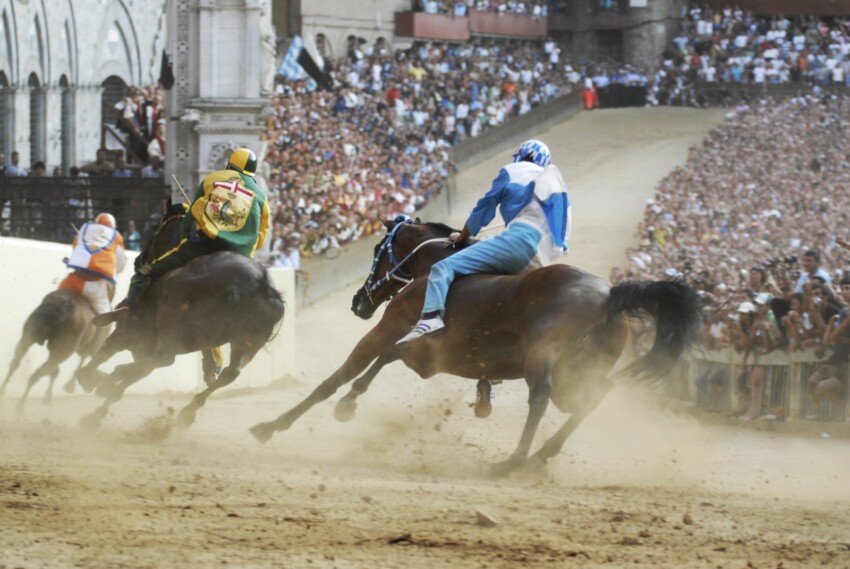
Every year, in the heart of summer, Siena transforms into an open-air theatre where one of Italy’s oldest and most cherished traditions is renewed: the Palio. Two dates mark the Sienese calendar with particular intensity – 2 July and 16 August – when Piazza del Campo becomes the arena for a competition that transcends its purely sporting aspect to become a manifestation of identity, religion and community.
The Palio of Siena is a competition between Siena’s seventeen Contrade (districts) in the form of a medieval jousting race. This is not a historical re-enactment staged for tourists, but a living tradition rooted in the social fabric of the city that continues to pulse at the heart of every Sienese.
The origins of the Palio date back to medieval times, with the first official race taking place in 1633, although horse racing in Siena is documented from the 12th century, and records from before the 12th century mention a “Palio of San Bonifazio”. This temporal continuity makes the Palio one of the most authentic manifestations in the Italian cultural landscape.
The “carriera”, as the race is traditionally known, involves ten of the seventeen city Contrade in a challenge renewed for centuries, maintaining its fascination and ability to involve the entire Sienese community in an experience of collective belonging unique in the world.
The oldest document testifying to this “first” Palio dates to 1239 and concerns matters of Palio justice. In the medieval period, when Siena was a powerful Republic rivalling Florence for control of Tuscany, the Palio took a completely different form from today’s version.
In Siena, horse racing in honour of the Assumption of the Virgin – venerated as the queen of the city – was the “national festival” of the Republic. The Palio was indeed the culminating moment of Assumption celebrations and was held on 15 August following the ceremony of offering candles to the Madonna.
The so-called “Palio alla lunga” (long-distance Palio) took place on a linear course that started outside the city walls and ended in front of the Cathedral. The oldest document testifying to the Palio alla lunga in Siena dates to 1239: Ristoro di Bruno di Cigurda was fined because he had refused the pig, which by regulation went to the last to arrive as a token of mockery.
At the beginning of the 17th century, the race was moved to Piazza del Campo primarily for safety reasons: the Palio “alla lunga” was extremely dangerous because the horses galloped at full speed through the narrow city streets. This change was fundamental not only for safety but also for the spectacle of the event.
On 26 June 1605, the Contrade staged for the first time a race in Piazza del Campo when, to celebrate the election as pope of Paolo V – who belonged to the Sienese Borghese family – the Balia organised a buffalo race, in which the Bruco, Chiocciola, Lupa and Torre Contrade participated, and which was won by the Bruco.
The transition from buffalo races to horse races represented a crucial moment in the Palio’s evolution. The date to which the first Palio of Siena as we know it today is traced is 2 July 1652, the moment when the tradition assumed the fundamental characteristics it still maintains.
In 1721, the Balìa council issued a decree that constitutes the modern Palio regulations. This document represents a milestone in the codification of the manifestation, establishing rules that have remained substantially unchanged over the centuries.
Another decisive moment was the decree on new Contrada boundaries promulgated in 1729 by Beatrice Violante of Bavaria, Governor of Siena, to end the continuous controversies between Contrade concerning not only their boundaries but also their number and demographic composition.
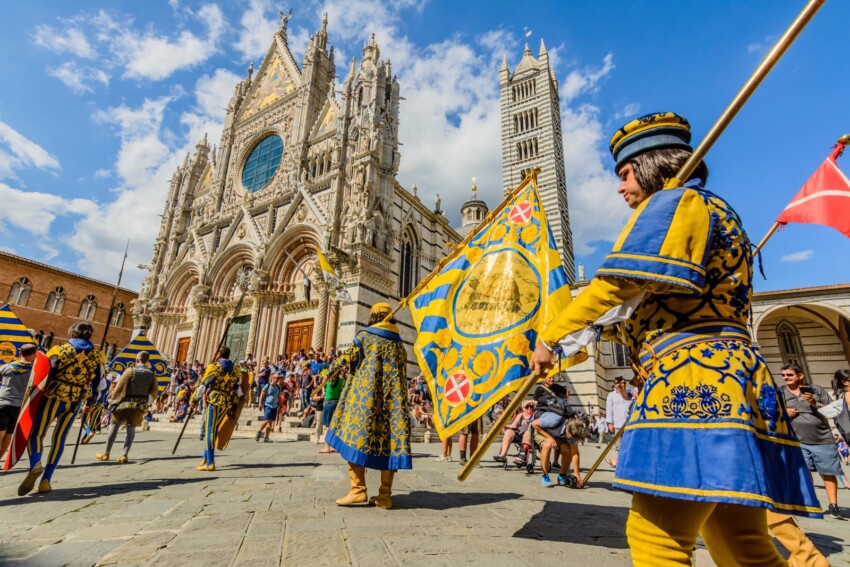
Siena is divided into three Terzi (thirds): Città, Camollia and San Martino, within which the seventeen Contrade are distributed. The Contrade participating in the Palio number seventeen in total: Aquila, Bruco, Chiocciola, Civetta, Drago, Giraffa, Istrice, Leocorno, Lupa, Nicchio, Oca, Onda, Pantera, Selva, Tartuca, Torre, Valdimontone.
Each Contrada represents far more than a simple territorial division. Each of the 17 contrade has its own church, its own social centre and its own museum, as well as a banner with a heraldic animal, from which almost all take their name.
One traditionally belongs to a Contrada in different ways. The oldest is ius soli, that is, birth within the Contrada’s boundaries. One also belongs through ius sanguinis, through direct descent from members of a Contrada.
The bond with one’s own Contrada manifests itself from the earliest moments of life: after baptism in church, children receive a second baptism in the fountain of their respective contrada. This “contrada baptism” represents their official entry into the Contrada’s extended family.
The contrada plays a fundamental role in an individual’s life: children learn to brandish flags and beat drums for the Palio and for contrada festivals, whilst adults are active in their social centres and participate in weddings and funerals.
The system of relations between Contrade is complex and fascinating. For centuries, the Contrade have maintained relationships of friendship with one another, involving mutual visits and special honours, the display of friendly banners at solemnities, and reciprocal aid in particular circumstances.
There are seven rivalry relationships between Siena’s Contrade, relations that have deep historical roots and manifest with particular intensity during the Palio. For Contrade with a rival, preventing that rival from winning becomes a priority (alongside Palio victory).
Amongst the most celebrated rivalries stands that between Oca and Torre, considered one of the oldest and most keenly felt, alongside those between Aquila and Pantera, Civetta and Leocorno, Istrice and Lupa, Nicchio and Valdimontone, Onda and Torre (one-sided), and Tartuca and Chiocciola.
The “carriera”, as the race is traditionally known, normally takes place twice a year: on 2 July the Palio is run in honour of the Madonna of Provenzano (the Visitation feast day in the old calendar) and on 16 August in honour of the Assumption of the Virgin.
The Palio of Provenzano on 2 July is dedicated to the Madonna of Provenzano, a miraculous image venerated in the church of Santa Maria in Provenzano. The Palio of the Assumption on 16 August celebrates the Assumption of the Virgin Mary, patroness of the city.
The Palio features ten contrade competing in a race covering three laps of the piazza. Siena is divided into 17 contrade, but not all compete simultaneously. Selection occurs through a rotation based on a temporal criterion: the seven contrade that did not race the previous year gain automatic entry to the new edition, while the remaining ones are drawn to complete the list of ten.
Jockeys are engaged by the Contrade on the basis of loyalty, fee and bonuses. Article 59 of the Regulations establishes that the jockey must be of legal age and must not be subject to “exclusion penalties nor have pending appeals with bodies external to the Municipality”.
The days of the Palio follow a rigid programme repeated for centuries. Traditionally, on 26 June the ceremony presenting the Drappellone takes place, the trophy to be awarded to the winning Contrada (known by Sienese as the ‘cencio’).
On 29 June, the Tratta (draw) takes place, a crucial moment when horses are assigned to the Contrade through a lottery. During this phase, the horses are presented, tested and assigned to the Contrade following codified procedures that guarantee fairness and transparency.
On 2 July, Palio day, proceedings open with the Jockey’s Mass in the early morning hours, followed by the horses’ exit from the Cortile del Podestà (Podestà Courtyard). In the afternoon, the striking Historical Procession crosses the piazza with over 600 costumed figures, before the final exit of the horses for the race.
The modern Palio has introduced important measures to ensure greater safety and transparency. Among the most significant innovations is the requirement to submit each horse to thorough veterinary checks, including pharmacological screening that automatically excludes any specimen that tests “positive”.
During regulated trials, horses run without leg wraps but may wear protective leg guards. The use of whips is strictly forbidden, in compliance with modern regulations that give particular attention to animal welfare.
A study conducted by the University of Parma demonstrated that there is no difference in percentage terms between incidents in regular races and in historical races. Analysis of the last forty years of the Palio revealed a significant reduction in catastrophic incidents: from 2.20% in the 1970-79 decade to 0.53% in the 2000-09 decade.
These figures confirm how the evolution of rules and procedures has contributed to making the Palio increasingly safe, demonstrating that tradition and modernity can coexist with respect for animal welfare.
Watching the Palio in Piazza del Campo, with its distinctive shell shape, is free. Access to the piazza is open, but requires some important precautions.
Arrive in the piazza at least three hours before the race and bring nothing with you: no chairs, pushchairs or even children (admission is forbidden for those under 12 years of age). You will not be able to leave the piazza before the race ends.
For those preferring a privileged vantage point, it is possible to book a place in the stands or balconies overlooking the piazza: these are paid seats, sold by private parties or through tourist packages. There is no centralised ticket office and prices vary considerably: they generally start from €250 and can exceed €500, depending on the position and services included.
For those travelling by car, Siena is reached by taking the A1 Motorway to the Florence-Siena link road. Exit at the signs for the city. During the Palio, many city centre roads are closed or restricted to traffic. It is advisable to use the designated car parks, then proceed on foot to the city centre.
The Palio of Siena represents far more than a simple sporting competition. The Palio is not a manifestation unearthed and organised for tourist purposes: it is the life of the Sienese people through time and in its various aspects and feelings.
This manifestation constitutes an intangible cultural heritage of incalculable value, recognised internationally as a unique example of a living tradition. The Palio demonstrates how it is possible to keep a community’s historical roots alive without transforming them into sterile folklore, but by making them pulse as a vital element of collective identity.
The contrada passion that ignites in the days of the Palio reveals tradition’s capacity to create deep and lasting social bonds, offering each Sienese a sense of belonging that spans generations and unites past, present and future in an experience of extraordinary emotional intensity.
The Palio continues to renew itself year after year, knowing how to reconcile respect for historical roots with necessary contemporary evolution, ensuring that future generations too can experience the unique thrill of the race in Piazza del Campo.
 Hotel
Hotel  Budget accommodations
  Apartments
  Family Hotel
  Luxury Hotel
  Resorts