Bestseller
Siena: Cathedral Complex Pass with Audio Guide (OPA SI PASS)
From 18,20 €
Buy the ticket
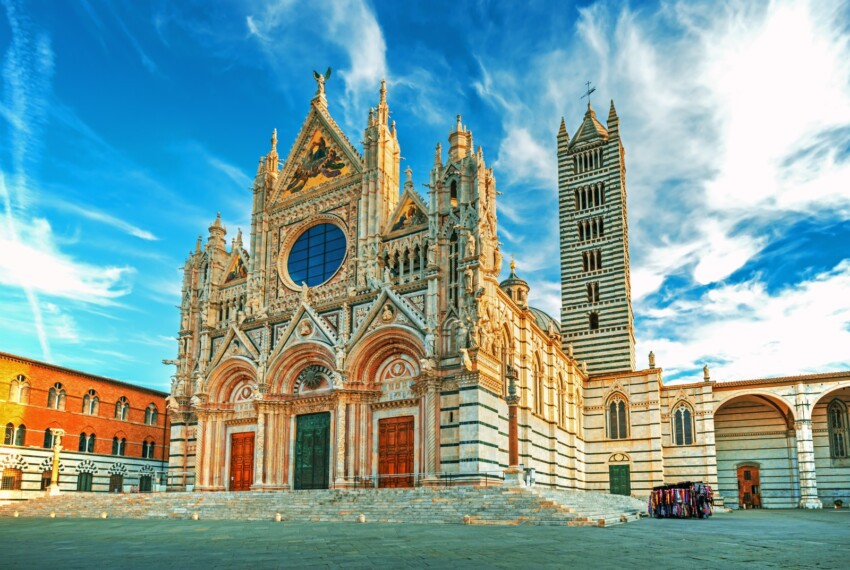
Among the things to see in Siena, the cathedral holds pride of place. This magnificent building stands in the heart of the Tuscan city, right in the historic centre, just a stone’s throw from Piazza del Campo, famous for hosting the Palio.
Officially known as the Metropolitan Cathedral of Santa Maria Assunta, it is a wonderful building dating from the 13th century, built in Italian Romanesque-Gothic style, and represents one of the city’s most important attractions. With its iconic façade and bell tower, it stands out on Siena’s skyline, and is particularly noticeable from afar thanks to its white colour, which contrasts sharply with the red brick façades of the other buildings in the centre.
The history of Siena Cathedral is long and turbulent. Indeed, as far back as the 14th century, the city had plans to build another cathedral, the so-called Duomo Nuovo (New Cathedral), a project that was never completed due to various reasons, including the Black Death epidemic of 1348. The skeleton of the Duomo Nuovo is still visible today in Cathedral Square and has been converted into one of the city’s most beautiful viewpoints.
Next to Siena Cathedral, a museum pathway has been created, which winds through the Cathedral Opera Museum, which houses sacred art masterpieces that were originally contained within the cathedral. The entire cathedral complex is managed by the Opera della Metropolitana di Siena, a non-profit organisation that uses ticket sales revenue for restoration and conservation work on the artistic heritage.
Although the cathedral itself is the most important attraction, the entire Siena Cathedral complex contains plenty of things to see, along a route that will take you on a journey through the history of the Tuscan city, its traditions and its centuries-old art.
The main building that makes up Siena Cathedral is the cathedral itself, the most interesting attraction to visit. It has a Latin cross interior with three naves and a hexagonal dome at the intersection of the arms. Inside the building there are plenty of things to see, starting with the beautiful counter-façade, with a marble sculpture that frames the entrance portal. Notable are the holy water stoups by Antonio Federighi, made from white Carrara marble, and the interior decoration of the dome, with blue coffers and golden stars.
Among the most representative sacred artworks, we highlight the Christ with Saints James and Philip by Francesco Trevigiani, the Adoration of the Magi by Pietro Sorri and the Mystical Marriage of Saint Catherine by Pier Dandini.
Finally, don’t leave the church without visiting the Piccolomini Altar, created by Andrea Bregno and enriched with a series of 4 sculptures by Michelangelo: Saint Peter, Saint Pius, Saint Paul and Saint Gregory the Great. It is said that Michelangelo later abandoned the project, leaving it unfinished, as he was drawn away by more important commissions, such as the David in Florence. Next to the Piccolomini Altar is the Piccolomini Library, richly frescoed by Pinturicchio.
On the exterior, the Cathedral of Santa Maria Assunta is framed by the wonderful white marble façade, richly decorated with three large entrance portals topped by corresponding arches, an enormous central rose window depicting the Last Supper, and three spires at the top. The lower part of the façade is the work of Giovanni Pisano, whilst the upper part was created by Camaino di Crescentino, and dates from a later period.
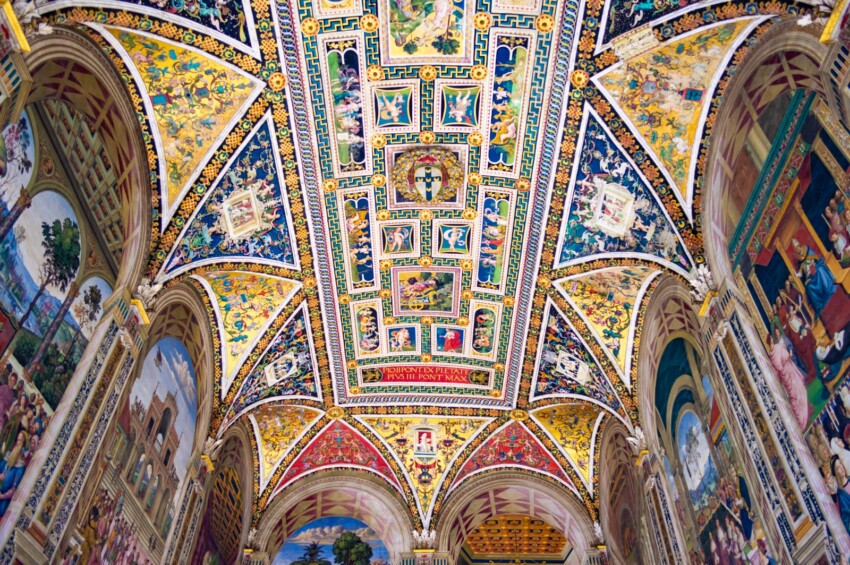
Inside Siena Cathedral, it’s worth spending some time at the Piccolomini Library, a room created to house the books of Enea Silvio Piccolomini, who became pope under the name of Pius II. It was commissioned by his nephew Francesco Todeschini Piccolomini, who later also became pope, as Pius III, inspired by the French tradition of libraries attached to cathedrals. In this magical place, in addition to some books from the period, you can admire incredible frescoes by Pinturicchio depicting the life of Pius II, created between 1503 and 1508.
The vault is also wonderful, richly decorated with bright and splendid colours, whilst in the centre of the room you can see the group of marble sculptures of the Three Graces, acquired in Rome by Cardinal Prospero Colonna. Finally, notice the floor, created with diamond-shaped mosaics made by the Ginori factory in Sesto Fiorentino.
The Cathedral Opera Museum contains a series of sacred artworks, originally positioned inside the Cathedral and its adjoining buildings. Inside you can admire masterpieces by artists of the calibre of Duccio di Buoninsegna, Giovanni Pisano, Donatello and Jacopo Della Quercia, alongside silk fabrics, gold work and illuminated manuscripts. The museum, founded in 1869, unfolds within the right nave of the Duomo Nuovo, spread across three floors.
In 1339 an expansion of Siena Cathedral was decided, with the intention of building what was known in the city as the “New Cathedral”. After years of projects and a slow start to the work, unfortunately the building was never completed, due to both structural problems and the economic recession caused by the arrival of the Black Death in the city.
The New Cathedral of Siena was therefore partially demolished, with the exception of what was meant to become the new façade, which today is known as the Facciatone. According to many, the finest panorama of Siena can be enjoyed from the Facciatone. The Facciatone is located in Piazza Jacopo della Quercia, which was originally meant to be the “ground” on which to build the New Cathedral, so much so that today the marble perimeters of the bases of the pillars of a nave are still visible.
A visit to Siena Cathedral’s crypt will take you into the depths of the cathedral, but unlike what you might expect, you will be amazed by the colour and beauty of the frescoes inside. The crypt was only discovered in 1999, when during a series of restoration works, richly frescoed spaces were brought to light beneath the cathedral’s choir, decorated with a fresco cycle dating from the 13th century, the work of artists of the calibre of Guido da Siena and Rinaldo da Siena.
What strikes you immediately when admiring the crypt’s frescoes is above all the colour: even today the tones are vivid, as if 800 years had not passed. Columns, pillars and capitals are decorated with geometric or plant motifs, whilst the walls depict scenes from the Old Testament in the upper part, and the New Testament in the lower part.
The baptistery of Siena Cathedral, like that of Florence, is dedicated to Saint John. Officially named the Church of San Giovanni Battista, the baptistery is located next to the staircase leading to Piazza Jacopo della Quercia, where the remains of the New Cathedral can be found. It dates from the 14th century, and inside there are splendid frescoes, evidence of the rich Sienese painting of the 15th century.
On the vaults are depicted 12 scenes narrating the articles of the Creed, the work of Lorenzo di Pietro known as il Vecchietta, who also decorated the apse, whilst the back wall of the left nave is decorated with the Miracles of Saint Anthony of Padua, the work of Benvenuto di Giovanni.
At the centre of the baptistery is the baptismal font, made of marble, bronze and enamel, created by the principal sculptors of the period, including Lorenzo Ghiberti and Donatello.
An extraordinary route inside Siena Cathedral: this is, in essence, a summary of the Gate of Heaven, which allows you to visit the cathedral’s interiors from above in areas not normally open to the public.
It starts from a spiral staircase in a corner of the church, which allows you to climb onto the walkway on the first floor from which, via a network of narrow corridors and external passages, you make your way around the entire cathedral, for the most part inside the building, but for brief stretches also outside, taking in splendid views of Siena, with the Mangia Tower and the Tuscan hills in the background.
A special feature of the Gate of Heaven route is the uniqueness of the spaces you walk through: they have never been open to the public for centuries, and today you can pass by the roof spaces and dome, viewing the building from a privileged vantage point.
The guided tour of the Gate of Heaven lasts one hour and 30 minutes, with two tours per day, one in Italian at noon and the second in English at 13:30.
Of secondary importance as it is overshadowed by the bell tower, the dome of Siena Cathedral is nonetheless very interesting. Its construction was completed in 1263 and underwent modifications in subsequent centuries until 1667, when the lantern was added.
The bell tower of Siena Cathedral, on the other hand, was completed in 1313. It is constructed in Romanesque style in white and green marble and develops over six storeys. Interestingly, each storey corresponds to the same number of windows: on the first floor there is one window, on the second floor there are two, on the third floor there are three, and so on up to the sixth.
With a height of 77 metres, Siena Cathedral’s bell tower is the second highest point in the historic centre after the Mangia Tower, which at 88 metres overlooks Piazza del Campo. Inside the bell tower there are 6 bells, all different in shape, size and period of construction. The oldest dates from 1149, whilst the most recent is the so-called friars’ bell, dating from 1859.
Tickets for Siena Cathedral and the entire museum route can be purchased directly on site or online. We recommend this option to avoid the long queues that can form at the ticket office, and to reduce the risk of daily admissions being sold out.
It is also possible to purchase the OPA SI pass, a combined ticket that allows access to all museum venues in the complex. The pass is valid for three consecutive days from the date of issue; discounts are available for children aged 7 to 11, whilst it is free for children up to 6 years of age, residents or those born in Siena, journalists, disabled visitors with companions, clergy and students of Siena University.
It is possible to be accompanied through the cathedral complex museum by expert authorised tour guides, to get an in-depth explanation of what you are seeing. You can purchase the guided tour directly at the ticket office, or entrust yourself to the city’s numerous private guides. In this case, we recommend you choose your guide in advance online, to avoid unpleasant surprises and to learn about their feedback beforehand.
The opening hours of Siena Cathedral are rather complex: the cathedral, Piccolomini Library, Opera Museum, views from the Facciatone, crypt and baptistery are open from 10:30 to 17:30 from 1 November to 31 March, and from 10:00 to 19:00 from 1 April to 31 October. On pre-holiday days the times vary, ranging from 10:30 to 17:30, the same applies for public holidays, from 13:30 to 17:30.
During the summer season, the Opera Museum is open from 09:30 to 19:30, whilst the San Bernardino Oratory is open from 13:30 to 19:00. Finally, the Gate of Heaven is open until 31 March only on Saturdays from 10:30 to 17:00 and on Sundays from 13:30 to 17:00, whilst from 1 April the opening hours follow those of the Cathedral.
Last admission is permitted 30 minutes before the museums’ closing time. Please note that opening hours may be subject to variation due to religious celebrations.
Siena Cathedral is located right in the heart of the city, in an area closed to vehicular traffic. Therefore, you’ll need to arrive on foot. From the station it takes around 30 minutes, passing through Porta Camollia, Via Camollia and Via dei Montanini, then skirting Piazza del Campo via Via Banchi di Sopra and Via di Città.
Speaking of Piazza del Campo, if you find yourself in Siena’s most iconic square, you’ll reach the Cathedral in just five minutes’ walk, heading west along the busy Via dei Pellegrini.
The nearest car park is Santa Caterina, located on Via Esterna di Fontebranda. From there it’s around a 12-minute walk to Siena Cathedral, climbing an elevation of approximately 70 metres as you enter the historic centre via Via Fontebranda.
The start of Via Fontebranda is also the closest point to Siena Cathedral where public transport buses stop, particularly lines 589, 637, S21 and S54 departing from Piazza Indipendenza.
Siena's cathedral dominates the square that bears its name, right in the heart of the Tuscan city's historic centre, just a stone's throw from Piazza del Campo.

 Hotel
Hotel  Budget accommodations
  Apartments
  Family Hotel
  Luxury Hotel
  Resorts