B&B Il Biancospino
Abbadia San Salvatore - Via Adua 33
Book now
The small Abbadia San Salvatore, perched on a hillside at 800 metres above sea level on the Siena side of Monte Amiata, lies in the province of Siena and forms part of the Amiata Val d’Orcia municipal union, of which it is the main town. Perfect for a holiday in the fresh mountain air, it’s also an interesting destination from a natural, historical and cultural perspective.
Its name itself reveals its ancient origins: it derives from the Benedictine abbey of San Salvatore, dating back as far as 743, where the church and crypt are still visible today. In the past, the location enjoyed considerable renown thanks to the abbey, though its fortunes gradually declined over the centuries. The town’s fortunes revived only in the late 19th century when a vast cinnabar deposit was discovered—a mineral containing mercury. Abbadia San Salvatore thus became an important mining and industrial centre, expanding rapidly until the inevitable decline of the 1970s, when the mining company closed due to international competition and, above all, the collapse of the mercury market for environmental reasons.
Yet the resources of Abbadia San Salvatore appear to be endless: with the closure of the mines came sustained tourism development, thanks to its proximity to Monte Amiata, the beauty of its medieval historic centre, and the old mines, now transformed into a mining museum that draws visitors from across Italy.
Begin your visit to Abbadia San Salvatore at its charming medieval historic centre, then venture out of town to experience the mines, and finally relax amid the natural beauty of Monte Amiata.
Given that the town takes its name from this very abbey, start your visit to Abbadia San Salvatore at the abbey itself. Located on Via del Monastero, it’s also notable for having housed for over a thousand years the Codex Amiatinus, or Amiatine Bible, the oldest complete handwritten copy of the Bible, now kept in the Medici Laurentian Library in Florence.
The ancient abbey of San Salvatore was consecrated in 762, whilst the church dates from 1035, later modified in the 17th century. It’s worth viewing from the outside, with its striking façade flanked by two towers, then exploring the interior in Romanesque style, with bare walls and a wooden ceiling. Particularly impressive is the wooden crucifix, dating to the 12th century and later painted.
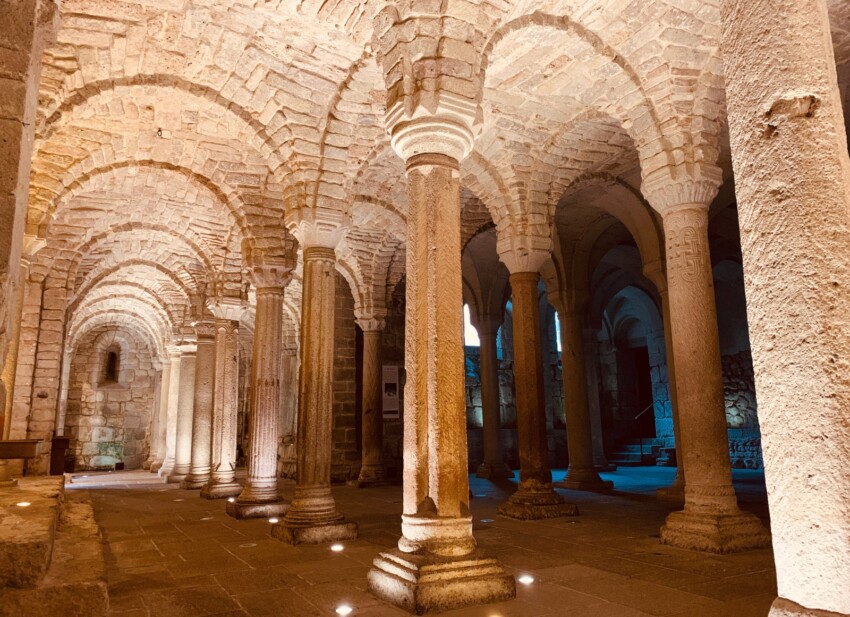
Beneath the church lies the crypt, containing 35 columns with capitals of varying designs. This section was only rediscovered in 1925, and major restoration work began in the following years, completing only in the 1990s. Today you can admire the crypt in its original splendour, enhanced by dramatic lighting.
Part of the abbey and accessed via the cloister, the Museum of Sacred Art of Abbadia San Salvatore is dedicated to Don Roberto Corvini and displays numerous treasures originally housed within the church.
Among the many artworks on display, we highlight the Scottish-Irish reliquary dating from the 6th-7th century, containing relics believed to belong to Saint Columban, a copy of the Amiatine Bible, and the reliquary of Pope Saint Marcus, standing over 60 cm tall and dating from the late 14th century.
The Don Corvini Museum of Sacred Art is open Saturday and Sunday from 10:00 to 12:00 and 16:00 to 19:00; during July and August it’s also open on weekdays except Monday, with the same hours. Special openings are arranged for public holidays, and it’s also possible to book an extraordinary opening for groups of at least 20 people.
At Via Suor Gemma 1, to the west of Abbadia San Salvatore town centre, you’ll find the fascinating Mining Museum Park, set up to relive and commemorate Monte Amiata’s mines and cinnabar extraction. Established to educate visitors about the mines’ evolution in the area, it tells the story of those who spent their youth working within these structures, risking their lives whilst enabling the town to progress towards modernity and industrialisation.
The Mining Museum Park of Abbadia San Salvatore comprises 4 routes:
In addition to the 4 routes, there’s a proper museum path comprising 3 areas: a multimedia museum opened in 2016, a documentary museum spread across 5 rooms, and the Level VII Gallery, a unique experience where you can board a miners’ wagon and travel 250 metres through a gallery with reconstructed mining workplaces.
The Mining Museum Park is open daily from 9 April to 1 May, 1 June to 15 September, and 23 December to 6 January, and open weekends and public holidays for the rest of the year. Hours are: mornings from 9:30 to 12:30 and afternoons from 15:30 to 18:30, except in August and October weekends/weekdays, when it’s open continuously from 9:30 to 18:30.
Tickets are purchased directly at the entrance. Prices vary as you can buy a combined ticket covering access to the multimedia museum, documentary museum and Level VII Gallery, or individual tickets for the 4 outdoor facility routes. Discounts are available for children aged 6-12, over-65s and disabled visitors, while entry is free for children aged 0-5.
You can also book a school visit, choosing from available activities, then contacting the museum by phone or email to finalise booking at least 30 days in advance. Each workshop accommodates a maximum of 25 students per time slot.
From the town centre, the peak of Monte Amiata is close and easy to reach, whether by car or even on foot. At the summit, you’ll enjoy a splendid view across the Siena and Grosseto countryside, along with the iconic Monte Amiata Cross, built in steel and administratively located within Abbadia San Salvatore’s municipality.
Whatever season you choose to visit, the mountain always has something to offer. During spring and summer you can tackle exhilarating trekking trails or enjoy mountain biking; in autumn you can savour the foliage and stunning colours; whilst in winter you can go snowshoeing and reach the mountain’s summit.
On the Amiata there’s also a small ski resort, with 10 kilometres of slopes and 8 lifts: whilst not the Alps, it remains a convenient destination for winter sports enthusiasts living in central Italy.
Read moreThe small town of Abbadia San Salvatore has numerous accommodation options, some located in the historic centre, others in the newer part of town. In the centre you’ll find mostly bed and breakfasts and private apartments, whilst outside the old walls there are several hotels, mostly 3-star establishments offering better amenities.
In the countryside surrounding Abbadia San Salvatore you’ll find different types of accommodation, chiefly farmhouses, along with country estates and rural dwellings ideal for experiencing authentic Tuscan life amid the surrounding countryside. Heading up towards Monte Amiata there are also some chalets and mountain lodges with typical alpine character, perfect for an immersive nature experience, though somewhat less convenient for proximity to services.
The location of Abbadia San Salvatore, rather isolated and distant from major transport routes, means it’s never particularly quick or straightforward to reach. From the provincial capital Siena, for example, it’s about 70 kilometres, which takes roughly an hour and a half, heading south along the regional road SR2, the Via Cassia, which winds through the wonderful Siena countryside landscapes and practically leads to your destination, except for the final kilometres along the SP61, which also passes through the popular tourist spot of Bagni San Filippo.
From Florence the distance is almost double, but the route is paradoxically much easier, being mostly along the motorway. Exiting the A1 at the Chiusi-Chianciano Terme junction, you continue south-west along roads SP146, SR2 and SP61 to your destination.
Travel from major Tuscan coastal cities such as Pisa and Livorno takes about 3 hours and covers over 200 kilometres. You follow the SS1 Aurelia state road heading south to Grosseto, where you turn onto the SS223 towards Paganico, then take the Cipressino provincial road which practically leads to your destination. The Grosseto-Abbadia San Salvatore section takes approximately an hour and 20 minutes for 85 kilometres.
Finally, bad news for public transport travellers: from Florence it takes 3 to 4 hours, with the journey comprising a first section by train—lasting around an hour and 40 minutes—to Chiusi-Chianciano Terme station, followed by intercity buses, often requiring a change at Sarteano. From the provincial capital Siena, the journey can sometimes be even longer: you start by train to Buonconvento, then continue by intercity bus. Despite being only about 70 kilometres, the journey can easily exceed 3 hours.
What's the weather at Abbadia San Salvatore? Below are the temperatures and the weather forecast at Abbadia San Salvatore for the next few days.
Abbadia San Salvatore sits in the heart of Tuscany, nestled within the countryside of Siena province, just a short distance from the Grosseto province border.
 Hotel
Hotel  Budget accommodations
  Apartments
  Family Hotel
  Luxury Hotel
  Resorts