Bestseller
Abbey of Sant'Antimo: Skip The Line
From 8,00 €
Buy the ticket
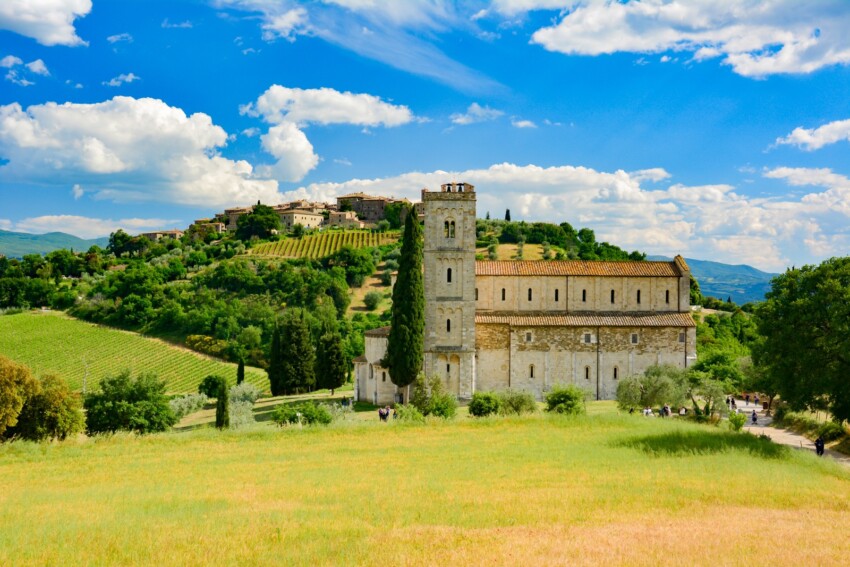
No image, no video, no virtual tour can yet replace or recreate the sheer enchantment of this place. The magic is total, and the harmony with which the abbey’s architectural geometries integrate with the landscape surpasses all comparison.
The incomplete façade features a single portal—likely a compromise solution for a project originally planned with two—crowned by an architrave datable to the first half of the 12th century, with capitals, friezes and mouldings from slightly later. The element that most distinctly gives this church its French character is the basilical layout with ambulatory and radiating chapels, unique in Tuscany and among the rarest in Italy.
In the morning light, the sun plays across the stone that adorns the ambulatory—the most precious of all materials used in the church: alabaster and travertine, fashioned into capitals and columns. Measuring 44 metres in length, the church is guarded at its entrance by two supporting lions, probably destined for the outer portal and dating to the 12th century, attributed to the Master of Cabestany along with the remarkable capital depicting the “Lions’ Den with Daniel”.
The refined phytomorphic and geometric motifs, precise in their design and crisp in their carving, betray origins to be sought in France, in Auvergne. Yet other capitals in the ambulatory display Lombard characteristics, lending credence to the theory that Sant’Antimo was worked on by two separate master craftsmen—one French and one, perhaps from Pavia—or alternatively that a single Lombard workshop had spent time in Auvergne.
To the right of the main church, at the beginning of the ambulatory, stands the Carolingian chapel of the 8th-9th century, a small single-nave rectangular building with a semicircular apse. On the left exterior rises the imposing bell tower, roughly 30 metres tall. Divided into four storeys and decorated with pilaster strips, featuring single and double-light windows, it displays Lombard style with a Pisan touch in the columns at the base corners. The bell tower has a flat roof, upon which two bells are mounted, one bearing the name of Abbot Ugo (1216–1222) engraved upon it, dated 1219. The apse of the great church, a synthesis of strength and soaring ambition, culminates in a delightful double-light window, the sole source of light for the entire interior.
Tradition, fairly reliable, holds that Charlemagne in 781, returning from Rome along the Via Francigena, passed through Monte Amiata with his court and army. Many fell victim to plague, and to end the scourge, the emperor made a vow and founded the Abbey.
Sant’Antimo is thus an imperial votive offering. According to other historians, its foundation dates to the Lombards, as does San Salvatore on Monte Amiata. It is not ruled out that a Roman villa once stood on this site, and it is certain that in the 4th-5th centuries Castelnuovo dell’Abate was an important settlement, equipped with a parish church, later vanished.
The monastery of Sant’Antimo did, however, exist in the year 814, as evidenced by a charter from Louis the Pious enriching the Abbey with gifts and privileges. From the 10th century, the monastery’s abbot also held the title of Palatine Count, a position of considerable public importance conferred by the emperor. In the 9th century the abbey faced financial difficulties, to the point that in 877 Charles the Bald entrusted it to the Bishop of Arezzo, on condition that he maintain forty monks there at his own expense.
In 992 Pope John XV (985–996) issued a bull placing the monastery under the direct jurisdiction of the Holy See. The year 1118 marked the beginning of Sant’Antimo’s golden age. Count Bernard of the Ardengheschi ceded his entire estate in moveable and immoveable property “throughout the whole kingdom of Italy and the entire March of Tuscany” to Ildebrando, son of Rustico, to transfer it to the Abbey. A record of this exceptional donation was inscribed on the altar steps as a “stone charter” in perpetual commemoration of the event. Abbot Guido (1108–1128), who received the donation, immediately set in motion the great building campaign for the construction of the new church.
The period of greatest splendour lasted until the loss of Montalcino, occupied by the Sienese who forced the abbey to sign a pact ceding to Siena a quarter of Montalcino’s territory. This occurred on 12 June 1212. The Abbey began its slow decline. Entrusted to the Williamites by Pope Nicholas IV (1288–1292) via a bull of 23 August 1291, it experienced a brief revival in the period between 1397 and 1404, until its suppression in 1462 by Pope Pius II (1458–1464), who transferred its properties to the bishop of the newly created diocese of Montalcino and Pienza, established on 13 August of that same year. Following the Abbey’s transfer to state ownership in 1867, an extended period of restoration began, which saved the entire building.
The works, begun in 1872 and completed in 1895, brought the church to its present appearance. In 1992 religious activity resumed with the arrival of the Premonstratensian Regular Canons.

 Hotel
Hotel  Budget accommodations
  Apartments
  Family Hotel
  Luxury Hotel
  Resorts