Agriturismo Mocine
Asciano - Strada Provinciale 451
Book now
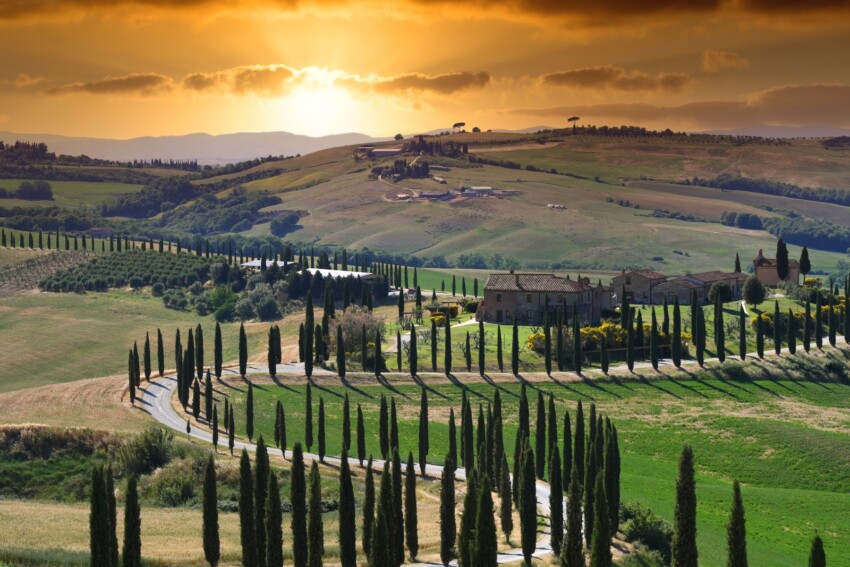
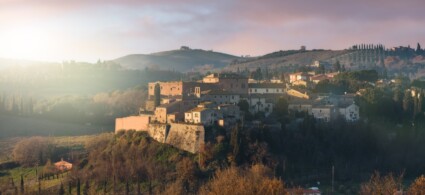
Asciano is the principal village of the Crete Senesi, situated just under 30 km south-east of Siena in the upper valley of the Ombrone river. The municipal territory largely coincides with one of Tuscany’s most recognisable and photographed landscapes: clay hills with soft, sinuous forms and virtually treeless, carved by deep ravines and biancane — characteristic dome-shaped ridges formed on clay through erosion — which shift colour with the seasons, from dark violet in winter to golden wheat in summer, passing through the yellow of spring rape. What we admire today is what remains of the bed of a shallow sea that disappeared around three million years ago, during the Pliocene.
The village preserves an almost intact medieval layout, with defensive walls still embracing the historic centre and Corso Matteotti as its main thoroughfare. Inhabited since ancient times — testified by the Etruscan necropolis at Poggio Pinci — Asciano came under the rule of Siena at the end of the 12th century, suffered devastation by the Florentines in 1234, became a signoria of the Tolomei in the 13th century and returned to Sienese control until 1554, when it entered the Medici state together with Siena. A large fragment of 4th-century AD mosaic flooring, preserved in the heart of the historic centre, is the most visible trace of Roman presence.
Asciano’s historic centre can be explored entirely on foot in a few hours and proves far richer than its size might suggest, with an unusual concentration of churches, museums and medieval architecture for a village of this scale.
The Palazzo Corboli Museum, housed in a medieval palace that once belonged to a noble Sienese family and recently restored, is the village’s main attraction. Spread across three exhibition floors, it holds a rich collection organised into two sections: Sacred Art, featuring masterpieces of Sienese painting and sculpture from the 13th century, originally commissioned for the territory’s churches, and Archaeology, with finds from the Etruscan necropolis at Poggio Pinci. The palace itself merits a visit for the intriguing 14th-century allegorical frescoes adorning the rooms. The Tourist Information Centre is also housed here, an ideal starting point for organising your visit to the territory.
A short walk from Palazzo Corboli, the Cassioli Museum is the only museum venue in the entire province of Siena dedicated exclusively to Sienese 19th-century painting. Inaugurated in 1991 thanks to the significant bequest of the Cassioli family, originally from Asciano, and expanded in 2007 with works from the Duccio di Buoninsegna Art School in Siena, it houses works by Amos and Giuseppe Cassioli alongside those of the leading exponents of the Sienese Academy of the period. The early 20th-century building in which it is displayed is itself an architectural document of interest. A combined ticket with Palazzo Corboli is available.
The Collegiata di Sant’Agata closes off the far end of Corso Matteotti with its grey stone façade set on a small flight of steps. The sober, solid Romanesque architecture has undergone restoration that respects its original character. Inside are preserved a fine 15th-century crucifix and two interesting 16th-century frescoes. In the immediate vicinity stand the Church of San Bernardino, the Palazzo del Podestà and the Torre della Mencia, which together form one of the village’s most photogenic corners.
The Church of San Francesco, built in Romanesque-Gothic style between the 13th and 14th centuries, preserves inside a cycle of high-quality Sienese school frescoes: the Stories of Christ and Stories of Saints by Jacopo di Mino del Pellicciaio, and the Stories of the Passion from the 13th and 14th centuries. The right presbytery chapel is finely decorated with the Martyrdom of Saint Catherine of Alexandria. The church also houses a large altarpiece from the Della Robbia workshop depicting a Madonna and Child with Angels and a marble holy water stoup by Antonio Ghini.
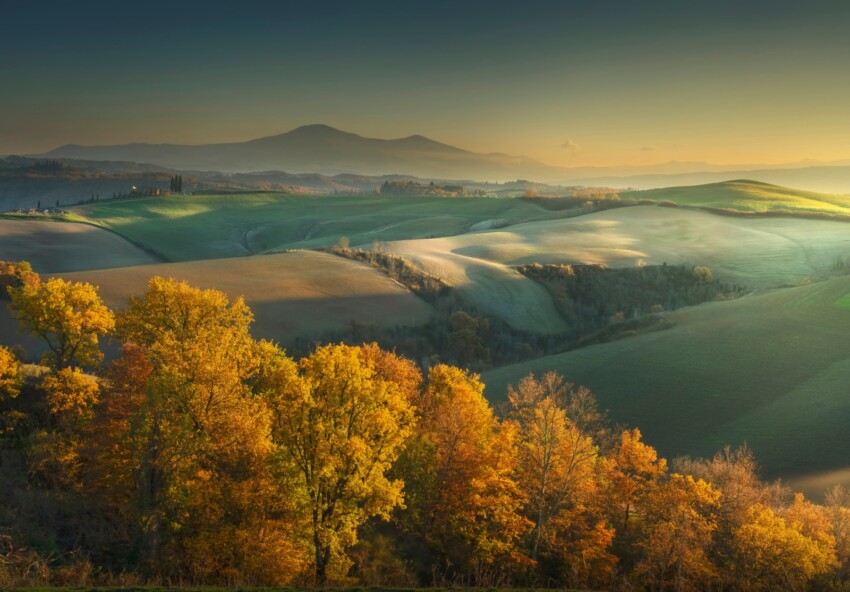
Asciano’s true spectacle lies outside the walls. From Asciano radiate some of the finest paths for venturing into the Crete, such as the roughly 7 km route leading to Monte Sante Marie. The most evocative way to experience this landscape is at dawn: the hills emerge from the mist like islands from a milky sea, the sun rises slowly and gold tints each crest in a sight hard to forget. For those who prefer not to walk, the Treno Natura — a steam locomotive with period carriages that runs along the white roads of the Crete — is a seasonal appointment allowing you to admire the landscape from the window in grand style.
The territory is also home to the castles of Gallico and Leolina, the Tower of Sant’Alberto and a circuit of 16th and 17th-century villas and palaces including Palazzo Venturi, Medane and the Buoninsegna. Also worth noting are the Badia di Rofeno and the Romitorio, a farmhouse nestled in the woods with the remains of an old convent.
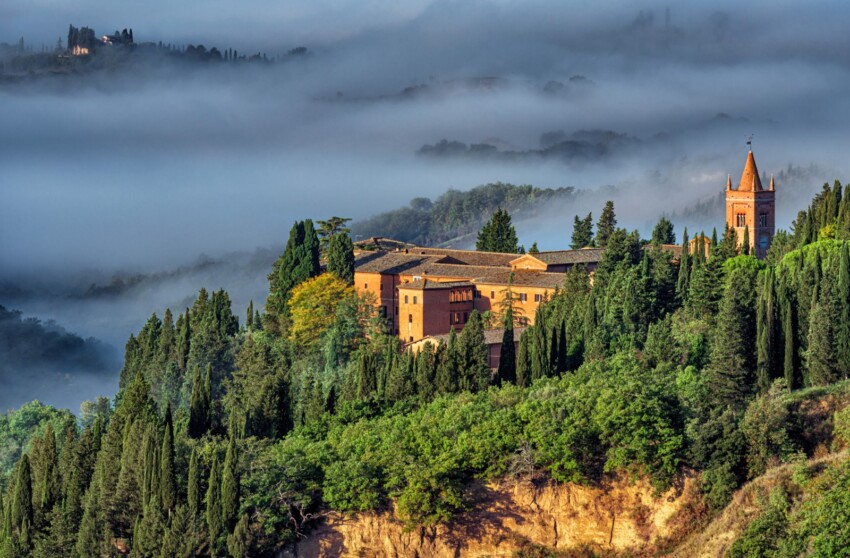
About 9 km from Asciano, among the ravines and cypresses of the Crete, stands the Abbey of Monte Oliveto Maggiore, one of Tuscany’s most fascinating monastic complexes. Founded in 1313 by the blessed Bernardo Tolomei, a young Sienese nobleman who abandoned luxury and wealth to pursue a hermitic life, it remains today the home of the Olivetan Benedictine Congregation. Within the great cloister is preserved a cycle of frescoes on the life of Saint Benedict by Luca Signorelli and Il Sodoma, among the most important testimonies of the Sienese Renaissance. The tree-lined avenue of cypresses leading to the entrance is in itself an unforgettable image.
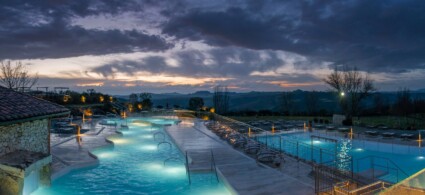
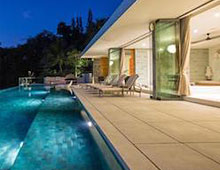
The Crete Senesi are agriturismos country par excellence, and those around Asciano number among Tuscany’s most renowned. Historic estates such as Baccoleno, with a panoramic covered pool and unrivalled views over the Crete, allow you to immerse yourself completely in the landscape and enjoy the sunrise over the hills directly from the terrace. In the historic centre there’s no shortage of small B&Bs and holiday homes for those preferring village convenience. For those arriving by car, the Strada Lauretana departing from Taverne d’Arbia (Siena-Bettolle junction exit) is the scenic route recommended for reaching Asciano whilst enjoying the Crete landscape kilometre after kilometre.
Asciano is 28 km from Siena and approximately 80 km from Florence. By car it’s reached via the SR438 Lauretana from Siena, with a scenic route through the Crete. It’s also accessible by train from Siena station on the Siena-Chiusi line, with a stop at Asciano. The Treno Natura — departing from Siena and crossing the Crete with a steam locomotive — is a seasonal alternative of great appeal, active on certain weekends during spring and autumn. Having a car is nonetheless recommended to freely explore the surrounding territory and reach the Abbey of Monte Oliveto Maggiore and nearby villages.
What's the weather at Asciano? Below are the temperatures and the weather forecast at Asciano for the next few days.
Asciano sits in the heart of the Crete Senesi, in the province of Siena, approximately 28 km from the provincial capital, 45 km from Arezzo and 20 km from Montepulciano. It lies along the Via Lauretana, a historic route once travelled by pilgrims, merchants and artists crossing the Crete towards the Marche region.
 Hotel
Hotel  Budget accommodations
  Apartments
  Family Hotel
  Luxury Hotel
  Resorts