B&B Il Fosso Bianco
Bagni San Filippo - 22 Via San Filippo
Book now
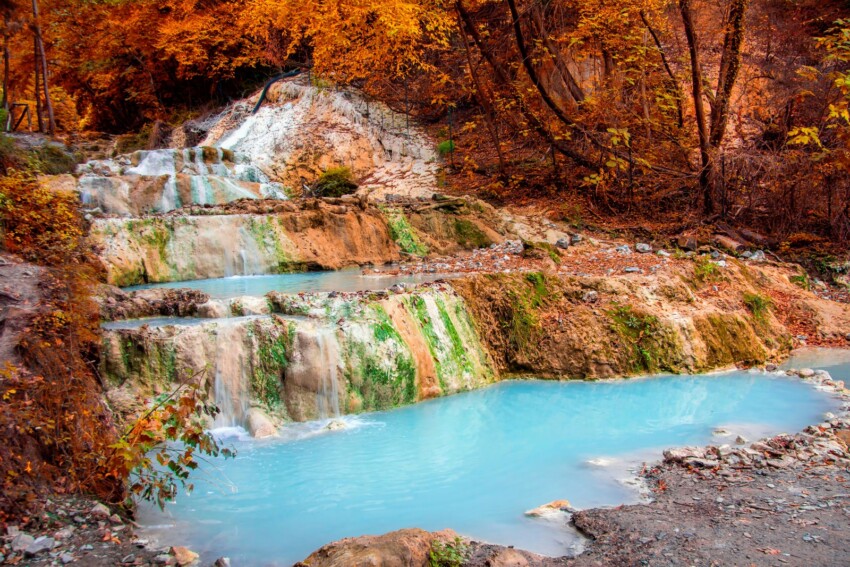
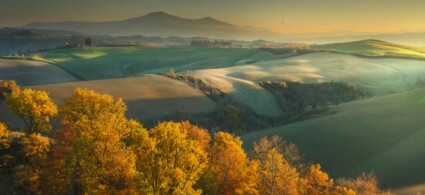
With just 91 inhabitants, Bagni San Filippo is a tiny village within the municipality of Castiglione d’Orcia. As the name suggests, we’re in the Val d’Orcia, a stunning area in south-eastern Tuscany that sits entirely within the province of Siena.
Yet despite its diminutive size, Bagni San Filippo draws considerable numbers of visitors throughout the year. Why? It’s a celebrated thermal spa resort, where sulphurous springs emerge to the surface, forming brilliant white limestone deposits, pools and small cascades. Among these, the most famous is undoubtedly the White Whale, an enormous mass of white limestone that, for its sheer impressiveness, resembles the profile of a whale.
The thermal waters spring up within a small stream at the eastern edge of the village and are therefore free, complimentary and open to everyone. If you’re after something more exclusive, there’s also a private thermal establishment with a paid entrance fee, located within a hotel.
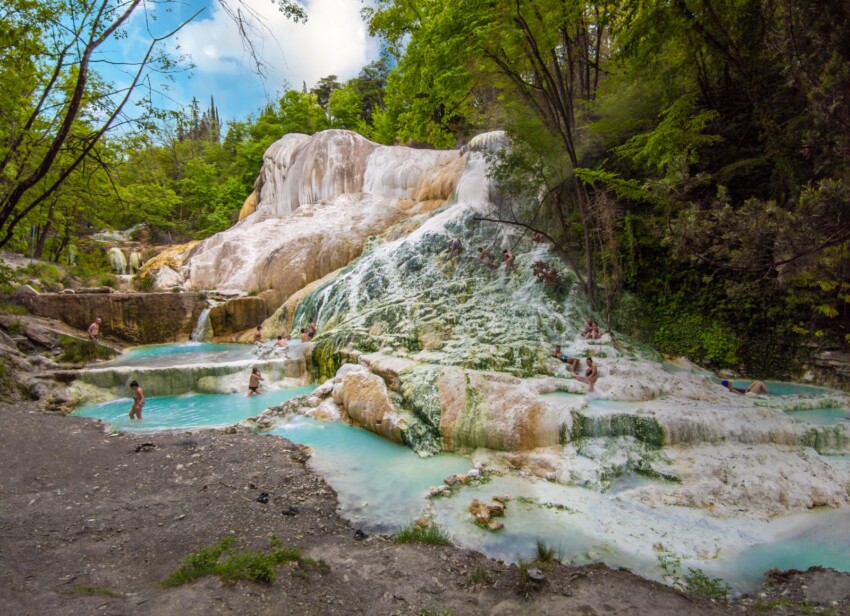
There’s no getting around it: many visitors to Bagni San Filippo come for its thermal springs. There’s a paid thermal establishment within a hotel and free hot springs, set within a fairy-tale natural landscape.
The free thermal springs at Bagni San Filippo are complimentary and always open: the thermal water forms a stream called Fosso Bianco, which creates genuinely magical scenes as it tumbles through cascades and pools. You can relax beneath the natural hot-water jets and enjoy the therapeutic mud found on the riverbed, which locals love to smear on themselves to soften their skin.
The thermal stream at Bagni San Filippo runs alongside the village; simply park your car along the main road and walk down for just a few dozen metres, entering a woodland where the thermal stream flows past. The water emerges from the earth’s crevices at 48°C, making it well worth visiting these parts even in winter to enjoy the steaming natural pools.
Also remarkable is the enormous limestone mass of the White Whale, Bagni San Filippo’s most celebrated attraction. It’s a true wonder of nature, and when the sun is high in the sky it’s completely illuminated, with its limestone crystals gleaming spectacularly. If you arrive at the White Whale after sunset, you’ll unfortunately find it in the shade of the trees, and won’t be able to admire it in all its majesty.
The thermal establishment at Bagni San Filippo is located within the Terme San Filippo hotel. The establishment’s springs have been approved by the Tuscany Region as therapeutic and their chemical-physical properties are constantly monitored. The facility offers treatments including mud therapy, hydrotherapy and inhalations, as well as wellness packages featuring body and facial treatments, massage and beauty therapy.
There’s also an extensive thermal pool, the oldest in Siena province, reached from the hotel via a truly scenic path. The pool has a sloping floor, and at its edge is a waterfall of hot thermal water. This section of the thermal establishment is open to external guests from March to October from 8.30 to 19.00; it closes on Tuesdays.
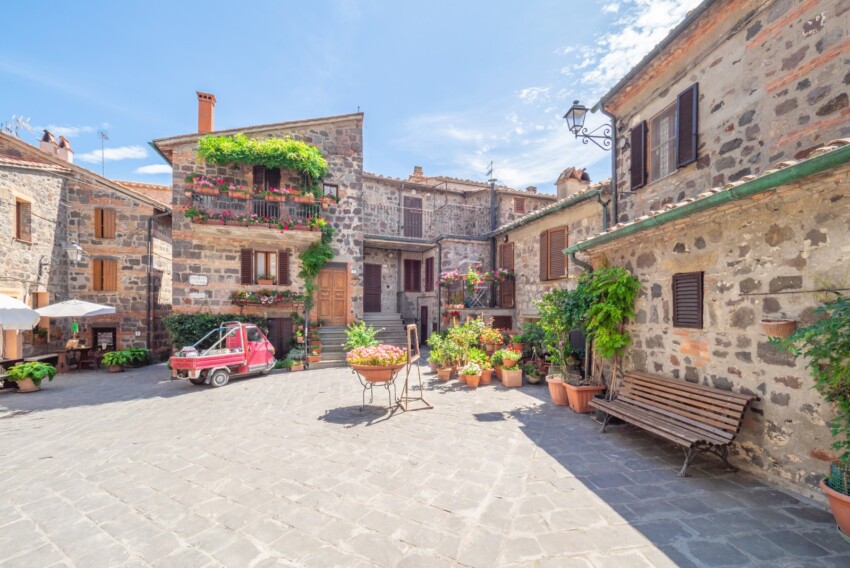
Being a very small village, there isn’t much to see in Bagni San Filippo itself. Just time for a dip in the warm thermal water, grab a bite to eat and then head off on your Tuscany tour. However, the surrounding area is very attractive and there are several worthy attractions.
The small oratory of the San Filippo grotto is located a short distance from the centre, reachable in just a few hundred metres heading west on foot or by car.
According to legend, Saint Philip Benizi withdrew to this grotto around the second half of the fifteenth century, and by striking a rock with his staff, he caused healing waters to spring forth, as a gesture of gratitude to the local inhabitants, who had welcomed him like one of their own during his stay.
This legend led to the construction of the chapel, built by the faithful inside the grotto, alongside the hermitage of the Servants of Mary. Today you can visit the grotto-oratory inside; above the altar you’ll see a black wooden bust of Saint Philip and other objects left in his honour.
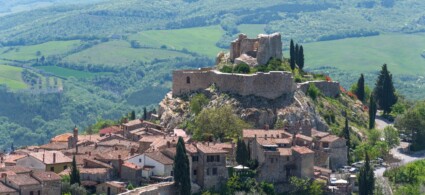
About 12 kilometres from Bagni San Filippo, along the provincial road SP468, you’ll find the Radicofani fortress, to the north of the village of the same name.
This impressive, well-maintained fortress is open to visitors inside, with a free route featuring explanatory panels where you can read about its history and purpose. It’s also possible to enter the tower, which houses a small museum, and climb to the top via around 100 steps to enjoy spectacular views of Radicofani village and the surrounding countryside, ranging from Mount Amiata to the west as far as Lake Bolsena to the south.
In Bagni San Filippo you’ll find several room rentals and small bed and breakfasts, as well as the Terme San Filippo hotel with its thermal establishment. It’s advisable to stay within the village or its immediate surroundings to have access to the few bars, restaurants and shops available.
Alternatively, as is very much in vogue in this part of the region, if you venture out from the village centre you’ll discover numerous farm stays, a perfect solution for sleeping in Tuscany if you love peace and quiet. Many farm stays in the area are ancient farmhouses completely renovated, often with a pool and in-house restaurant, where you can savour local specialities.
Bagni San Filippo is quite remote, but distances from Tuscany’s major cities are manageable thanks to its proximity – just 30 minutes’ drive – to the A1 motorway exit at Chiusi-Chianciano Terme; from the tollbooth, take the provincial roads SP146 and SP40 to reach the village directly.
Bagni San Filippo lies approximately 150 kilometres from Florence, covering which takes around 2 hours, whilst from the provincial capital Siena it’s just 60 kilometres but takes roughly an hour and 15 minutes, as there are no major trunk roads, only the regional road SR2. From the Tuscan coast the distance and journey time increase: roughly 3 hours from Pisa, approximately 2 hours and 40 minutes from Livorno.
Paradoxically, it’s easier to get here from Rome: from the capital’s centre it takes two and a half hours, travelling up the A1 motorway heading north to the Chiusi-Chianciano Terme exit. Chiusi also has the nearest railway station: once off the train, you’ll need to continue by regional bus, though services aren’t particularly frequent.
What's the weather at Bagni San Filippo? Below are the temperatures and the weather forecast at Bagni San Filippo for the next few days.
Bagni San Filippo is a village in the municipality of Castiglione d'Orcia, in the province of Siena. It sits in the heart of the Val d'Orcia, north-east of Monte Amiata, not far as the crow flies from the Umbrian border.
 Hotel
Hotel  Budget accommodations
  Apartments
  Family Hotel
  Luxury Hotel
  Resorts