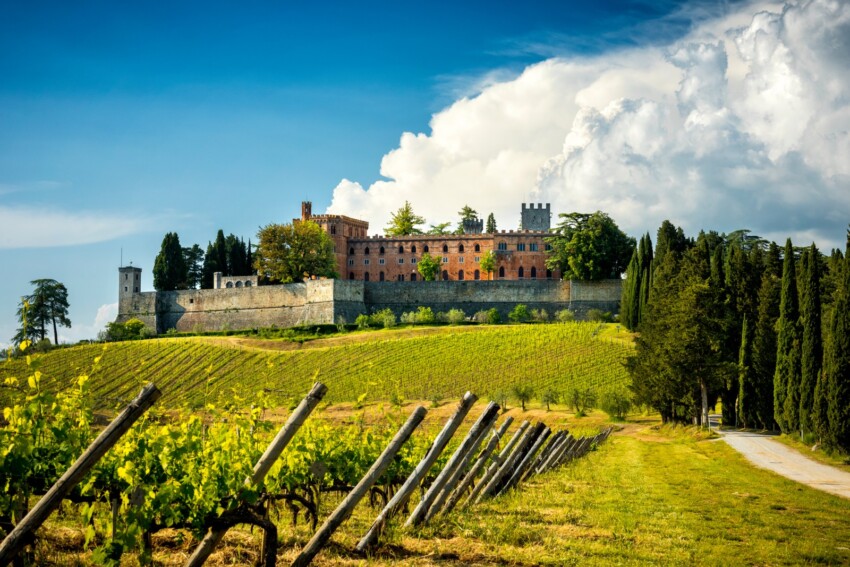
The Brolio Castle dates from the Lombard era, though no trace of the original fortress remains today save for its original location. Its significance in history began to grow from the 12th century onwards, when it fell into the hands of the powerful Ricasoli family from Cacchiano, to whom it still belongs.
Its strategic position was crucial for controlling that stretch of Chianti territory at the margins of Florentine influence, bordering the Sienese lands. Consequently, from the 14th century until the mid-16th century, the castle found itself at the centre of the bitter struggle between Siena and Florence for control of these important frontier territories.
We are indeed in the heart of Florence’s Chianti territory, with the Chianti League comprising the districts of Radda, Castellina and Gaiole, a region perpetually rich in feudal estates and fiercely contested between the two great powers. All the castles in the area, whether on the Florentine or Sienese side, were continuously reinforced to create two distinct opposing defensive lines.
The Brolio Castle remained almost consistently under Florentine control, with the exception of a temporary Sienese occupation following the second Aragonese invasion of Chianti in 1472. From 1484 onwards, when the castle returned to Florentine hands, a comprehensive programme of restructuring and reinforcement began, transforming Brolio into one of Italy’s earliest bastion fortresses.
Its stone bastions, in perfect condition to this day, form an irregular pentagonal shape, though with a more primitive structure than the development this new form of fortification would soon undergo. Some sources attribute the work to architect Giuliano da Sangallo, who was responsible for many of the Medici’s fortifications.
The walls enclose the remains of the original medieval castle, particularly the keep and a Romanesque church, along with a grandiose red-brick neo-Gothic villa built in place of the existing structures by Baron Bettino Ricasoli (1809-1880), the renowned statesman known as the Iron Baron, in the last century. The castle stands at the centre of extensive vineyards, from which the Ricasoli counts have been producing their celebrated wine since 1141, aged in cellars within the fortress walls. Though privately owned, the castle is open to visitors, with the exception of the palace itself. It’s possible to walk the entire circuit of the bastions, from where there are magnificent views across the Chianti hills.
The Brolio Castle stands at the heart of the Chianti Senese region and is easily reached from Siena via Castelnuovo Berardenga, or from the "Valdarno" exit on the A1 motorway, following the SS408 until the junction with the SS484, which is named after the "Castello di Brolio".
Brolio is 65 km from Florence, 22 km from Siena and 7 km from Gaiole.
 Hotel
Hotel  Budget accommodations
  Apartments
  Family Hotel
  Luxury Hotel
  Resorts