Agriturismo Percenna
Buonconvento - Località Percenna
Book now
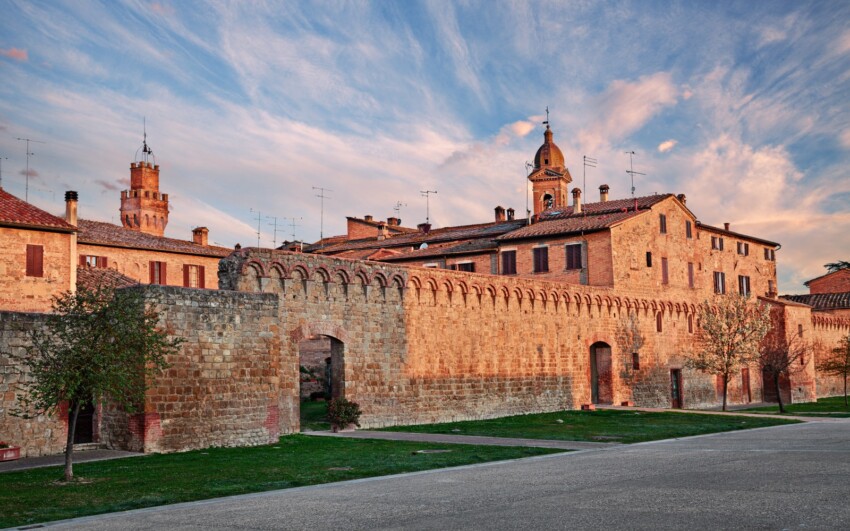
An important agricultural centre situated on the gentler slopes of the Crete Senesi, Buonconvento experienced significant development in the thirteenth century thanks to its particularly favourable position at the confluence of the Arbia and Ombrone rivers and along the Via Francigena.
It remained consistently under Sienese rule until 1313, when it was occupied by the forces of Emperor Henry VII, who died there suddenly. The town is enclosed within the rectangular plan created by the fourteenth-century town walls, of which it preserves the monumental northern gate.
In the past, alongside flourishing agricultural production—particularly of mulberry trees that fed the silkworms—came the rearing of cattle, which became so important that from 1854 it warranted an annual fair. A striking example of the passionate recreation of the medieval-humanistic past in a modern key, as was mentioned regarding the Cappella Pieri Nerli at Quinciano in the municipality of Monteroni d’Arbia, is also present in the church of the Arciconfraternita della Misericordia in Buonconvento, rich in polychromatic decorations alluding to the white and green marble tradition of Sienese art between the fourteenth and fifteenth centuries, with vaulted ceilings painted in coloured bands and golden stars against blue backgrounds, pointed arch windows with richly decorated stained glass, and expertly carved wooden furnishings.
These were essentially all the ingredients that artists such as Giuseppe Partini would employ during those stylistic restorations (from the lost interior of the Collegiata in Asciano or many sections of the convent complex of Monte Oliveto Maggiore, to Sienese buildings such as the interior of the church of San Francesco or the imposing and wholly neo-medieval Castellare dei Salimbeni) which more often than not aimed at erasing the artistic evidence of the centuries following that ‘golden’ moment of Tuscan art, regarded as the fruit of a ‘decline’ that they sought to reverse by restoring the building in question to its ‘original’ appearance (genuine or more often merely presumed).
A practice that led to the reconstruction of entire sections of the building ‘under restoration’ according to an architectural language that was certainly not (and was certainly not intended to be) a faithful (servile) reproduction of the original thirteenth or fourteenth-century work (thus new brick towers, new marble facades, imposing crenellations, richly carved portals, wall surfaces adorned with artistically wrought ironwork, rooms or choirs whose walls were entirely covered in carved and inlaid wooden panelling and stalls, vaults frescoed in the manner of fourteenth and fifteenth-century artists, coloured windows, and so forth), but rather a sentimental testimony to how nineteenth-century artists and art enthusiasts relived the forms of a cherished age in their ‘troubled and moved’ hearts—an age largely invented by themselves (much as certain interpretations of the Middle Ages or Renaissance, revisited in so many melodramas through the romantic sensibility of Giuseppe Verdi).
In the territory, note should be made of the new church of San Lorenzo, built at Bibbiano to designs by the Sienese Lorenzo Doveri between 1820 and 1822, as well as the pieve of San Lorenzo at Percenna, of medieval origin, renovated in 1830.
The fortified settlement of Bibbiano has been present here since at least 850, property of the Lombard count Guinigi of Reghinari, an imperial legate in the time of Louis II. The name Bibbiano derives from ‘Bibbio’ (in Latin bibianum), a water bird similar to a duck of which these lands were rich, also called a Wigeon.
The Bibbiano castle dominates the upper Ombrone valley from a hilltop at a short distance from Buonconvento. The fortified settlement has been present here since at least 850, property of the Lombard count Guinigi of Reghinari, an imperial legate in the time of Louis II. The name Bibbiano derives from ‘Bibbio’ (in Latin bibianum), a water bird similar to a duck of which these lands were rich, also called a Wigeon.
Property of the Guiglieschi, in 1051 Emperor Henry III entrusted it to the protection of the Abbey of Sant’Antimo. Bibbiano then passed to the Cacciaconti counts, who in 1197 donated it to the Sienese Republic, which proceeded to strengthen the structures. Further additions and restorations were carried out in 1338 and in 1400. During this period Pietro Lorenzetti was a guest of the castle, painting his final work here, the Annunciation. Damaged repeatedly, at the beginning of the sixteenth century the complex was purchased by Cardinal Raffaello Petrucci, who had it restored by Baldassarre Peruzzi, who painted a splendid Madonna in the castle chapel. Other significant changes brought Bibbiano first into the hands of the Borghese, the Chigi and the Malavolti of Siena. In the last century the castle was declared a national monument (1922). Today the castle remains private property, part of a vast agricultural and wine-producing estate owned by Commendatore Silvio Nardi.
Although it was used more as a residence than as a stronghold, Bibbiano still presents itself today in its proud aspect as a medieval castle, a massive quadrilateral surrounded by a moat, the main gate equipped with a drawbridge, two curtain walls with loopholes, a wall-walk and much of the Guelph crenellation intact, two corner turrets with defensive apparatus projecting on stone corbels (both on the western front, one intact and one lost), a central keep (whose top was rebuilt after the 1909 earthquake and fitted with a roof resting on the pre-existing crenellation). The whole is freely visitable from the outside, the interior only by appointment.
What's the weather at Buonconvento? Below are the temperatures and the weather forecast at Buonconvento for the next few days.
To see all the facilities and book accommodation in Buonconvento use the form below, entering the dates of your stay.
 Hotel
Hotel  Budget accommodations
  Apartments
  Family Hotel
  Luxury Hotel
  Resorts