Podere La Ciabatta
Casole dʼElsa - Locolità Monti
Book now
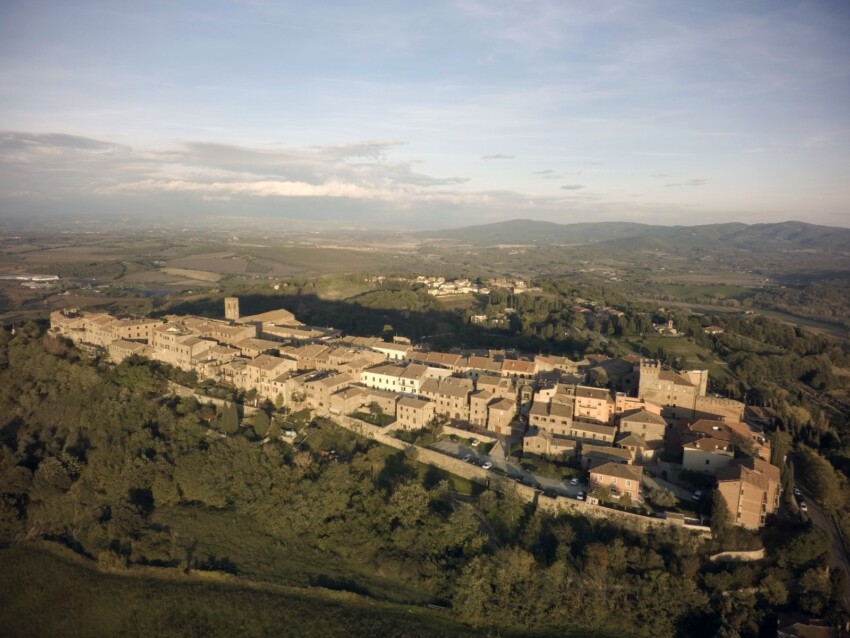
The territory of the Municipality of Casole d’Elsa is composed predominantly of gently rolling and low hills planted with vines, olives and cereals, situated along the watershed that separates them from the upper Elsa valley. It lies in the north-western part of Siena Province, approximately 34 km from the provincial capital.
The most notable reference points, running north to south, are the heights of Casole (418 m), Querceto (333 m) and Mensano (499 m). From a hydrographic perspective, the area is mainly affected by two streams: the Senna, which flows east of Casole and joins the Elsa river just north of Collalto, and the Sellate stream, which originates from the slopes of Monte Pilleri west of Casole and describes a wide curve from south to west, running for some distance parallel to the Cecina river before joining it.
Environmentally significant features include its woodlands, comprising the Berignone Forest and the Montagnola Senese forests. It borders the Municipalities of Colle Val d’Elsa, Monteriggioni, Sovicille, Chiusdino, Radicondoli, Castelnuovo Val di Cecina and Volterra (from N. to W. following a clockwise direction).
The Municipality of Casole d’Elsa covers an area of 148.63 sq km and includes 4 hamlets: Cavallano, Mensano, Monteguidi and Pievescola.
Now the seat of the Municipal offices, this is a fourteenth-century fortress considered one of the most important castles in the Val d’Elsa region. However, the complex has undergone numerous alterations over the centuries.
An imposing quadrangular structure, it features a massive stone tower at the north-west corner and a smaller one projecting diagonally at the opposite corner. On either side of the entrance door are several well-preserved arrow slits.
Inside, rooms have been converted for the Living Art Gallery (Pinacoteca d’Arte Viva), spaces dedicated to young people’s art and their meeting point. In the municipal atrium, contemporary paintings exhibitions by Siena artists are organised fortnightly, called “Palazzo Exhibitions”, which enjoy considerable recognition throughout the area. The Rocca atrium is open to the public daily, including holidays, from 8.30 am to 8 pm with free admission.
Its façade is adorned with the coats of arms of ancient families from Casole and Siena. It currently houses the Twentieth-Century Siena Art Gallery (Pinacoteca d’Arte Senese del 900). Visit by appointment by contacting the Tourist Office on 0577 949737 – Free admission.
Originally a Romanesque Parish Church, it was consecrated in 1161.
Inside you can admire the Baptistry with a sixteenth-century baptismal font; the funeral monument of B. Aringhieri, from the first decade of the fourteenth century by sculptor Marco Romano; the funeral monument of fourteenth-century sculptor Gano di Fazio; the painting by Alessandro Casolani entitled “Pietà and Saints Andrea and Niccolò”, documented 1586-87; painted fragments from the Duccio school; a glazed polychrome terracotta altarpiece by Giovanni della Robbia; numerous seventeenth-century canvases by prestigious artists (Pisani, Manetti, Volpi) and other nineteenth-century works (Ridolfi and Cassioli).
Situated on a small hillock a few hundred metres from Casole, the Church of San Niccolò is documented from 1348 onwards. Inside you can find frescoes by Vincenzo and Francesco Rustici and, above the main altar, a Madonna from the Siena school of the fourteenth century.
Divided into two sections, it preserves in the archaeological section various artefacts found in necropolises from the Hellenistic period (4th-2nd centuries BC), ceramics and cremation urns, whilst the sacred art section contains paintings and sculptures created from the 13th to 16th centuries.
Casole d’Elsa, an ancient Etruscan settlement as evidenced by the numerous tombs discovered there, is a village perched on a hilltop that offers visitors a panoramic view of great beauty. In the eleventh and twelfth centuries, it was a fief of the Bishops of Volterra.
Passing under Siena’s rule in 1260, as it was a location of strategic interest, it was subsequently necessary to build new fortifications to defend it from external attacks, including two round towers on the eastern side that still exist today. Casole thus took on the characteristics of a “walled tower town”, surrounded by walls that remain preserved to this day.
The walls encircling Casole are ovoid in shape, with the major axis extending approximately 400 metres and a width of around 130 metres. The two ancient gateways no longer exist; the northern one was called Porta ai Frati; the southern gate, known as Porta Rivellino, can now only be seen in old photographs taken before it was destroyed by the Nazis during the Second World War.
On the eastern side, two round towers built in 1481 by Francesco di Giorgio Martini, who was commissioned to strengthen all the fortifications, are still standing.
What's the weather at Casole d’Elsa? Below are the temperatures and the weather forecast at Casole d’Elsa for the next few days.
To see all the facilities and book accommodation in Casole d’Elsa use the form below, entering the dates of your stay.
 Hotel
Hotel  Budget accommodations
  Apartments
  Family Hotel
  Luxury Hotel
  Resorts