Castello di Fonterutoli Wine Resort
Castellina in Chianti - Via Puccini 4
Book now
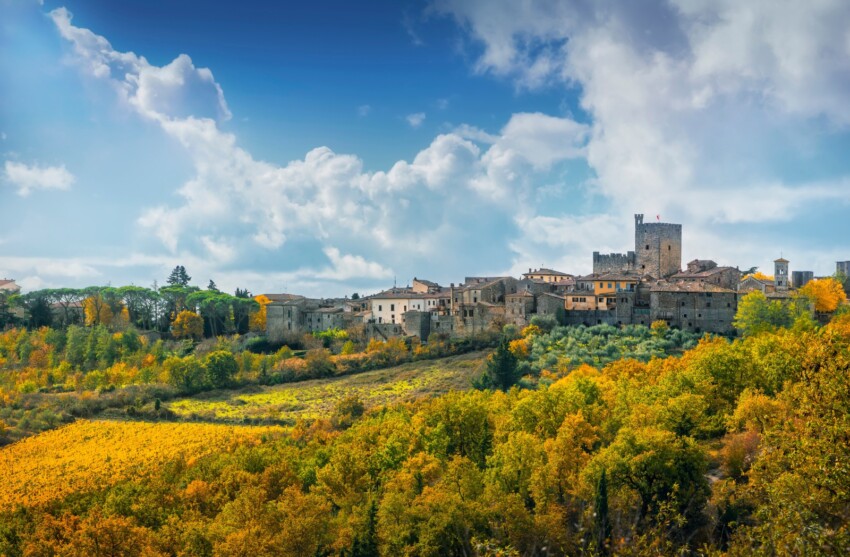
Castellina sits perched majestically on its hillside position. The town boasts a succession of noble mansions and converted military strongholds, initially erected by the allies of the Counts Guidi, who originated in Garfagnana and pushed deep into the heart of Tuscany in attempts to control it through diplomatic or direct military means, and later reinforced by the Florentines, who remained ever watchful of their Sienese rivals. The heart of the settlement is dominated by the ancient Rocca, designed in the second half of the fifteenth century by Giuliano da Sangallo, the supreme architect whom Vasari himself documented extensively.
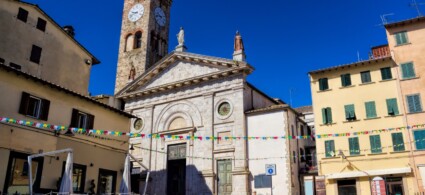
Via Ferruccio, meanwhile, offers a sense of Castellina’s former opulence. It is precisely at the end of this street, at the junction leading to the Rocca, that you’ll find the Church of San Salvatore in neo-Romanesque style, rebuilt after destruction during the Second World War.
A visit to Castellina naturally lends itself to wine tastings in the numerous wine bars, but also provides the opportunity to experience the distinguished charcuterie traditions of Chianti, offering cured meats of exceptional quality and unforgettable flavours.
Of Etruscan origin, Castellina in Chianti played a primary role thanks to its strategic position connecting the southern Etruscan cities with the north. In 1200 it came under Florentine influence after being a fief of the Lords of Trebbio, serving as their military garrison, particularly given its geographical proximity to Siena, Florence’s historical enemy. During this period it was the capital of the Chianti League, which encompassed the territories of Gaiole in Chianti and Radda in Chianti, whose emblem is a black rooster, the same symbol reproduced in the coat of arms of Castellina municipality. In 1500 it became a permanent part of the Grand Duchy of Tuscany, losing its strategic military character and transforming into an agricultural centre: its hills became covered with farms and rural dwellings.
In 1944, during the Second World War, Castellina witnessed the German troops’ retreat, who established a defensive line here, destroying the ancient Florentine gate and the Church of San Salvatore. Castellina’s centuries-long strategic military role is represented by the fifteenth-century Rocca Comunale, which houses an Antiquarium containing Etruscan finds, in whose courtyard you can admire the well. The Rocca formed part of the walls built by the Florentines, which encircled the entire town, interrupted only by two gates facing one towards Siena, the other towards Florence.
The historic centre retains a medieval layout, evidenced by Via delle Volte, a covered street running alongside the ancient walls.

The ruins of Monternano can be reached by following a secondary branch of the SS429 Val d’Elsa stretch connecting Poggibonsi to Castellina in Chianti. The junction, which leads onto an unpaved lane, is located on the right after approximately 6 km for those coming from Castellina [from this direction it is more easily identifiable], and bears the tourist signage for the Pieve di Cispiano. Past this locality continue on, and a few hundred metres after the lane begins to descend, turn right at the sign for La Spedda/Monternano. After approximately 1.5 km of driving through woodland, the road ends at a tower house [private property] in front of which stands what remains of the castle. Monternano was one of the most powerful and extensive castles of the Val d’Elsa, mentioned as early as 1089 in a donation deed by Countess Mingarda di Morando to a certain Giovanni di Benzo, later confirmed as a fief to the Counts Guidi by emperors Henry VI and Frederick II. From these it passed to the Sienese family of the Squarcialupi, becoming their principal stronghold.
Monternano’s position [previously also known as Montennano, Mortennano and Montennana], on the border between the territories of the Sienese and Florentine Republics, was of primary strategic importance: situated along the southern slope of the mountainous ridges descending from Chianti into the Val d’Elsa, on a rocky spur above the Strolla stream, from which it exercised control over two fundamental medieval roads including the Via Francigena in the valley below and the Giogoli road in the Sienese Chianti.
Together with nearby Poggibonsi it constituted an impregnable barrier to Florentine incursions southwards. As early as 1201 the Florentine army attacked Monternano causing severe damage, but it was in 1220, under the pretence that Florentine merchants had been robbed by the Squarcialupi, that the mighty fortress was taken and razed almost to the ground.
A massive structure rising over the main square with a fourteenth-century crenellated tower from whose summit you can admire a remarkable Chianti landscape. Inside it houses a small Etruscan museum. This area of Chianti has been inhabited since antiquity. Based on recent excavations, an Etruscan settlement appears to have existed between Casa Vico and Salivolpe, localities only a few hundred metres from the present-day town of Castellina, a hypothesis supported by the discovery of four underground tombs dating from the seventh to sixth centuries BC on the Montecalvario hilltop. Subsequently the area was also home to a Roman centre destroyed during the Gallic invasions.
The earliest written records date back to the Middle Ages; in the eleventh century Castellina was mentioned as a settlement dependent on the nearby Trebbio castle (corresponding to present-day Trebbia in Radda in Chianti municipality) under the control of the Counts Guidi, to whom the construction of the first fortifications is owed. At the time the locality was known as ‘Castellina de’ Trebbiesi’.
As early as 1193 the castle, thanks to an agreement signed by the Lords of Trebbio, was garrisoned by the Florentines. By the mid-thirteenth century Castellina had become part of the Chianti League and subsequently became the capital of one of the three districts (the other two were headed by Radda and Gaiole) into which the league was divided, the one called ‘Terzo di Castellina’. As is well known, Chianti was throughout the Middle Ages a theatre of conflicts and disputes between the powers of Florence and Siena. Castellina, commanding the ridge road connecting the two cities, was one of the most advanced Florentine strongholds and consequently of great strategic importance.
In 1397 the castle was destroyed by troops of the Duke of Milan, allied with the Sienese. A few years later, in 1400, the Florentine Republic decided to strengthen its defences with the construction of a wider and more massive ring of walls, in an irregular hexagonal form, interspersed with numerous square towers, equipped with two gates, one facing Siena and the other Florence, and crowned at the highest point of the settlement by a powerful crenellated rectangular keep with battered walls. Extensive stretches of the walls and towers remain encircling the town (though in several places incorporated into buildings), the two gates unfortunately no longer exist today, the Florentine one was destroyed during the last world conflict [what we see today is a later opening in the wall line]. The keep, formed of two square structures, with its tall walls, is in perfect condition, thanks to careful restoration work in the early twentieth century; today it houses the town hall.
This series of powerful fortifications saw its baptism of fire in 1452 when it resisted a forty-four-day siege by the Duke of Calabria. It appears that during this period Castellina was further strengthened by the great Medici architect Giuliano da Sangallo. Despite this, in 1478 the castle capitulated to an attack by the Aragonese army and, like those nearby, was plundered and half-destroyed. In 1483 Castellina returned permanently to Florentine hands.
In 1774 the Chianti League was abolished but the territory of the new ‘Comunità di Castellina’, born from the reforms desired by Grand Duke Peter Leopold, like the present-day municipality now in Siena province, coincided almost perfectly with the ancient Terzo. A brief tragic war event saw Castellina as protagonist in 1944, when German troops in retreat, favoured by the difficult terrain, set up a defensive line that caused dozens of civilian deaths and considerable destruction.
A short distance along the SS222 you’ll encounter this archaeological site comprising four underground tombs dating from the seventh to sixth centuries BC. The entrance dromos remains, and in two tombs the burial chamber is also preserved.
What's the weather at Castellina in Chianti? Below are the temperatures and the weather forecast at Castellina in Chianti for the next few days.
To see all the facilities and book accommodation in Castellina in Chianti use the form below, entering the dates of your stay.
 Hotel
Hotel  Budget accommodations
  Apartments
  Family Hotel
  Luxury Hotel
  Resorts