Castello di Bossi
Castelnuovo Berardenga - Località San Felice
Book now
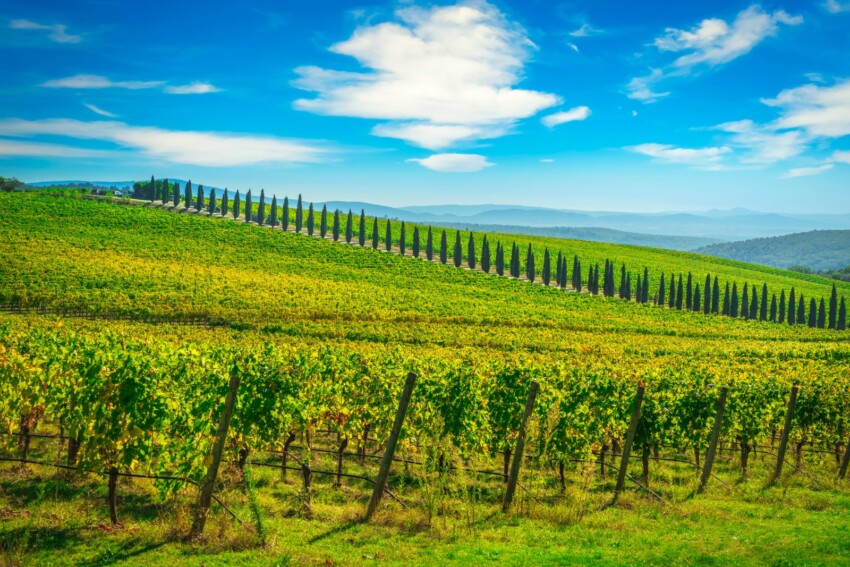
Castelnuovo Berardenga, situated away from the Chiantigiana road but now considered part of Chianti, has maintained many of the architectural characteristics and cultural values typical of small medieval Chianti centres despite fairly modest urban growth and building renewal, attracting large numbers of Italian and foreign visitors throughout the year.
The settlement originated in the High Middle Ages as the domain of a Frankish nobleman (Berardo, from which the territory takes its name, the County of Berardenga), and was fortified by Siena in 1366 to control its border with Florentine territory. Following the fall of the Florentine Republic, it became part of Florence and developed into a predominantly rural area.
In 1833, Emanuele Repetti described the large rural community of Castelnuovo, governed from the castle (now a distinct settlement), which served as the seat of a podestà (with a Monday market and three annual fairs). This structure resulted from administrative reform enacted by royal decree on 2 June 1777, which consolidated the 38 separate communities and settlements of Berardenga that had previously been divided between the municipalities of Castelnuovo and San Gusmè.
The Berardenga territory was traversed by various roads made suitable for wheeled traffic (including the royal Siena-Arezzo road, the provincial Siena-Castelnuovo road and the Chianti provincial road between Siena and San Gusmè). In 1833, it had 6,663 inhabitants (compared to 4,465 in 1745) and comprised two distinct environments: the northern area of harsh, stony structural hills representing the southern edge of the Chianti mountain system, and the southern area of gentler clay hills of marine origin, which connects instead to the Crete Senesi.
Repetti noted the “fine wines, palatable pastures and substantial grain [that] the clay hills produce, though more fruitful are the slopes not stripped of the upper layer of sand or marine tufa. The wines near Castelnuovo and in the northern and western parts of the community in the upper Chianti mountains are highly regarded; the cheeses are excellent, and the oil produced in both areas is of outstanding quality”.
The wooded northern hills supported countless pigs, whilst the grazing southern hills were home mainly to sheep. Numerous domestic craft activities were also widespread in the villages and countryside, particularly in silk production (there were “several silk mills”), wool and hemp processing. Regarding land ownership, “the greater part of the soil is possessed by noble Sienese families, who have converted so many small fortresses, granaries, strongholds and towers into rural administrative houses, or pleasure villas”.
In this ancient “new land” of Siena (renewed between 1373 and 1374 according to plans by architect Mino Dei), significant Lorraine-period buildings are evident, notably the Villa Chigi Saracini, commissioned by Galgano Saracini in 1820 from Agostino Fantastici, who completed it in 1840. The villa occupies a space left by the demolition of part of the ancient walls and includes the chapel of San Giovanni with a rusticated façade, triangular pediment and Ionic portal. The interior features a barrel-vaulted ceiling with family tombs, and above the altar hangs Giovanni Bruni’s painting of the Martyrdom of Saint Ursula.
Also worthy of note are the church of Santi Guido and Clemente (1843-1846), also designed by Agostino Fantastici on commission from Count Agostino Saracini, with a Greek cross plan, Ionic tetrastyle portico in travertine, and brick rusticated walls; and the oratory of the Confraternity of Santa Maria del Patrocinio (1851-1860), by Andrea Chiusarelli, featuring a gabled façade in travertine and rendered plaster. Built to honour a 14th-century polychrome terracotta figure of the Virgin Mary that the residents of Castelnuovo Berardenga believed to be their community’s protector, they attributed to the Madonna – called for this reason ‘del Patrocinio’ (of Protection) – the credit for safeguarding their land from invasions and wars on multiple occasions.
The municipality of Castelnuovo Berardenga boasts numerous 17th and 18th-century villas, such as those at Arceno, Geggiano (Villa Bianchi-Bandinelli), Guistrigona (Villa Bulgarini), Sestano and Villa a Sesta; as well as renowned religious establishments, including the Certosa di Pontignano, Badia Monastero, and the church of Santa Maria a Pacina. The territory also contains the site of the Battle of Montaperti between Sienese and Florentine forces, immortalised by Dante Alighieri.
The villa of Arceno lies between Castelnuovo Berardenga and Gaiole. The complex was renovated by the Del Taja family in the 18th century. The 18th-century chapel of San Giovanni, transformed by Agostino Fantastici in 1833, and the romantic garden are particularly noteworthy.
The church of San Salvatore at Badia Monastero, near Quercegrossa, was once the church of an ancient monastery that was initially a female Benedictine community and later a male Camaldolese one. Suppressed in 1810, it subsequently became the property of the Piccolomini family and a villa-farmhouse in the early 20th century. The church, with its bell tower on the façade, was reduced in size in the early 19th century: the original structure retains the apse, the transept arms and a small elliptical dome in the drum (the crowning was removed in 1840), whilst the short nave with tie-beams dates to 1806.
The Villa Bianchi-Bandinelli at Geggiano is located near Pontignano, towards Vagliagli. From 1777-1784 it hosted for brief periods Vittorio Alfieri, who recited some of his compositions in the open-air theatre of the garden. The villa was visited by Pope Pius VI in 1798, fleeing Rome following the Treaty of Campoformio. In the ground-floor corridor are frescoes depicting Scenes of the Months by Tyrolean artist Ignazio Moder (based on designs by Giuseppe Zocchi engraved by Francesco Bertolazzi), which also features a portrait of Alessandra Mari, a leading figure in the “Viva Maria!” movement of 1799. Also noteworthy is the chapel of Madonna del Rosario (1769-1799) with elegant stucco work.
At Guistrigona, near Pacina, stand the Villa Bulgarini with its chapel of San Francesco Saverio dating to 1801; and the 11th-century church of San Donato, enlarged in the 18th century.
At the site of the famous Battle of Montaperti fought in 1260 between Sienese and Florentine forces, immortalised by Dante Alighieri, a romantic commemorative monument marks the spot in memory of “the slaughter and the great bloodshed / that the river Arbia ran red with” (Inferno, X, 85-86). A double ring of cemetery cypresses surrounds a small stele on the hill of Montapertacci. Near Montaperti stands the church of Santa Maria, with a central arcaded plan, executed in 1836-1837 from a design by Francesco Canale.
The church of Santa Maria a Pacina, near Pianella, dating from the proto-Romanesque period (three naves with a cylindrical bell tower), was transformed in the 17th and 18th centuries, rather than restored.
The Certosa di Pontignano was founded in 1343 and underwent profound renewal in the second half of the 16th century following damage sustained during the War of Siena. In 1784 it was given to the Camaldolese monks of Monte Celso; it was sold after suppression in 1810. The church’s ‘great chapel’ (decorated in the late 16th century by Poccetti and Sienese artists associated with him) deserves particular attention, having been redecorated in the 18th century with Saints by Apollonio Nasini, circa 1720.
The villa of Sestano, near Quercegrossa, dates from the 18th century. The adjoining chapel of Maria Santissima, erected by Agostino Fantastici in 1833, is octagonal internally and rectangular externally, with a small brick façade. At Villa a Sesta, situated between Castelnuovo Berardenga and Brolio, the very ancient church of Santa Maria is noteworthy, having been rebuilt in the early 19th century in Neoclassical style.
What's the weather at Castelnuovo Berardenga? Below are the temperatures and the weather forecast at Castelnuovo Berardenga for the next few days.
To see all the facilities and book accommodation in Castelnuovo Berardenga use the form below, entering the dates of your stay.
 Hotel
Hotel  Budget accommodations
  Apartments
  Family Hotel
  Luxury Hotel
  Resorts