Terre di GIORGIO Agriturismo Villa la Palazzetta
Castiglione dʼOrcia - Strada Provinciale del Monte Amiata
Book now
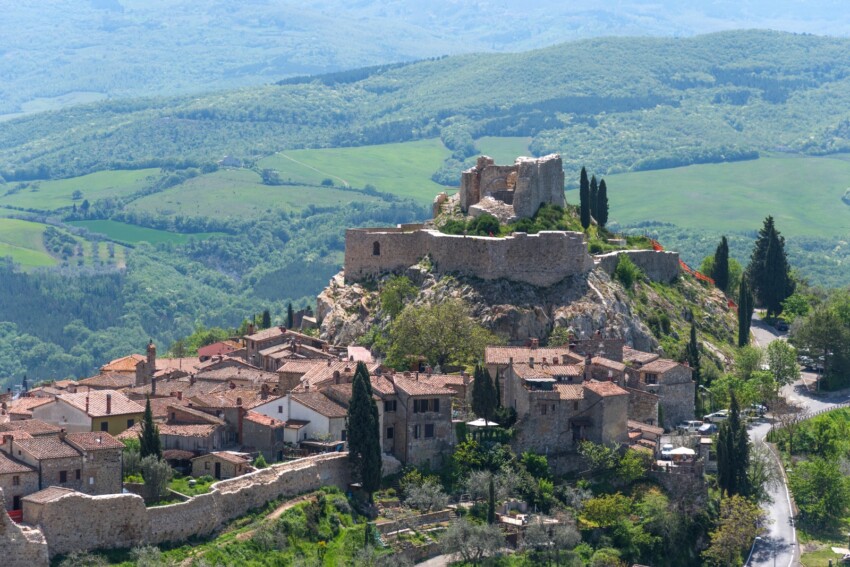
It’s hardly a secret that the Val d’Orcia is one of the most beautiful areas in Tuscany. Stunning landscapes, rolling hills stretching to the horizon, rows of vineyards and winding roads lined with cypress trees. This is the iconic image of the region, and it’s here in this zone that its most authentic soul is revealed.
Among the numerous villages dotting the Val d’Orcia, Castiglione d’Orcia deserves special mention. You’ll find it in the province of Siena, in the heart of Tuscany, in an area far from the coast and certainly not well served by transport links. But the effort to get here will be more than rewarded, thanks to the beauty of the landscape and the charming historic village, small and compact, perched on a hilltop.
Castiglione d’Orcia makes a perfect stop on a Tuscany tour, but it can also serve as a comfortable base for staying overnight, as the town centre offers a range of apartments and B&Bs, not to mention an almost endless array of agriturismos in the surrounding countryside, from where you can make the most of the Tuscan landscape. From here you can easily venture out to discover other treasures of the area, such as Bagno Vignoni, just a few kilometres away, or the Abbey of Sant’Antimo.
The first thing to see in Castiglione d’Orcia is the small but charming historic village. After that, venture into the surrounding area to enjoy some of Tuscany’s most beautiful views.
Begin your exploration of Castiglione d’Orcia with a stroll through the town centre. The village is small and easily walkable, and exploring it all won’t take more than half a day, including a lunch break.
With its stone and brick buildings, Castiglione d’Orcia is a perfect example of a Tuscan village, offering splendid views of the surrounding countryside, thanks to its commanding position.
Start your tour from the heart of the historic centre, namely Piazza Il Vecchietta, then wander up the narrow streets without a fixed route, to experience Castiglione d’Orcia at your own pace. During your walk, you’ll pass the Church of Santa Maria Maddalena, the San Giovanni Art Hall museum, and be sure not to miss the Rocca Aldobrandesca, the town’s symbol and the highest point of the historic village.
The San Giovanni Art Hall is a small museum located in the heart of Castiglione d’Orcia, at Via San Giovanni 15. Inside you can admire paintings by renowned artists such as Simone Martini and Lorenzo di Pietro, known as Il Vecchietta, among the most important exponents of the Sienese school.
The museum is housed in the former Oratory of St John the Baptist, a building dating from the 16th century. Alongside works by Martini and Il Vecchietta, you can also see liturgical furnishings from the churches of the area.
The Rocca Aldobrandesca in Castiglione d’Orcia is now in ruins, and what remains to be seen are the remnants of the ancient medieval defensive walls. It dominates the village from above, and since 2018 it has been closed for restoration work. However, you can walk around it to observe the ruins of the ancient castle.
The fortress was built at the behest of the Aldobrandeschi family around the 10th century to control the road from Mount Amiata to the Val d’Orcia, a strategic communication route to the Maremma.
The locality of Rocca d’Orcia, a tiny village with only 34 inhabitants, is famous because its buildings are built around a hill at the centre of which stands the Rocca di Tentennano, a medieval fortress built on the summit of the rocky spur for military purposes.
The Rocca di Tentennano boasts the distinction of being the only fortress in the Val d’Orcia that has never been taken by storm. Built of limestone, this impressive fortification has an enclosed area and a ring of walls, beneath which lies what is now the park, but was originally the castle.
In 1971 the fortress was donated by its owners to the Italian state, and restoration work began 4 years later. Today, aside from being one of the symbols of the Val d’Orcia and one of the most photographed sites in the Castiglione d’Orcia area, the Rocca di Tentennano has also become an exhibition space, hosting a series of permanent and temporary exhibitions.
Worth noting are the picturesque villages of Ripa, Campiglia and Vivo d’Orcia, which preserve beautiful churches and splendid palaces, among which stands out the ancient Camaldolese Hermitage of Contea, founded before the year 1000, but still visible in the majestic 16th-century forms desired by the Cervini of Montepulciano, who entrusted its realisation to a skilled architect (probably Antonio da Sangallo the Younger).
At the foot of the Hermitage stands the wood of native firs, the Abetina del Vivo; those who reach the hermitage on foot can also cross a striking little valley where the charming Lovers’ Bridge stands.
Not far from the Hermitage is the Romanesque church of Ermicciolo, surrounded by a small copse of chestnuts. Above Campiglia stands the ruined Visconti palace known as Campigliola, which would deserve proper restoration, if only for its location, once strategic and now panoramic.
The heart of Vivo is constituted by the Hermitage, also called Contea, which stands lower than the village that formed in more recent times. The Hermitage is made up of a group of houses dominated by the palace of the Counts Cervini and the Church of San Marcello. The Cervini palace was originally a monastery of the Camaldolese order, and was ceded to the Cervini family in 1517.
In the main village you’ll find the Church of San Marcello, which was probably the original church of the monastery and was later dedicated to Marcello Cervini, who was elected pope in 1555.
Bagni di San Filippo owes its origin to the presence of thermal waters with therapeutic properties known since ancient times. The Fosso Bianco, near the village, is worth a visit, where waters flow and create a landscape of white rocks through the limestone deposits left by their passage.
Also worth visiting is the cave of San Filippo, carved from a single large block of travertine and divided in two by a partition. Tradition has it that St Philip Benizi took refuge here in 1267 to escape election as pope and live as a hermit.
Basically, there are two options for those who choose to stay in Castiglione d’Orcia: remain in the historic village or venture into the surrounding area.
The first choice means you’ll most likely be staying in an apartment or a bed and breakfast, almost certainly housed in an ancient building and completely renovated.
If you choose to stay in an agriturismo instead, you’ll be a few kilometres from the centre and in the heart of the Tuscan countryside, where you can best enjoy the peace and tranquillity, spending a holiday focused on relaxation and good food.
Castiglione d’Orcia is never particularly convenient to reach, as it’s far from major transport routes. From Florence, for example, it takes 2 hours driving first south along the Florence-Siena motorway link, and then, once you reach Siena, continuing along the SR2 road which takes you virtually to the edge of the historic centre. The total journey is almost 130 kilometres.
The distance from the provincial capital Siena is approximately 55 kilometres, which takes about an hour.
To reach Castiglione d’Orcia from Tuscany’s coastal towns such as Pisa or Livorno, the journey takes almost 3 hours. There are two alternatives: go via Florence or head down the coast along the SS1 Aurelia road as far as Grosseto. Either way the journey is over 200 kilometres.
Bad news, finally, for those wanting to reach Castiglione d’Orcia by public transport. The town has no railway station, and the few bus connections depart from Siena or Buonconvento, a town 25 kilometres further north where regional trains from Siena stop. The bus journey from Buonconvento to Castiglione d’Orcia takes about an hour, and is part of the suburban service in the province of Siena operated by Autolinee Toscane.
What's the weather at Castiglione d’Orcia? Below are the temperatures and the weather forecast at Castiglione d’Orcia for the next few days.
Castiglione d'Orcia is located in Siena province, in the heart of Tuscany, just north of the Monte Amiata mountain massif.
 Hotel
Hotel  Budget accommodations
  Apartments
  Family Hotel
  Luxury Hotel
  Resorts