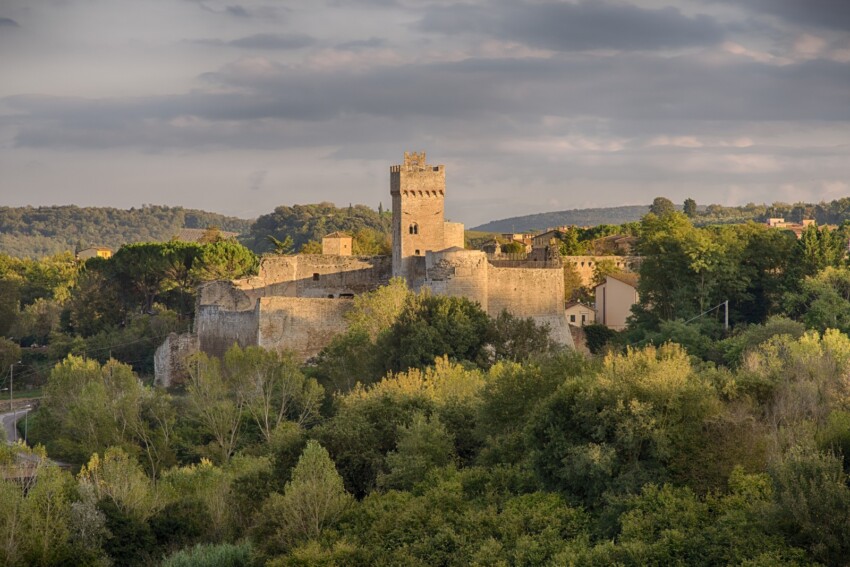
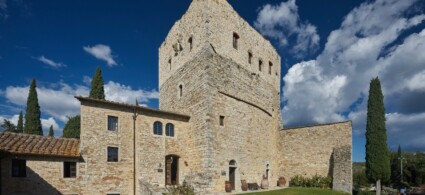
The castle was closely linked to Abbadia ad Isola and sat on an important route along the Via Francigena. The earliest records of the settlement date back to 994. The castle’s first lords were the Lambardi, followed by the Soarzi and the Franzesi. Over the next two centuries, the complex developed into a proper fortified residence: the battlemented circuit wall featured a gateway topped with a semicircular arch, and within it stood a large square tower that served as the family’s palazzo.
In the 13th century, Staggia came under the territory of Poggio Bonizio: the economic and political rise of the neighbouring settlement, combined with the thriving flow of goods and people along the Via Francigena, created the conditions for the centre to flourish. As a result, the population expanded and the village grew larger.
Following various vicissitudes tied to the struggles between Siena and Florence for control of the Val d’Elsa region, in 1361 Staggia was ceded by the Franzesi to Florence, finally becoming a peripheral centre within the city’s domain. The castle was restored with the construction of walls roughly 7 metres high around the village, establishing itself as a strategic base for potential raids against Siena.
The fortress today has a roughly rectangular plan divided into two sections by an internal wall; the circuit features two circular towers positioned to the north-west and south, and a square tower on the north-east side. A fourth tower, straddling the internal wall, is identified as the keep. The walls currently visible, arranged in an irregular polygon, date from the Florentine intervention of 1431. No traces remain of the Sienese fortifications from 1273, nor of those the Florentines built a century later. The circuit, enclosing an area of roughly 300 square metres, is almost entirely preserved, except for a short section where the now-vanished Porta Romana once stood. The walls were originally punctuated by numerous towers: eleven remain visible today.
 Hotel
Hotel  Budget accommodations
  Apartments
  Family Hotel
  Luxury Hotel
  Resorts