Albergo Martini
Chianciano Terme - Viale Baccelli 174
Book now
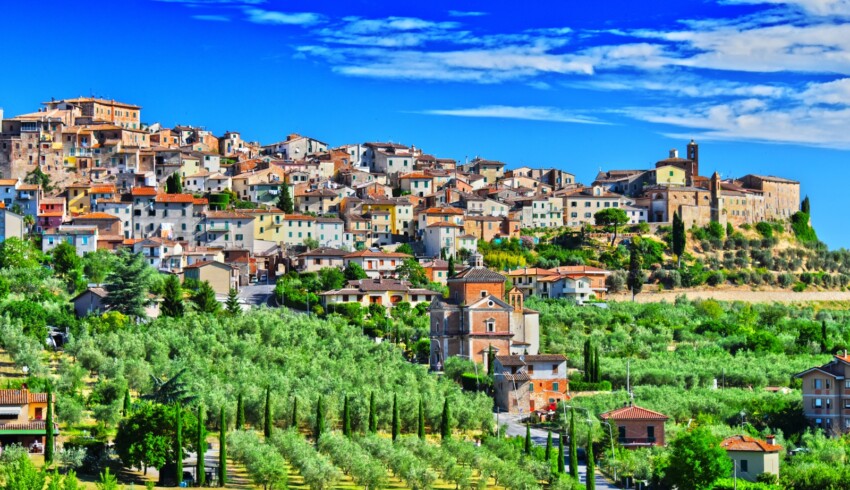
Chianciano Terme is a renowned spa town in Italy that has flourished thanks to its healing thermal waters, which drove considerable development particularly in the post-war years. The main settlement has grown a short distance from the old Chianciano, the historic village, perched on a hilltop in typical Tuscan style.
Located in Siena province, it occupies a favourable position between the Val d’Orcia and the Valdichiana. In other words, Chianciano Terme sits within easy reach of some of the region’s most beautiful attractions and villages, making it an ideal base for combining visits to historic towns and countryside with some well-deserved spa time.
At Chianciano Terme you can enjoy a two-fold holiday: on one hand, you can explore the historic centre, with its charming pedestrian streets and ancient buildings. On the other, you can stroll along the elegant avenues of modern Chianciano Terme, where you’ll find the spa facilities and thermal parks, plus numerous shops and services.
As mentioned, the historic centre of Chianciano Terme corresponds to the ancient village of Chianciano. Here you’ll find the typical medieval Tuscan village, set atop a hilltop as if watching over the surrounding valleys. The spa facilities are located in the modern part of town, both within natural parks and private establishments.
Wander freely through the streets of the historic centre of Chianciano and you’ll discover a village that, while not overly touristy, is nonetheless deeply rewarding. Stop by the collegiate church of San Giovanni Battista, dating from the 13th century, and discover the Church of the Immaculate, completed in 1580 under the original name of Church of Death.
Don’t miss the Clock Tower, right in the centre, next to which you’ll find an open square offering wonderful views across the surrounding valley.
During your visit to the historic centre of Chianciano, visit the Collegiata Museum, housed within the Arcipretura Palace. It’s a sacred art museum featuring works spanning the 13th to 19th centuries. You’ll find panel and canvas paintings, as well as furniture and sacred vestments.
Among the most interesting objects on display at the Collegiata Museum are the crucifix by Segna di Bonaventura, dating from 1300, a wooden Madonna from the school of Nicola Pisano, and an altarpiece depicting Saint John the Baptist protecting Chianciano, from the 16th century.
With its 341 hectares, the Pietraporciana Nature Reserve is one of the largest protected areas in the entire Siena province. Established in 1996, it spans the municipalities of Chianciano Terme and Sarteano, and extends from a minimum altitude of 400 metres to a maximum of 847 metres.
Within the reserve, you can walk along footpaths and country roads that wind through woods and countryside, immersed in bucolic scenery and complete tranquillity. You can explore these trails by bicycle or on horseback as well.
There’s also a visitor centre where you can obtain all the tourist information and hospitality services you need. Right beside it is the beech wood, an extensive beech forest protected by tall limestone cliffs.
The spa facilities of Chianciano Terme are the primary reason visitors come to this Tuscan town. Here are the best ones in the area.
The Terme di Chianciano is located along Viale Roma, the main road in Chianciano Terme. It’s a spa complex featuring indoor and outdoor pools, a spa and a section dedicated to therapeutic treatments.
You can use the facilities both for relaxation in harmony with nature and for treating various physical ailments. Entry packages are available in combination with hotel stays or food tastings.
In Piazza Martiri Perugini, at the entrance to the Acqua Santa park, you’ll find the Sensorial Thermal Baths of Chianciano Terme, where you can regenerate body and spirit. The strength of the Sensorial Baths lies in their blend of classic thermal treatments with Eastern philosophies.
The facility features what are called the “20 wonders” – 20 treatments including a salt room, river walk, caldarium and mud bath – which can be experienced individually at your own pace, or by following 5 itineraries designed by expert naturopaths.
Within the Acqua Santa thermal park, the first spa facilities were built at the end of the post-war period. Spanning 7 hectares, the thermal spring emerges at 33 degrees from a rocky grotto: when channelled, it allows everyone to enjoy these healing and relaxing waters.
The park itself is also beautiful, with pathways and flower beds winding around centuries-old trees. There are also various services, including a bar, a shopping arcade and even a dance floor, which also hosts live music.
The Acqua Santa spring water, if drunk in the morning on an empty stomach, is effective against liver and biliary tract conditions. It can be purchased from the official Chianciano Terme spa website, and treatment cycles are covered by the Italian National Health Service.
With over 500 square metres of pools, divided into 4 outdoor and 3 indoor pools all connected together, the Theia Thermal Pools are truly special. Also known as “the Etruscan bath” because the beneficial properties of its waters were already known to the ancient population, it’s today a major wellness centre equipped with all comforts, including sunshades, loungers and wi-fi connection.
Highlights include hydromassage facilities, a wellness centre with sauna and Turkish bath, and emotion showers. There’s also an interesting dedicated children’s area, with a dry grotto and a humid grotto with temperature-controlled conditions.
The Terme Sillene specialises in medical and physiotherapy treatments, focusing on rehabilitation of the muscular and skeletal systems. The centre’s doctors are specialists in rheumatology and orthopaedics, and there are also zones dedicated to mud therapy, for treating gastroenterological and biliary problems, and to colonic hydrotherapy, carried out by flushing the intestine with mineral-rich thermal water.
As mentioned, you have two distinct options for staying in Chianciano Terme. The first is to stay in the historic village, to experience medieval atmosphere surrounded by Tuscan countryside, where you can choose from apartments, B&Bs or small hotels; the second is to stay in the spa district, in modern Chianciano Terme, where you’ll find large hotels, often 4-star, many of which have spa areas and indoor and outdoor pools.
Chianciano Terme is fairly straightforward to reach, as it’s just a few kilometres from the Chiusi-Chianciano Terme exit on the A1 motorway. Once you’ve taken the slip road, continue along the SP146 road heading west: you’ll arrive in town after about 10-15 minutes.
From Florence it takes approximately an hour and a half, whilst from Rome it takes just under two hours. The distance from the provincial capital Siena to Chianciano Terme is an hour and 10 minutes, despite being much shorter in actual distance, as they’re not connected by high-speed roads.
The nearest railway station is at Chiusi Scalo, called Chiusi-Chianciano Terme station, and is served by regional trains on the Florence-Chiusi and Florence-Rome routes. It’s also the terminus for regional trains to and from Siena, plus a stop for some long-distance intercity services.
To reach Chianciano Terme once you’ve left the train, you’ll need to use Tiemme buses, line FT4 Montepulciano-S.Albino-Chianciano-Chiusi, which run fairly frequently. The journey takes about 30 minutes.
What's the weather at Chianciano Terme? Below are the temperatures and the weather forecast at Chianciano Terme for the next few days.
Chianciano Terme is located in the province of Siena, in south-eastern Tuscany, not far from the border with Umbria. To the north lies the Valdichiana, whilst to the west you'll find the Val d'Orcia.
 Hotel
Hotel  Budget accommodations
  Apartments
  Family Hotel
  Luxury Hotel
  Resorts