L'Albero Di Gamelì
Chiusi - Nucleo Abitato Giovancorso 26
Book now
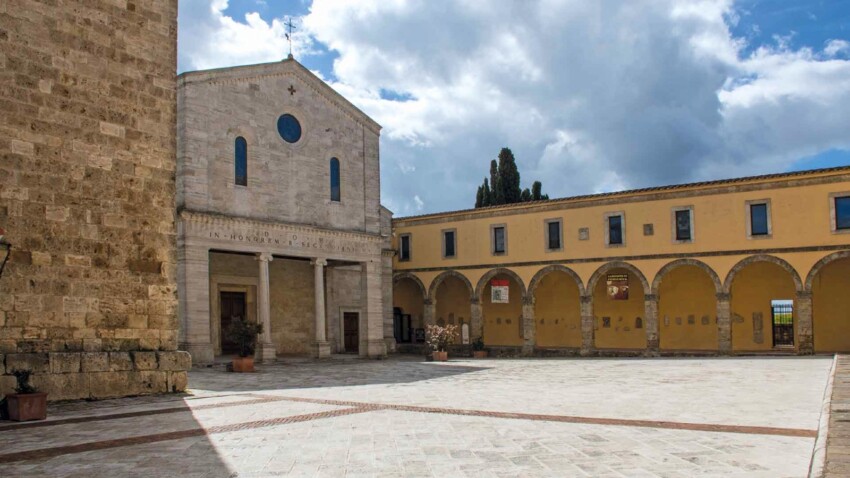
The charming Chiusi, situated in Siena province at the south-eastern edge of Tuscany, just a few kilometres from the Umbrian border, is a fascinating destination from every perspective. Awarded an Orange Flag by the Touring Club Italiano, this lovely town perched at nearly 400 metres altitude in the heart of the Valdichiana has much to offer visitors, thanks both to the beauty of its own territory and its magnificent surroundings. Within a few kilometres you can visit treasures including Montepulciano, Chianciano Terme and the Val d’Orcia, plus you can venture across into Umbria to expand your holiday horizons.
Here are the finest things to see in Chiusi: visit them all during your time in town, then venture out by car or public transport to discover the wonderful surrounding area.
The Chiusi cathedral, officially the co-cathedral of San Secondiano, is a church in the early Christian style dating back to the 6th century, though throughout its long history it has been remodelled several times, most recently in 1894, which gave it its present appearance.
The exterior of the church is particularly striking, with its freestanding bell tower dating from the late 16th century, which was created by transforming an ancient defensive tower. Beneath it lies a Roman swimming pool from the 1st century BC featuring two barrel-vaulted chambers.
Inside Chiusi cathedral, amongst the three naves separated by marble and travertine columns, there are some genuinely worthwhile religious artworks, including various frescoes and paintings. The fresco in the apse, one of the finest, depicts the martyr Ursula and Saint Catherine of Alexandria. In the right nave there is also a chapel with a beautiful fresco by Arturo Viligiardi, dating from the late 19th century.
In the heart of Chiusi, on Piazza XX Settembre, stands the church of Santa Maria Novella, worth visiting as it was built over the remains of an earlier church, of which only the apse and bell tower remain. Like the cathedral, the bell tower was constructed from an ancient defensive tower.
The exterior of Santa Maria Novella is not particularly ornate, being small and plain, but do visit the interior as excavations carried out in the 1980s uncovered two old houses from the imperial era, on whose foundations the original church was built in the 11th century.
Around Chiusi and its surroundings there are approximately 20 tombs dating to the Etruscan period, discovered within an area known as the Poggio Renzo necropolis. We highlight some of these:
Testament to Chiusi’s important past and that of its surroundings is the National Etruscan Museum of Chiusi. Founded in 1871, it displays finds from the successive excavations conducted in the area, ranging from ancient canopic urns to sarcophagi, and encompassing Lombard art and Roman-era ceramics.
It is run by the ministry for cultural heritage and activities through Tuscany’s museum network, and was completely refurbished in 2003. The displays, arranged chronologically and thematically, occupy numerous rooms, whilst the ground floor houses Hellenistic and Roman period finds.
With a ticket to Chiusi’s national archaeological museum you can also visit some Etruscan tombs in the Poggio Renzo necropolis.
Inside the Bishop’s Palace, situated on Piazza del Duomo, is housed the cathedral diocesan museum and Etruscan tunnels of Chiusi, one of the city’s most interesting museums.
It contains numerous archaeological finds and artworks discovered throughout Chiusi diocese across its entire territory, spanning from the 2nd to the 20th century. The museum is spread over three floors with the exhibition divided into four sections.
From the diocesan museum you can access Porsenna’s Labyrinth, a series of tunnels and narrow underground passages dating to the 1st century BC, constructed by the Etruscans originally as an aqueduct. You can thus walk within the original Etruscan water supply system, which is quite extensive and comprises numerous passages up to one metre wide and between 2 to 5 metres high. As you walk you’ll encounter cisterns and basins used to collect water from seepage.
During excavations within the tunnels, numerous interesting finds came to light, including a section of the city’s old defensive walls, remains of a private villa and numerous urns made of alabaster and travertine.
The curious name “Porsenna’s Labyrinth” derives from the mausoleum of Porsenna, an ancient Etruscan king who, according to Roman historians, was buried together with an immense treasure, which was protected by a labyrinth. Regrettably, when archaeologists discovered the tunnels and galleries in the 1920s, convinced they were part of the mausoleum, they had to think again: there was no trace of the mausoleum in Chiusi.
For a day in the open air, nothing beats a trip to Lake Chiusi, just a few kilometres north-east of the centre. It is Tuscany’s second largest lake, and since 2000 the southern shore between Sbarchino and Poggio Casale has been part of a WWF nature reserve covering 8 hectares.
On the lake you can observe numerous bird species, including some quite rare ones. The lake also serves as a stopover for migratory birds, amongst them the osprey and the collared pratincole. Its waters are home to numerous crustaceans originally from elsewhere, introduced by humans, such as the Louisiana crawfish and the American crayfish.
On the southern shore of the lake you can spend days of pure relaxation: there are restaurants, fishing and boating sports associations, whilst events and festivals are frequently held. The most important is undoubtedly that held on 3 July, the feast day of Saint Mustiola, patron saint of Chiusi, when a commemorative crossing is staged and the lake is blessed.
In the following map you can see the location of the main places of interest mentioned in this article.
In Chiusi’s historic centre you can stay at a two-star hotel or in one of several apartments. There are also accommodation options in Chiusi Scalo, where the railway station is located: here too you’ll find a two-star hotel plus some apartments and B&Bs.
If you prefer tranquility, head a few kilometres inland: here you won’t lack for farm stays, villas, country resorts and everything you need for a holiday immersed in the idyllic Tuscan countryside.
Despite its somewhat remote geographical position compared to Tuscany’s main cities, Chiusi is extremely easy to reach, thanks to the Chiusi-Chianciano Terme junction on the A1 motorway. From Florence it’s over 120 kilometres, but the journey takes less than an hour and a half: it’s practically all motorway until the junction, from which Chiusi’s historic centre is just 5 minutes away.
From its provincial capital Siena, Chiusi is exactly an hour away, reached by taking the SS715 Siena-Bettolle road to the Valdichiana junction on the A1, which you then follow to Chiusi-Chianciano Terme. The journey from Arezzo is also brief thanks to the motorway, taking around 45 minutes.
From Tuscany’s coastal cities such as Pisa and Livorno, you must first reach Florence via the SGC FI-PI-LI and then join the A1 until the Chiusi-Chianciano Terme exit. From either city the journey takes around two and a half hours.
There’s good news too for those travelling by public transport: at Chiusi Scalo there is the town’s railway station, called Chiusi – Chianciano Terme, where intercity and regional trains stop along the Florence-Rome route, connecting Chiusi with Milan and Naples too. The journey from Florence Santa Maria Novella takes about 2 hours, with both direct trains and connections via Terontola-Cortona available. The train journey from Siena is always direct, lasting around an hour and a half. Once you’ve alighted, you can reach Chiusi’s historic centre using the local public transport buses, which takes just about ten minutes.
What's the weather at Chiusi? Below are the temperatures and the weather forecast at Chiusi for the next few days.
 Hotel
Hotel  Budget accommodations
  Apartments
  Family Hotel
  Luxury Hotel
  Resorts