Hotel Palazzo San Lorenzo & Spa
Colle Val D'Elsa - Via Gracco Del Secco 113
Book now
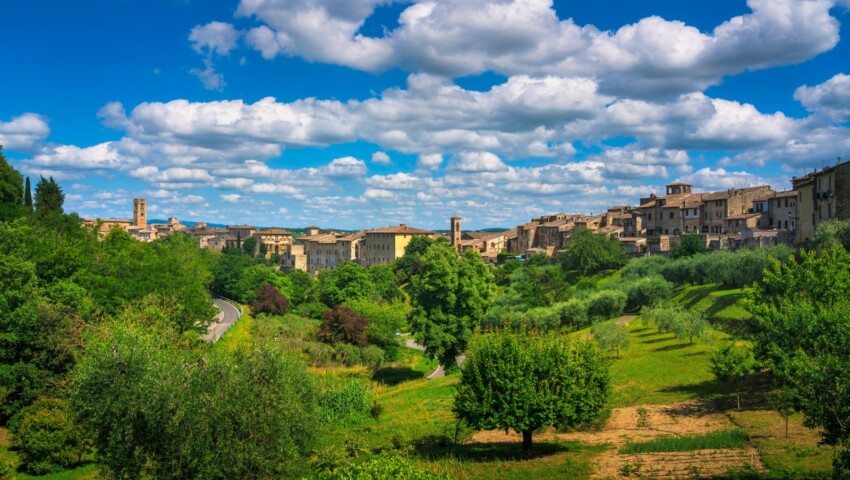
Colle Val d’Elsa is a town of over 20,000 inhabitants situated in the heart of Tuscany in a strategically favourable location, close to the cities of Siena, Florence and Volterra and along the route of the Via Francigena, which falls outside the mainstream tourism circuit.
And honestly, it’s hard to understand why, given that it has everything you need for a wonderful weekend and even a longer holiday. It boasts a lovely historic centre perched on top of a hilltop, contrasted by the lower town with all the amenities, interesting monuments, magnificent museums, and above all, as is typical of this part of Italy, stunning surroundings where you can lose yourself in nature and countryside.
The town today is divided into what locals know as “Upper Colle” and “Lower Colle”, connected by a lift-funicular operating 24 hours a day. Colle Val d’Elsa also boasts a centuries-old tradition in crystal production, which has made it one of Italy’s leading production centres for this extraordinary material. Testament to this is the beautiful crystal museum, well worth visiting, along with the numerous specialist shops.
Colle Val d’Elsa is also the birthplace of Arnolfo di Cambio, the famous Tuscan sculptor and architect. The main square of the lower town is dedicated to him, whilst in the historic centre you’ll find his tower house, an interesting medieval building where the artist was born.
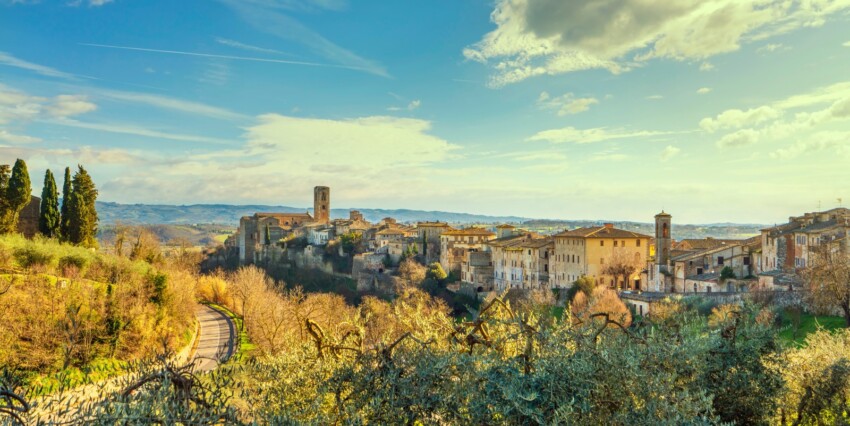
There are plenty of interesting things to see in Colle Val d’Elsa. Many are found in the historic centre, that is, the upper part of the town; but don’t overlook the new area, and above all, don’t miss visiting the crystal museum.
To get between the upper and lower town without having to walk, you can use the lift system, a sort of lift-funicular installed in 2006, which negotiates a height difference of 40 metres; it’s free and operates 24 hours a day.
The co-cathedral of Saints Albert and Martial, simply known as the Cathedral to locals, is the most important church in the town. It was built on the remains of an old medieval parish church, and has been extensively remodelled and restored throughout its centuries of history.
Today, the exterior features a neoclassical façade in brick and sandstone, with clean lines and travertine mouldings; the interior has a Latin cross layout with three naves, displaying several sacred art works by artists of the calibre of Giovan Paolo Merchiolli, Vincenzo Dandini and Astolfo Petrazzi. Particularly striking is the crucifix above the main altar, a cast bronze work by Pietro Tacca based on a model by Giambologna.
The Palazzo Pretorio, or Podestà’s Palace, dates back to the 14th century and is one of the town’s symbols. Located in Cathedral Square, its main façade bears the coats of arms of the Podestà and Commissioners who ruled Colle Val d’Elsa throughout its long history.
In 1990 the palace underwent restoration and was brought back to life, during which a series of Renaissance frescoes were discovered. Particularly beautiful is the courtyard at the back, which, during a period when the building served as a prison, was used by inmates for their exercise time.
Today, inside Palazzo Pretorio you can visit the Colle Val d’Elsa Archaeological Museum and the Etruscan Antiquarium.
The Baluardo is Colle Val d’Elsa’s defensive bastion, overlooking the lower town like a terrace: it’s a perfect spot to admire a stunning panorama that stretches all the way to the Chianti hills.
A short distance from the Baluardo are two interesting streets to explore on foot: la Costa, a steep road that exits the historic centre and leads down to the lower part of the town, and Via del Muro Lungo, which runs alongside the historic centre.
Behind the Baluardo stands the tower house of Arnolfo di Cambio, another of the town’s undisputed symbols. It holds this status for two reasons: firstly, it’s one of the few towers in Colle Val d’Elsa still standing today, whereas there were dozens of them in centuries past, and secondly because it was the house where Arnolfo di Cambio, the famous sculptor and architect, was born.
You can admire the tower from the outside, with its beautiful main façade facing south, built in stone and terracotta. The tower has recently undergone restoration; inside, frescoes have been created depicting scenes of medieval battles that affected Colle Val d’Elsa.
This beautiful square in the lower part of Colle Val d’Elsa, named after the sculptor Arnolfo di Cambio, is the heart of the town’s new area. Built in 1865, when it was created as a space for the market and fairs, it features at its centre an evocative war memorial for those who fell in the First World War, a work by Mario Sabbatelli, inaugurated in 1925 in the presence of King Victor Emmanuel III.
The elegant former railway station building also overlooks the square, with its beautiful façade featuring arches and columns.
Inside the San Pietro Conservatory, in Via Gracco del Secco, you’ll find the civic and sacred art museum, formed from the merger of two previously separate museums in the town – the civic museum and the diocesan museum of sacred art.
The exhibition pathway develops across three rooms, with the first hosting mostly paintings from the 17th and 18th centuries, among which stand out the Annunciation by Arcangelo Salimbeni, the Madonna Appearing to Saints Gregory and Albert by Antonio Salvetti, and Angels with Instruments of the Passion by Annibale Mazzuoli.
In the second room you can admire panels with gold backgrounds, notably the Majesty by the anonymous Master of Badia a Isola. The third and final room houses the Galognano Treasure, a Eucharistic set in silver comprising 4 chalices, a plate and a spoon, discovered nearby, bearing witness to an ancient Christian community already existing in the 6th century AD.
Finally, you cannot leave Colle Val d’Elsa without visiting the crystal museum, the precious material thanks to which the town became famous throughout Italy and became economically prosperous in centuries past. Located in Via dei Fossi, inside the former Boschi glassworks area, it was inaugurated in 2001.
Beautiful from the outside as well, thanks to an ingenious recovery plan for old abandoned areas, it showcases the history of crystal production from the 14th century through to the factories that brought enormous economic development to Colle Val d’Elsa in the 19th century. The exhibition concludes with a series of design objects, representing the natural evolution of crystal production into modern times.
After thoroughly exploring the historic centre of Colle Val d’Elsa and the town’s museums, dedicate one or more days to exploring its surroundings.
Among the main attractions in the Colle Val d’Elsa area is the impressive Staggia Fortress, which can only be visited on a guided tour that must be booked online on the official website. Usually you can book a visit every day from 10:00 to 17:00 in winter, and from 10:30 to 19:00 in summer.
You’ll be able to admire this imposing medieval defensive fortress, with its 10 centuries of history. The fortress is a magnificent architectural example from the 14th century, enriched a hundred years later by a defensive wall.
Inside there are also some spaces dedicated to temporary exhibitions, as well as a splendid permanent itinerary called Pathways of Light, a series of luminous installations that create truly sensational effects. There’s also an educational space for schools, reserved for organised school trips, and an offering for families consisting of an interesting workshop for children and parents.
The Diborrato Waterfall is also known by the curious name of “the armoured vehicle splash”, because of an old story straddling fantasy and reality in which it was said that a tank plunged over the waterfall and fell into the water.
Whatever the truth, take the time to reach this marvellous timeless place, immersed in splendid and majestic nature. The waterfall drops approximately 15 metres before filling an almost circular basin over 10 metres deep. During the first half of the last century, young people from Colle Val d’Elsa would dive from the top of the waterfall as a test of courage.
In the surroundings of Colle Val d’Elsa, don’t miss the ancient Caldane thermal baths, with warm water springs with therapeutic properties known since the time of the Etruscans. The water is rich in mineral salts and is ideal for treating skin eruptions.
Today the Caldane thermal baths are an outdoor bathing spot, highly appreciated by locals. The original baths were destroyed in 1260 by Sienese troops, though they were partially rebuilt approximately 150 years later; regrettably, the Roman mosaic flooring was also destroyed.
The Sentierelsa is a trekking route well worth experiencing, worthy of the trip on its own. Starting in Gracciano, south of Colle Val d’Elsa, and departing from the San Marziale bridge, it follows the river for 2 kilometres as far as the Spugna in Colle bridge. In total, the round trip is approximately 5 kilometres, and takes about two hours to complete, though obviously this could be considerably longer if you decide to stop for photos!
Along its path, as well as the splendid Diborrato waterfall and Caldane thermal baths, you’ll climb about 100 metres in elevation and walk through part of the Upper Val d’Elsa River Park, a locally protected natural area.
In the following map you can see the location of the main places of interest mentioned in this article.
Choosing where to stay in Colle Val d’Elsa might seem straightforward, but it really isn’t. In the historic centre you’ll find mostly apartments and B&Bs, all very charming and beautifully furnished, whilst hotels are almost entirely absent. You’ll be close to the main monuments and points of interest, but you’ll have the disadvantage that finding a parking space won’t be easy.
Therefore you might decide to move to the lower part of the town: you’ll have amenities at your disposal, supermarkets, shops and everything you need, but unfortunately the choice of accommodation here isn’t particularly extensive.
So why not choose to stay in the Colle Val d’Elsa area? Just minutes from the town you’ll already be immersed in the splendid Tuscan countryside, where you can spend a holiday straight out of a fairy tale by staying in historic villas, relais, farmhouses and rural homes, all beautifully maintained (or restored) properties with all amenities, often including a swimming pool and in-house restaurant where you can savour the delights of zero-kilometre Tuscan cuisine. The obvious disadvantage of this option is that you’ll need to take the car each time you need to travel to reach Colle Val d’Elsa and its attractions.
Colle Val d’Elsa is straightforward to reach, situated along the Florence-Siena motorway link road, approximately 45 minutes from Florence and around 20 minutes from Siena. There are two junctions, Colle Val d’Elsa Nord and Colle Val d’Elsa Sud; both are equally convenient, so choose whichever exit suits you best, as the historic centre is around 10 minutes away from either one.
As for distances from other Tuscan towns, it’s worth noting an interesting geographical quirk: Colle Val d’Elsa’s central position means it’s never excessively far from anywhere. Despite the roads varying depending on your starting point, the journey from Arezzo, Pisa, Livorno and Grosseto takes roughly the same time of about an hour and a half.
By contrast, reaching Colle Val d’Elsa by public transport is not particularly convenient. The town itself is not served by railway, with the nearest station, Poggibonsi-San Gimignano, situated approximately 10 kilometres away. Fortunately, once you’ve disembarked, there are local buses that make the journey in around 15 minutes, though the total travel time including waits, buses and train can take up to two hours. A better option might be to use the regional bus network operated by Tiemme SPA, such as the 131 service, which departs from Florence’s Leopolda station and reaches Colle Val d’Elsa’s centre in just over an hour.
What's the weather at Colle di Val d’Elsa? Below are the temperatures and the weather forecast at Colle di Val d’Elsa for the next few days.
Colle Val d’Elsa originally developed as three separate boroughs, each with distinct structures and urban layouts: the Borough of Santa Caterina, the Castle of Piticciano and the Piano.
The first two settlements are the oldest, serving as strongholds for the town’s ruling classes, positioned along the same hilltop ridge running east-west and separated by a broad valley. They overlook the valley floor where the third “borough”, the Piano, stands—more recent in its urban development and traditionally devoted to productive activities.
Although Colle’s territory boasts significant archaeological finds dating back to the fourth millennium BC, the earliest documented references to Colle di Val d’Elsa appear in the tenth century. However, it was from the late twelfth century onwards that the town progressively acquired autonomy and political identity, with the earliest recorded municipal statutes dating to 1307.
Even in medieval times, the urban fabric occupied a vast area encompassing not only the upper town but also the Piano, which developed along the course of the ancient gore. These were artificial channels of the Elsa river, constructed from the early 1200s onwards and lined with numerous water-powered buildings such as mills, paper factories and fulling mills.
The gore were therefore decisive in shaping the town’s economy, fostering the development of industrial activities.
Throughout its history, Colle di Val d’Elsa witnessed frequent military conflicts. Among the most notable are the 1269 battle between Guelphs and Ghibellines, which had significant repercussions on Tuscany’s political landscape, and the siege by the forces of the Duke of Calabria in 1479 in defence of Florentine territory, which led first to serious destruction and subsequently to substantial reinforcements of the fortification system.
During the sixteenth century, Colle di Val d’Elsa remained within Florence’s sphere of influence, gaining increasing power, especially thanks to the Medici family and illustrious local figures who served in the Prince’s administration.
Following the War of Siena and the establishment of the Grand Duchy of Tuscany, Colle became the seat of a new diocese in 1592 with the Bull of Clement VIII.
The sixteenth century saw a new chapter in the modern history of Colle di Val d’Elsa under the Usimbardi family.
As the contemporary era dawned, paper production was superseded by new industries based on iron and glass.
It was particularly glass production, followed by crystal manufacturing, that came to characterise Colle di Val d’Elsa‘s industrial activity, earning it the epithet “the Bohemia of Italy” from the nineteenth century onwards. Today it has become the true “Crystal Capital”, accounting for 15% of world production and over 95% of Italian output.
The period of industrialisation coincided at Colle with the rise of Socialism and associated publications reflecting the new political climate, marked by the launch of the newspaper “La Martinella”.
A centre of art and culture throughout the twentieth century, Colle di Val d’Elsa today presents itself as a thriving town of over 20,000 inhabitants, with ancient and modern architecture nestled amongst the green hills watered by the Elsa river.
Among the internationally renowned figures born here, we recall Arnolfo di Cambio, sculptor and architect of Florence’s Duomo, and in more recent times the artist “il selvaggio” Mino Maccari and writer Romano Bilenchi.
 Hotel
Hotel  Budget accommodations
  Apartments
  Family Hotel
  Luxury Hotel
  Resorts