Hotel Ristorante Borgo Antico
Monteroni dʼArbia - Via Di Lucignano 405
Book now
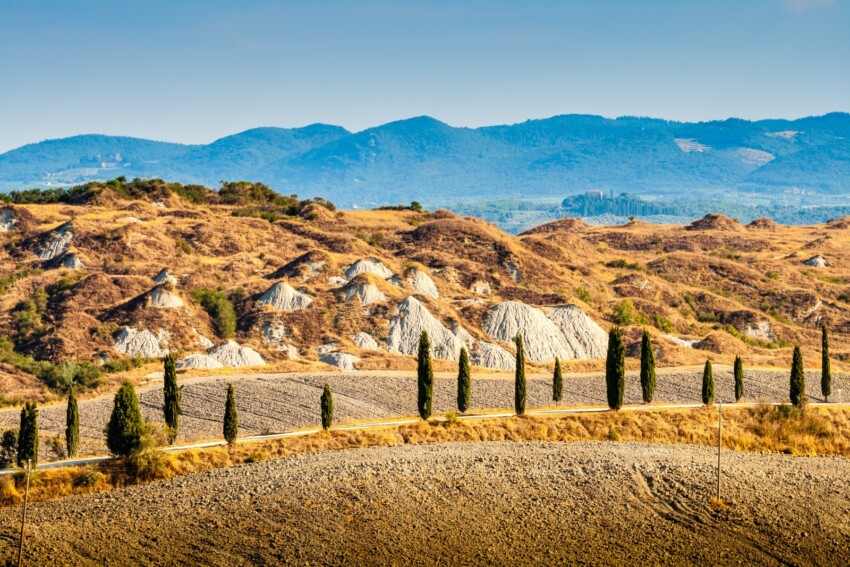
A journey through the Crete Senesi feels like a dream with eyes wide open and feet firmly on the ground; because the crete embody, in an almost tangible way, the essence of a captivating landscape that sometimes expresses itself through the sculpted forms of a Greek statue, and at other times through the curves of a temptress siren.
The Crete, then, as a journey of the soul – an itinerary of discovery to be travelled with the same spirit as the Grand Tour travellers, without chasing mythical yet futile destinations. Navigating between the earthen waves of the crete, each of us will find places that “speak” through the breath of the wind and the magic of unexpected light.
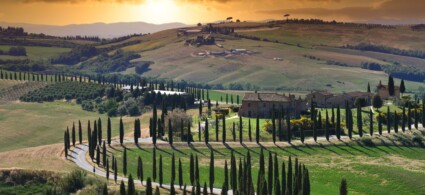
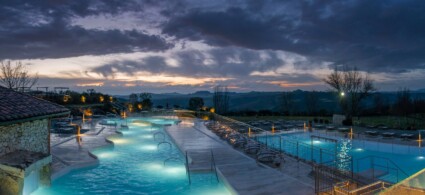
There are no iconic landmarks such as piazzas, cathedrals or castles that define this territory – only intimate corners like a solitary cypress tree, an old farmstead, the curve of a white dirt road, or the window of a bed & breakfast; or moments tied to powerful sensations such as the aroma of pecorino cheese filling the shelves of a small grocer’s shop, the soothing warmth of thermal springs, or the mystical simplicity of a small Romanesque parish church.
The landscape of the Crete is a triumph of simplicity and harmony – a timeless image, a canvas where the forms of an Etruscan graffito blend with a mark of modern art. It’s a harmony that enters within you and has the power to restore balance to your own energy: emotions and sensations transform and expand in the calm of the space.
From the 4th century onwards, the evangelisation of the Roman Empire progressed by gathering communities of believers who inhabited the countryside into religious districts known as pievi. The Latin word “plebs” indeed means community or assembly. Within the pievi, in turn grouped into dioceses, resided the “pievano” – a priest representing the bishop and responsible for spreading the faith. The principal religious ceremonies took place in the parish church.
One of the highest expressions of asceticism was realised through the foundation of monastic orders ruled by regulations such as the Benedictine rule, which spread throughout Europe. Among the reforms inspired by the Benedictine tradition, that inspired by Blessed Bernard at Monteoliveto in the Crete took on particular characteristics. Unlike the Benedictines, Franciscan monastic settlements preferred cities to the isolation of the countryside. It’s no surprise that the only Franciscan convent in the Crete is found in the important centre of Asciano.
An exploration of the religious architecture of the Crete leads off the beaten path to where canonries stand – buildings modest only in their size but of great historical and architectural interest. A canonry is a religious community organised in communal living following the example of the apostles. Whilst the pievi brought together members of the clergy in collegial life destined for priesthood, canonries grouped members of the secular clergy. In the hierarchy of religious institutions, the canonry occupied a middle position between the pievi, on which they depended, and the parish churches. Canons could own property individually and collectively as a community.
The flavours of a cuisine from another era survive and are celebrated through cooking that remains true to its roots.
To discuss traditional cuisine, we must dispel a common misconception: peasant food was essentially a matter of survival. The diet of the sharecropper was poor in meat and rich only in flour-based foods and seasonal garden produce. Even bread, the staple food, was understood in the broadest sense – not just wheat, but any grain that could be made into bread, such as maize, oats and barley. A watchword echoed across peasant tables: consume with great, great moderation.
It was only on certain feast days and special occasions that this motto was broken. And it is precisely this festive dimension that is today at the heart of revivals which, under the name of sagre, revisit peasant cuisine. How can we not think of the “panella” of Rapolano – a thin sheet of bread pasta fried in olive oil – or “pici“, the long hand-made pasta, a typical dish of the Crete and variously prepared according to locality. Given the scarcity of protein, it’s hardly surprising to find today a festival devoted to what for centuries was the main source of meat for peasant tables – the pig.
In Rapolano, the grilling of “costoleccio” – pork ribs over hot coals – recalls the abundance of that single day of the year when the peasant family allowed itself the luxury of a meat-based meal. Hunting rarely supplied the sharecropper’s protein needs because the landowner saw it as a distraction from the more necessary work of the fields. In Rapolano, where the hills begin to dress themselves once more in woodland, the Wild Boar Festival marks the end of the hunting season and becomes a moment of shared celebration.
To see all the facilities and book accommodation in Crete Senesi use the form below, entering the dates of your stay.
 Hotel
Hotel 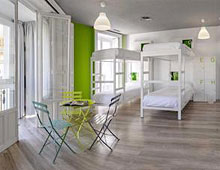 Budget accommodations
  Apartments
  Family Hotel
 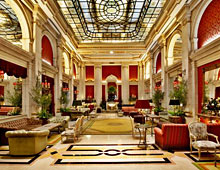 Luxury Hotel
 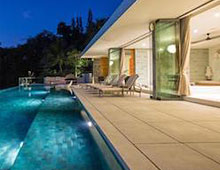 Resorts