Agriturismo San Sano
Gaiole in Chianti - Località San Sano n.6
Book now
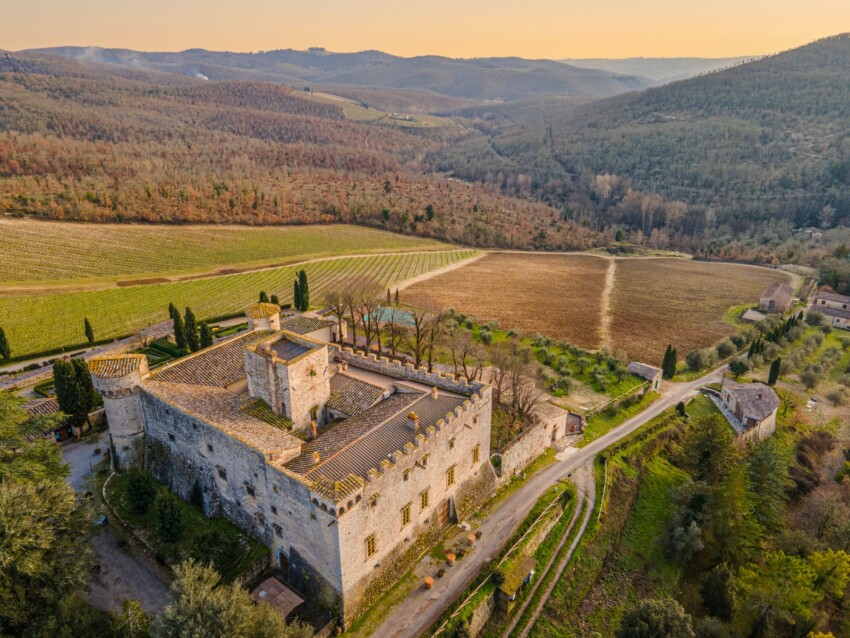
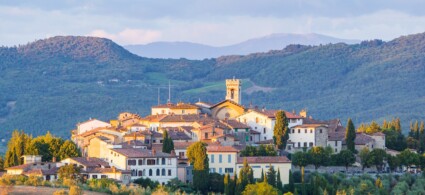
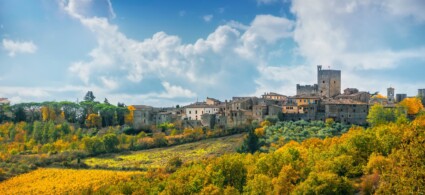
The small historic centre of Gaiole, reached from Castellina and Radda via a turning off the Chiantigiana road, emerged in the late Middle Ages as a market town serving the nearby castles, much like Greve.
The town has managed to preserve its urban and cultural character, despite becoming a popular destination for both domestic and international tourism.
The geographer Emanuele Repetti noted only briefly in 1835 the centre of Gaiole (“a small village on the provincial road through upper Chianti, administrative centre of the community with its parish church”), but gave considerable attention to the character of the municipality, which had 4,398 inhabitants (compared to 3,782 in 1745): a wholly rural territory based on sharecropping agriculture, which suffered from only one structural weakness—the lack (or complete absence, as in the time of Pietro Leopoldo) of proper roads.
The steeply rolling landscape “is most favourable to olive and vine cultivation, as well as to other fruit-bearing trees of considerable height; and it is precisely in the municipality of Gaiole that one obtains the most exquisite wines and lustrous silks, supplied to commerce chiefly by the estates of Cacchiano and Brolio of the Ricasoli house”. Its extensive woods of holm oak and cerro oak also represented great wealth, as they supported “numerous herds of pigs” (or black “Cinta Senese” pigs which were then common everywhere).
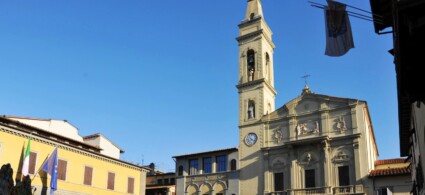
Pietro Leopoldo mentions the fair held there in December and notes the presence of an internal Customs post between Sienese and Florentine territory. The parish church of San Sigismondo, neo-Gothic in style and built in 1959 from pietra serena, stands as a rather belated testament to that ‘invented’ neo-medieval character which had been applied to the Chianti territory since the early nineteenth century.
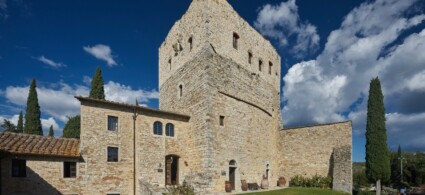
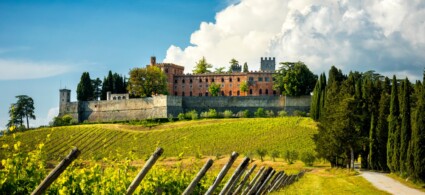
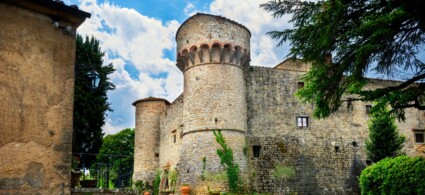
The territory of the Municipality of Gaiole is rich in celebrated settlements, including Brolio castle, the hub of Bettino Ricasoli’s innovative activities, and Meleto castle, the hamlets of San Regolo and Monti, the parish church of San Marcellino and the Abbey of Coltibuono. Meleto castle, dating from the twelfth century, was transformed by the Ricasoli into a villa-farm in the eighteenth century. It contains a small theatre from 1742. The church of San Regolo, situated between Brolio and Gaiole, dates from the nineteenth century. In the hamlet of Monti, lying between Cacchiano and Brolio, stands the Church of the Ascension, built in 1825 in neoclassical style with three naves. The parish church of San Marcellino, near Brolio, of medieval origin, was renovated in the nineteenth century. A medieval-style façade was added to the ancient church of San Pietro in Avenano in 1832.
What's the weather at Gaiole in Chianti? Below are the temperatures and the weather forecast at Gaiole in Chianti for the next few days.
To see all the facilities and book accommodation in Gaiole in Chianti use the form below, entering the dates of your stay.

 Hotel
Hotel  Budget accommodations
  Apartments
  Family Hotel
 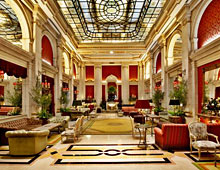 Luxury Hotel
 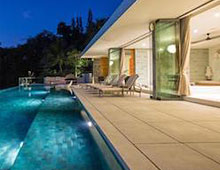 Resorts