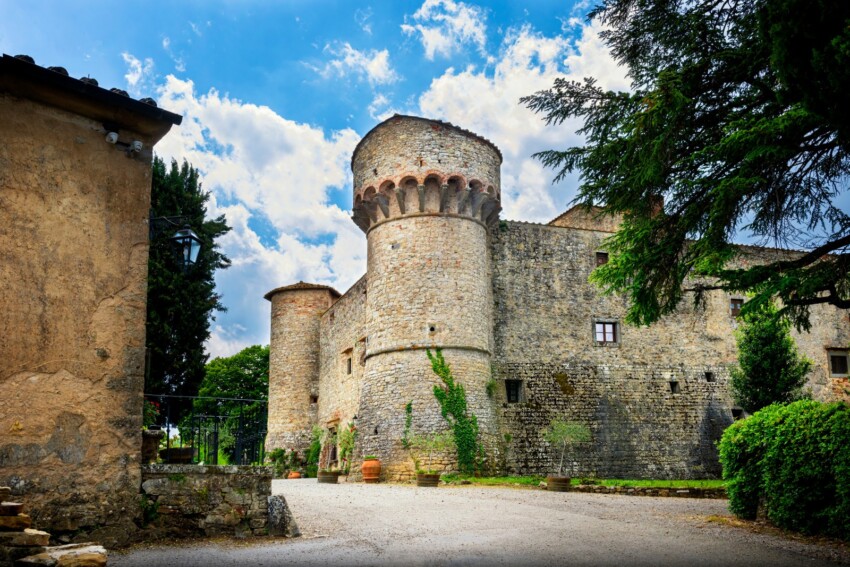
The Castello di Meleto stands along the State Road 408 connecting the Valdarno to Siena.
The castle’s origins date back to the 11th century as a possession of the Vallombrosian monks from the nearby Abbazia di Coltibuono. The castle’s first feudal lord was a man named Guardellotto, who was soon stripped of all his lands due to disputes with Emperor Frederick I Barbarossa. Barbarossa entrusted Meleto to the local Firidolfi family, already established in other castles in the area. This gave rise to the branch of the Firidolfi known as “da Meleto”. A subsequent family division created the Ricasoli Fibindacci line, whose name became inextricably linked with the history of these Chianti lands.
Meleto was one of the principal fortifications of the Terziere della Lega del Chianti captained by Gaiole, the final bastion of territories controlled by the Florentines. Its strategic position on a hilltop commanding the valley road connecting upper Valdarno with Chianti determined Meleto’s fate as a theatre of centuries of warfare, yet it never suffered serious destruction.
The settlement’s essentially military structure still stands out today, despite the transformations it underwent in the 18th century: the irregular quadrilateral shape, almost trapezoidal, with the keep tower at its centre, though considerably lowered, exemplifies a classic castle-enclosure.
In 1478 the castle was occupied by the Aragonese army allied with Siena, but two years later it was promptly recaptured by the Florentines, who carried out considerable reinforcement works on the structures. From the 1480 works, the following remain intact:
With these defensive structures, in 1529 Meleto successfully withstood the siege of imperial forces.
In 1700 the castle was converted into a villa and its defensive works partly dismantled. Its interiors, which can be visited with a paid guide, date from this period and feature decorated and frescoed rooms. Worth seeing is a distinctive small theatre from 1742 complete with its seven original scenic designs.
Meleto remained the property of the Ricasoli family until about thirty years ago; today it houses a wine-producing agricultural enterprise.
 Hotel
Hotel  Budget accommodations
  Apartments
  Family Hotel
  Luxury Hotel
  Resorts