Si Montalcino Hotel
Montalcino - Via Osticcio 21
Book now
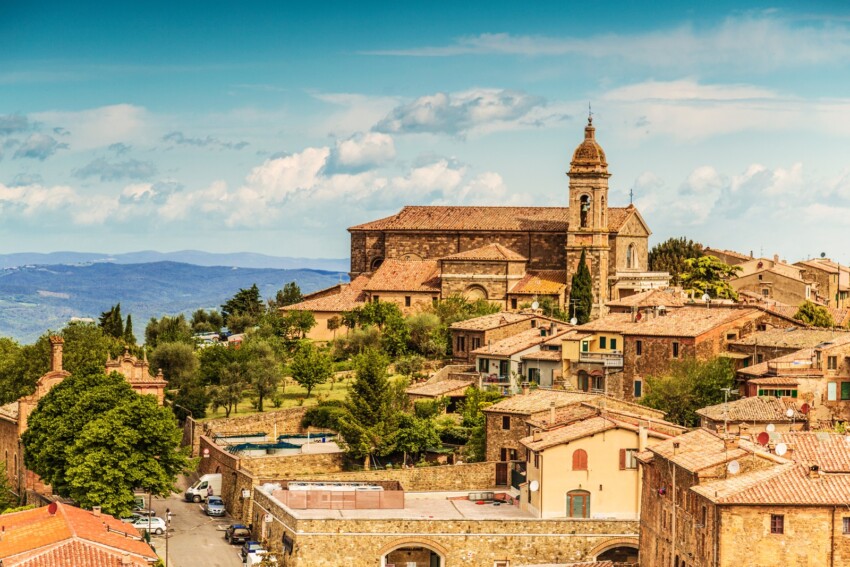
A small town in Siena province renowned worldwide for the wine produced here, Brunello, Montalcino is truly unmissable during a Tuscany tour. Located on the western edge of the Val d’Orcia, near Monte Amiata and not far from the border with Grosseto province, the ancient medieval village of Montalcino sits atop a hilltop, its magnificent monuments overlooking the soft Tuscan hills.
Remarkably, despite having just 5,000 inhabitants, Montalcino is the largest municipality in Siena province. Much of its territory comprises hamlets, small settlements and villages, some virtually uninhabited, yet they preserve such unique historical heritage—including ancient parish churches and castles—that some have been entirely converted into distributed hotels or guesthouses.
Montalcino thus presents itself as an area with excellent tourist facilities, well-equipped and offering all services. Thanks to its favourable location, you can also use it as a base for overnight stays and visit nearby attractions on day trips. The town centre awaits you with numerous traditional restaurants serving authentic Tuscan cuisine at reasonable prices, always accompanied by a glass of fine wine.
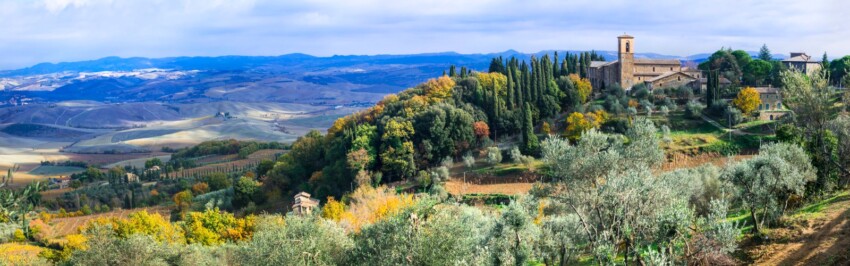
The historic centre of Montalcino is very compact and easily explored on foot: all the main sights are concentrated here. If desired, there are also several important attractions outside town, accessible only by car.
In the heart of Montalcino’s historic village, in the splendid setting of the central Piazza del Popolo, stands the impressive Palazzo dei Priori, dating from the late 13th century. On its façades, you can still admire the coats of arms of the podestà who governed Montalcino over the centuries, whilst behind it rises the medieval tower with crenellations and an incorporated clock.
In the hamlet of Castelnuovo dell’Abate, about 10 kilometres’ drive from Montalcino’s centre, stands the beautiful Sant’Antimo Abbey. A former Benedictine convent built in Tuscan Romanesque style dating from the 12th century, it was used until the 1500s and subsequently abandoned by monks until recent years.
Dedicated to Sant’Antimo, who according to some accounts was a priest imprisoned under Diocletian and according to others a martyred Aretine deacon, it stands in open countryside and its impressive complex is truly wonderful to behold. The abbey has been modified and enlarged several times over the centuries; today, the original abbey retains the Carolingian chapel and the remains of the chapter house. The entire complex also includes a large abbey church and a cloister.
To reach Sant’Antimo Abbey from Montalcino’s centre, simply take the SP55 provincial road heading south until you reach Castelnuovo dell’Abate. From here, a small lane leads to the abbey car park.
The Musei Riuniti (United Museums) of Montalcino comprise a complex made up of two museums: the civic museum and the diocesan museum of sacred art. They were merged in 1997 and are now part of the Siena museums circuit.
Within the 12 rooms spread across 3 floors are over 200 artworks in total, including the striking Sant’Antimo crucifix, a tempera painting on panel from the 12th century originally from Sant’Antimo Abbey. Also remarkable are Simone Martini’s Madonna, Bartolo di Fredi’s Coronation of the Virgin, and a Maestà by Vecchietta, representing the Renaissance.
Beyond painting, the museum also displays sculptures, majolica, sacred vestments, gold work and illuminated manuscripts. Additionally, one section is dedicated to the 20th century, featuring works by Montalcino-born painter Arturo Luciani. Finally, there is a section devoted to archaeology, with artefacts from the Bronze Age and Etruscan and Roman civilisations.
Officially named the co-cathedral of the Most Holy Saviour, Montalcino Cathedral dates from 1800 and is built in neoclassical style according to architect Agostino Fantastici’s design. Located in the historic centre in the square bearing its name, Montalcino Cathedral also features a bell tower predating the current church; inside, you can admire the neoclassical style, with three naves, the central one boasting a splendid coffered barrel vault.
The cathedral’s pipe organ dates from 1858, whilst among the works housed inside, Francesco Vanni’s Immaculate Conception with Jesus and God the Father from 1588 stands out.
One of Montalcino’s undisputed symbols is its fortress, built in 1361 on the town’s highest point for protection against potential invaders. It has a pentagonal structure and incorporates a series of previously existing buildings, including an ancient basilica, which became the chapel of the Romitorio gatehouse, which already existed in Roman times.
There is also the opportunity to walk along the fortress bastions to enjoy splendid views of both Montalcino and the surrounding countryside.
Since 1957, on the last Sunday of October, Montalcino celebrates the Sagra del Tordo (Thrush Festival), an event with a smaller-scale counterpart in the Opening of the Hunt held on the second Sunday of August. Twice yearly, therefore, Montalcino’s districts—Borghetto (white and red), Pianello (white and blue), Ruga (yellow and blue) and Travaglio (yellow and red)—compete in an archery competition that stirs the passions of the entire population.
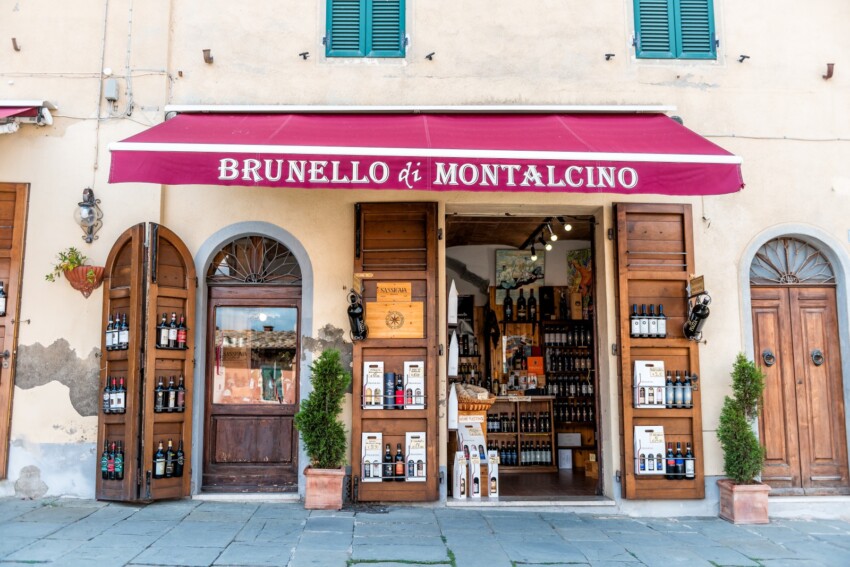
A must during your stay in Montalcino is a winery tour. Choose your preferred wine estate—there are plenty in the surrounding area—and during opening hours, have them guide you inside a cellar to discover all the secrets of this famous Tuscan wine. Typically, guided tours are held daily during the summer months and through October, with a tasting almost always offered at the end.
You may also have the opportunity to visit the vineyards, walking between the vines amidst truly unique scenery. For more information, contact your chosen wine estate.
The historic centre of Montalcino, with its narrow alleyways and magnificent vistas, is the ideal place to stay if you want a fully authentic 100% Tuscan experience, especially in the evenings when day-trippers return home. Here you’ll find countless apartments and B&Bs, all privately managed, which have skillfully restored the village’s old buildings, converting them into charming homes.
Don’t forget, however, that this part of Tuscany is the home of agriturismos (farm stays): you’ll find plenty of them, so choose based on the services offered, price and degree of isolation you prefer.
Montalcino is located in a rather isolated position in the heart of Tuscan countryside. From Florence, reach it by heading south towards Siena via the Florence-Siena motorway link, then continuing on the SR2 to Buonconvento, from which the Strada Provinciale del Brunello branches off leading to Montalcino. Total travel time is almost 2 hours.
Those visiting Montalcino from the south should instead exit the A1 motorway at Chiusi-Chianciano Terme, then continue along regional and provincial roads through the Siena countryside, passing through Chianciano Terme, Bagno Vignoni and San Quirico d’Orcia. The distance from Rome is approximately 2 and a half hours.
Finally, to reach Montalcino by public transport, take the train to Buonconvento railway station, situated on the Grosseto-Florence line, then continue by local bus for approximately 10-15km.
What's the weather at Montalcino? Below are the temperatures and the weather forecast at Montalcino for the next few days.
Montalcino is located in the province of Siena, approximately 40km south of the provincial capital. Its territory borders Grosseto province to the east and Monte Amiata to the south. To the east of Montalcino lies the Val d'Orcia, home to the towns of Castiglione d'Orcia and San Quirico d'Orcia.
 Hotel
Hotel  Budget accommodations
  Apartments
  Family Hotel
  Luxury Hotel
  Resorts