Hotel More di Cuna
Monteroni dʼArbia - Via Cassia Nord, 1444
Book now
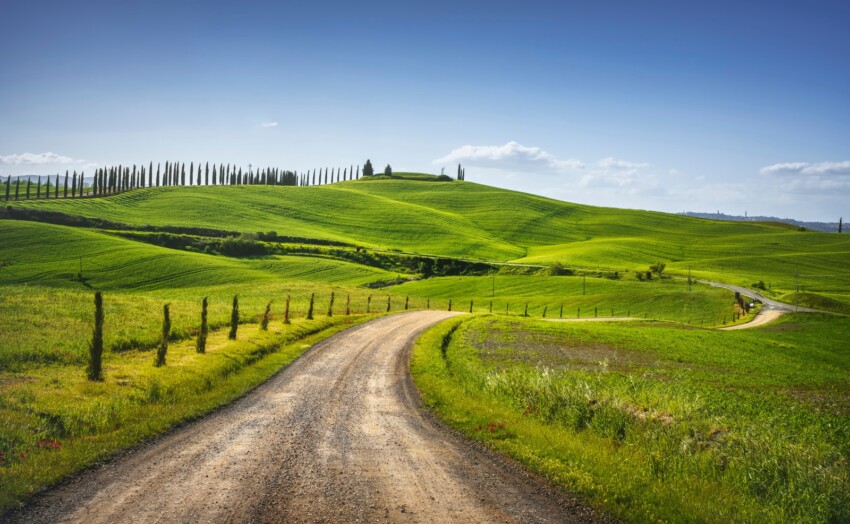
Nestled in the breathtaking landscape of the Crete Senesi, the municipality of Monteroni d’Arbia sits on the right bank of the Arbia stream, in the province of Siena. Positioned at an altitude of 161 metres above sea level with a population of around 7,000, it offers visitors the historic Fortified Mill.
The village of Monteroni developed thanks to the work of Siena’s Hospital of Santa Maria della Scala, which had been active in the area since the early 13th century. During the following century, the small settlement grew around the Fortified Mill. This is a water mill, probably dating back to the 1st century BC, and is therefore considered one of the earliest installations for the industrial processing of raw materials in history.
The structure was fortified between 1322 and 1324, again at the behest of the Sienese Hospital. The Hospitallers’ interest in this area was undoubtedly due to its proximity to the Via Francigena. Traversed each year by thousands of pilgrims and travellers visiting or on pilgrimage to Rome, this road, once known as the Via Cassia, was a source of wealth for the entire region. It was in Monteroni’s territory that the greatest concentration of inns, taverns and hospitals was located.
In 1382, despite continuous requests for autonomy from its inhabitants, Monteroni was incorporated into the Vicariate of Lucignano d’Arbia. In 1554, the bloodiest episode in the settlement’s history occurred when the forces of the Marquis of Marigianoci devastated and plundered its castle. For the remainder of this period, the population lived mainly on agriculture and livestock farming. Connected to the former, mulberry cultivation for silk production also developed. Later, however, the municipality saw the emergence of new craft activities that would pave the way for industrial development during the economic boom.
Today, Monteroni is also known for the abundance of medieval architecture within its boundaries. Besides the Mill, you can see the Grancia, a fortified farmstead built in the 13th century by the Hospital and the city of Siena. Just outside the centre stands the 14th-century church of SS. Iacopo and Cristoforo. Outside the town are located the 11th-century Pieve di Corsano, which includes the church of San Giovanni Battista, and the two gate-towers of Lucignano, dating from the 14th century.
The surrounding area particularly emphasises the relationship with history, starting with Cuna, on the banks of the Tressa stream just beyond its confluence with the Arbia, and its grancia, a fortified farmstead built in 1224 by the city of Siena and the Hospital of Santa Maria della Scala on the pre-existing structure of the Hospital already established in the 12th century.
Very spacious and still perfectly preserved, the complex consists of a small walled village and the fortified farmhouse overlooking the triangular square, accessed by passing through the entrance tower. Outside the fortified nucleus stands the small church of SS. Jacopo and Cristoforo, dating from 1314. Nearby is the Pieve di Corsano, founded in the 11th century and dedicated to San Giovanni Battista. It displays typical Romanesque style with a façade of two superimposed orders of blind arches and corbelled arcading.
Returning to the Via Cassia, just beyond Monteroni the small settlement of Lucignano d’Arbia also reveals its origins as a fortress through two 14th-century gate-towers and a substantial medieval tower converted into the bell tower of the Romanesque parish church. The water mill that appeared in the 1st century BC can be considered the first industrial installation in history, both because it transforms natural resources into motive power, and because raw materials must be transferred from the place of production to that of processing, characteristics today attributed to modern industrial production.
In one respect the mill differs from modern industries: it produces no secondary effects that would affect environmental quality. The water taken from the environment to operate the mill’s machinery is entirely returned to the environment without undergoing any chemical or physical changes.
What's the weather at Monteroni d’Arbia? Below are the temperatures and the weather forecast at Monteroni d’Arbia for the next few days.
To see all the facilities and book accommodation in Monteroni d’Arbia use the form below, entering the dates of your stay.
 Hotel
Hotel  Budget accommodations
  Apartments
  Family Hotel
  Luxury Hotel
  Resorts