Bosco Della Spina
Murlo - Via Della Tinaia 13
Book now
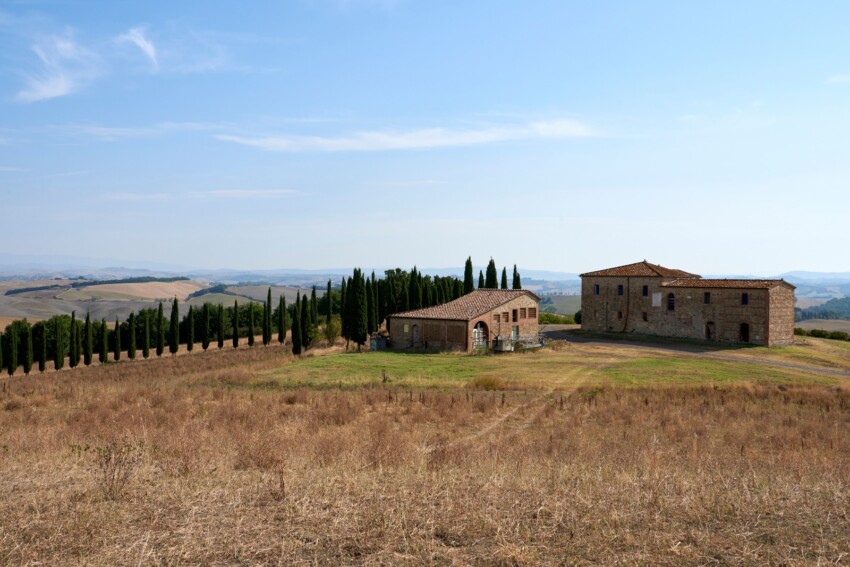
Murlo is a border settlement between the Val di Merse region, to which it belongs, and the Crete area of the Val d’Arbia. Magnificently positioned, it overlooks the Ombrone valley and the Montalcino pass.
The origins of this place are linked to Etruscan civilisation, clearly evidenced by the discoveries at Poggio Civitate and Poggio Aguzzo.
The castle of Murlo, with its typical fortified urban structure, dates back to the Medieval period (12th century), when it was the principal seat of the Fief of the Bishops of Siena, or Vescovado.
The layout, as it appears today, bears witness to the transformations that occurred at the end of the 16th century following the fall of the Sienese Republic, and reveals the castle’s structure with walls topped by small dwellings that surround the Bishop’s Palace (now home to the Archaeological Museum), the prison building and the cathedral. There are two access gates to the castle.
A small, isolated and ancient medieval village, situated on a hill overlooking the Crevole torrent and enclosed by 12th-century walls: the recent construction of a row of houses has not disturbed the original nucleus.
The Middle Ages are omnipresent in the churches and palaces, even though they have been altered in subsequent periods, yet the appeal to Etruscan civilisation is equally strong. From antiquity onwards, the fame of this enchanting hillside village has been linked to its geographical position, which is excellent from a strategic point of view (it lies 20 kilometres south of Siena, close to the borders with Lazio and Umbria).
The earliest traces of human settlement in this area date back to the Etruscan period (7th and 6th centuries BC), to which the numerous artefacts from the famous architectural complex of Poggio Civitate belong, situated south-east of Murlo. In this archaeological area, several excavation campaigns have brought to light the remains of two important buildings, one Orientalising and one Archaic, as well as a vast quantity of objects in ivory, bone, ceramics, bronze and alabaster, preserved in the Archaeological Civic Museum of Murlo. The Museum also houses an important laboratory of archaeometry and experimental archaeology, highly esteemed by foreign researchers.
In 1151, the fief of Murlo was donated by Count Ugolino di Ranuccio Ardengheschi to Bishop Ranieri, and it remained under the Sienese bishopric until the abolition of feudal holdings, which occurred by grand-ducal decree in the 18th century. For nearly two centuries, the territory of Murlo was the subject of bitter disputes between the Sienese government and the bishopric, which concluded in 1387 with the recognition, albeit partial, of Sienese sovereignty over the castle.
The castle is mentioned from 1189 onwards in the document by which Pope Clement III assigned it to Bishop Bono, but its construction certainly predates this, possibly even dating back to the years immediately after 1000. It was destroyed (like many others in the area) by the Imperialists of Charles V in 1554, but remarkably, its particular status as a bishop’s fief survived the fall of the Sienese Republic, and these privileges even remained in force until 1749, when they were abolished by Grand Duke Leopold II.
A visit to the Museum allows you to admire the splendid palace, known as “il Palazzone”, which in the Medieval period (11th-12th centuries) was the seat of the Bishopric of Murlo, ruled by the Bishop of Siena. Dating from this era are castles, towers, fortified works, parishes and hermitages with which the surrounding territory is dotted.
In the surroundings of Murlo, practically on every hilltop, there are the remains of several other castles: Fabbrichella, Formignano, Macereto, Montepertuso, Montepescini (the Castelvecchio di poggio castello), Valresta and Vescovado. Among the many, the localities of Montespecchio, Crevole, Montepertuso, Montepescini and Vallerano are of particular historical and artistic interest; also worth mentioning are the Petriolo thermal springs.
The territory of the municipality of Murlo extends over the Metalliferous Hills, partly on the left bank of the Merse river valley and partly on the right bank of the Ombrone valley.
From the Medieval age onwards, the resources of the territory of Murlo, which was sparsely populated, have been linked to agriculture and forestry. In addition to agricultural activity, which today produces wine and oil of high quality, in the past the area’s economy was also tied to lignite mining, which remained active until the mid-20th century. As a testament to this extractive activity, in which up to three hundred miners were employed, an educational route has been created, “the Miners’ Trail”, which, following the old railway built along the Crevole torrent to transport coal to places of use, illustrates through posters and maps the historical and naturalistic aspects of the area.
Near Murlo is Vescovado, a larger settlement formed by the merger of two villages, l’Andica and Tinoni, which at the beginning of the 19th century were still separate. In the church of Vescovado is preserved a painting by Benvenuto di Giovanni depicting a Madonna enthroned with Saints, dated 1475.
Worth noting at Murlo are the Fairs on 31st March, 31st May, 25th August, 1st October and 24th December, excellent opportunities for entertainment and gastronomic tastings. In this regard, mention should be made of the famous “Festa in collina” (Festival in the Hills), which is celebrated every year at Casciano di Murlo in the second half of May, with exhibitions, sporting competitions, traditional games, charity fair, concerts and evening dances.
An interesting fact: Murlo was certainly an Etruscan settlement, and even today, perhaps thanks to the isolation that has characterised these areas, the features of its inhabitants lead us to believe that they are the most direct descendants of the Etruscan people.
It is located approximately 20 kilometres south of Siena, whether you arrive from the Cassia (exit at Lucignano d’Arbia or Buonconvento) or from the SS 223 road (exit at Fontazzi).
What's the weather at Murlo? Below are the temperatures and the weather forecast at Murlo for the next few days.
To see all the facilities and book accommodation in Murlo use the form below, entering the dates of your stay.
 Hotel
Hotel 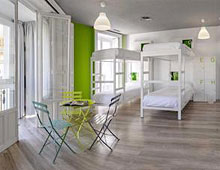 Budget accommodations
  Apartments
  Family Hotel
 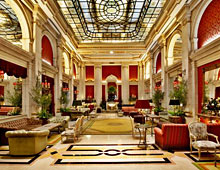 Luxury Hotel
 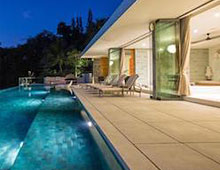 Resorts