Piccolo Hotel La Valle
Pienza - Via Di Circonvallazione 7
Book now
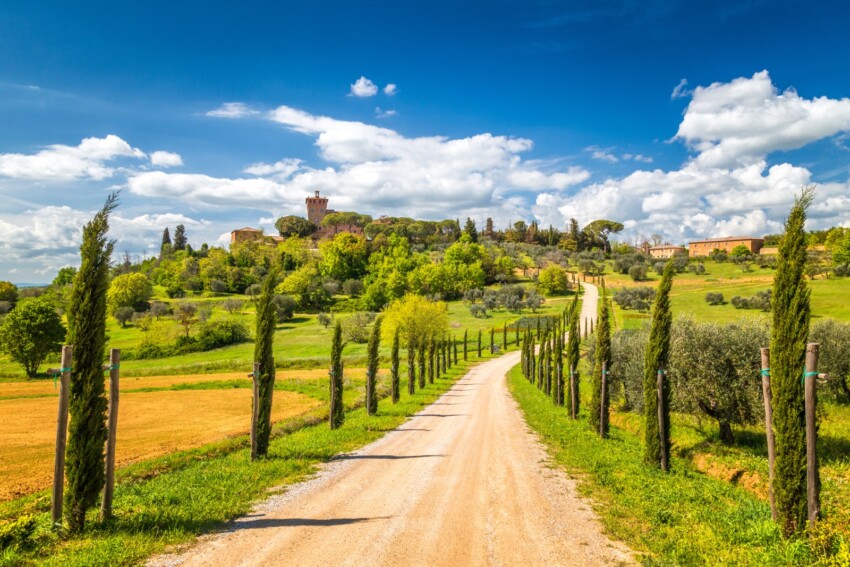
In Val d’Orcia, long established as one of Tuscany’s most popular holiday destinations, one of the most compelling villages to visit is undoubtedly Pienza. Located in the province of Siena, this is an area with a strong tourism appeal, where typical countryside settlements blend seamlessly with the surrounding landscape, creating the distinctive mix for which Tuscany is renowned across the globe.
With its historic centre protected by UNESCO, which has designated it a World Heritage Site, Pienza attracts visitors from across Italy and beyond, who come not only to admire its unique scenery but also to savour some of the area’s finest produce, most notably the celebrated Pienza pecorino cheese, alongside the gastronomic treasures Tuscany is famous for, including extra virgin olive oil and wine.
Beyond its splendid historic centre, well worth exploring, Pienza also makes an excellent base for discovering the Val d’Orcia and its attractions. The town is well developed for tourism, meaning you’ll find no shortage of central hotels or countryside agriturismos in the surrounding area, plus shops, bars and restaurants practically everywhere in town.
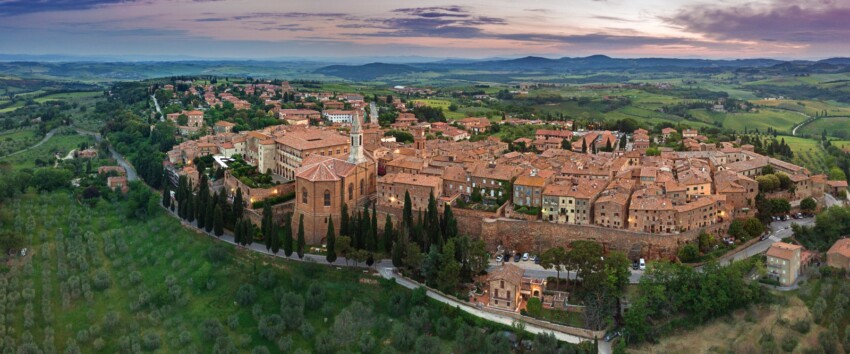
Pienza’s historic centre is small and easily explored on foot, yet meticulously maintained. This is where you’ll find most of the town’s attractions. Here are the highlights, so you won’t miss a thing.
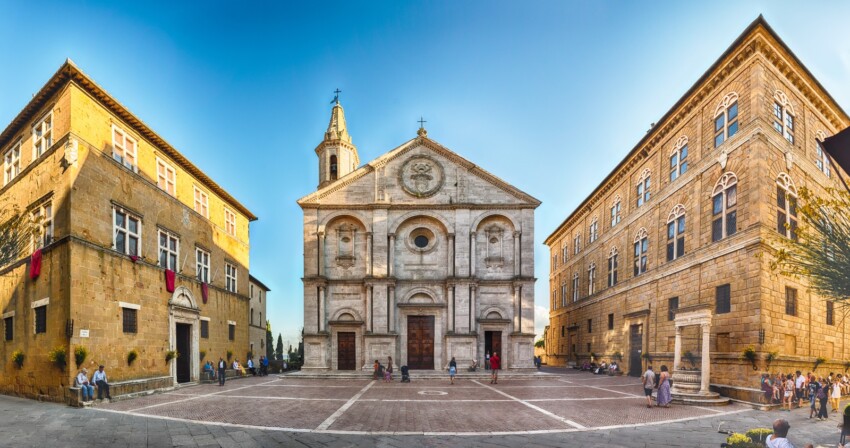
Pienza’s cathedral, dedicated to Santa Maria Assunta, stands in Piazza Pio II and is one of the principal monuments of the Italian Renaissance. The travertine façade is particularly striking, divided by a cornice into two sections: a lower zone featuring the entrance doors and an upper section with elegant arches supported by columns.
Inside, the cathedral is divided into three aisles of equal height, separated by two rows of pillars. The right aisle features a splendid pipe organ, though it dates only to the late 20th century. Among the notable paintings are the Assumption of the Virgin by Lorenzo di Pietro called Vecchietta and the Madonna and Child with Saints by Matteo di Giovanni.
Palazzo Borgia, also known as Palazzo Vescovile, overlooks Piazza Pio II. It has a restrained façade, and inside you’ll find the marvellous Diocesan Museum, one of Pienza’s unmissable attractions. Opened in 1998, it houses a collection of medieval art featuring paintings from both the Cathedral and throughout the Diocese of Pienza. Spread across 11 rooms, the collection includes works by artists of the calibre of Lorenzetti, Sano di Pietro, Luca Signorelli and Fra Bartolomeo della Porta.
Palazzo Borgia and the Diocesan Museum are open 10.30am to 6.30pm daily throughout summer except Tuesday; winter hours are reduced to 10am to 4pm on Saturdays and Sundays only. Discounts are available at the entrance for over-65s, groups of 15 or more, residents, students and teachers. Children under 10, professional tour guides and students from Tuscan universities receive free admission.
Walking past the cathedral’s apse, you’ll notice on your left a narrow pedestrian lane that runs above the ancient city walls. This is Via del Casello, otherwise known as the Pienza scenic walkway. Walk its entire length and pause at the specially designated viewpoints, which align with the former towers of the city walls, to capture stunning photographs of the Tuscan countryside.
Originally known as Palazzo Pubblico, Pienza’s Town Hall stands directly opposite the Cathedral. It was the former residence of the Priori, and its defining feature is three arches that create an elegant portico, within which you’ll find stone coats of arms of the Podestà who once lived there.
Inside Pienza’s Town Hall, you can admire a splendid 15th-century fresco in the Council Chamber depicting Pienza’s patron saints—San Vito, San Modesto and San Matteo—alongside the Madonna and Child.
Another of Pienza’s most elegant palaces is Palazzo Piccolomini, also called Palazzo Pontificio. Designed in the 15th century with inspiration from Florence’s Palazzo Rucellai, it’s a square-plan building spread over three floors with a rectangular courtyard opening onto a colonnaded loggia. To the south, the palace gardens overlook Val d’Orcia.
Palazzo Piccolomini has served as a film set for several productions, including L’arcidiavolo and Le piacevoli notti, both starring Vittorio Gassman, and Zeffirelli’s Romeo and Juliet.
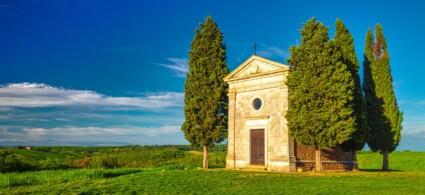
The Corsignano church, officially the Church of Saints Vito and Modesto at Corsignano, is a small chapel situated just a few kilometres from Pienza’s centre in the Corsignano locality. It dates to the 12th century, though its bell tower was actually built even earlier.
The exterior façade features a distinctive portal framed by two small columns and an arch, whilst on the church’s right side stands a second portal, richly decorated with scenes of the Journey of the Magi and the Nativity.
This church is historically significant as it contains the baptismal font where future popes Pius II and Pius III were baptised.
In the Spedaletto locality, along Provincial Road 53, stands a magnificent castle dating to the 12th century, originally belonging to the Hospital of Santa Maria della Scala in Siena. The Spedaletto castle visible today incorporates elements added in the 14th century and during the 19th century. Its plan is quadrangular with a tower at each corner.
Adjacent to the castle, you can also visit the Church of San Niccolò at Spedaletto, dating to the 14th century, featuring an attractive façade and an elegant interior decorated with frescoes from the 1600s.
Here’s a treat for cinema enthusiasts: south of Pienza, along the Terrapille road starting from the Church of Saints Vito and Modesto at Corsignano, you’ll find an unpaved turning. Walking along it for a few minutes leads to the clearing where the final scene of Gladiator was filmed. Obviously for non-film aficionados it’s simply another Val d’Orcia vista, but for Russell Crowe fans it’s truly unmissable.
Pienza’s historic centre is dotted with apartments and bed and breakfasts, often beautifully renovated in typical Tuscan style. They’re convenient options for staying overnight, particularly for enjoying the town at leisure in the early morning or late evening, as most tourists arrive on day trips mid-morning and leave in the afternoon.
If you’d prefer to immerse yourself in the spectacular natural setting of Val d’Orcia, we recommend staying at one of the many agriturismos in the countryside around Pienza. If you’re fortunate enough to find one serving local specialities grown on site, you’ll experience authentic Tuscan living at its finest.
Pienza is approximately two and a half hours from Rome: simply take the A1 motorway heading north and exit at the Chiusi-Chianciano Terme junction, then continue along provincial road SP146 to the town centre.
For those coming from the north, such as Florence or Bologna, the A1 motorway exit is the same, though driving times naturally vary. It’s approximately 2 hours 50 minutes from Bologna and 1 hour 40 minutes from Florence. The provincial capital Siena is about an hour away, despite being considerably closer in kilometres, as there are no motorways.
If you’re planning to reach Pienza by train, be aware that the town has no railway station. The nearest ones are at Montepulciano and Torrita di Siena, roughly 20-25 kilometres away. Once you’ve alighted, you’ll need to continue by regional bus.
What's the weather at Pienza? Below are the temperatures and the weather forecast at Pienza for the next few days.
Pienza lies in the province of Siena, in the south-east of Tuscany. It forms part of the Val d'Orcia, and comprises the town centre along with a number of hamlets, some consisting of just a handful of isolated houses. It sits on the SP146 provincial road: heading east along it takes you to San Quirico d'Orcia, whilst westwards leads to Montepulciano.
 Hotel
Hotel  Budget accommodations
  Apartments
  Family Hotel
  Luxury Hotel
  Resorts