Toscana Ambassador
Poggibonsi - Via Salceto 11
Book now
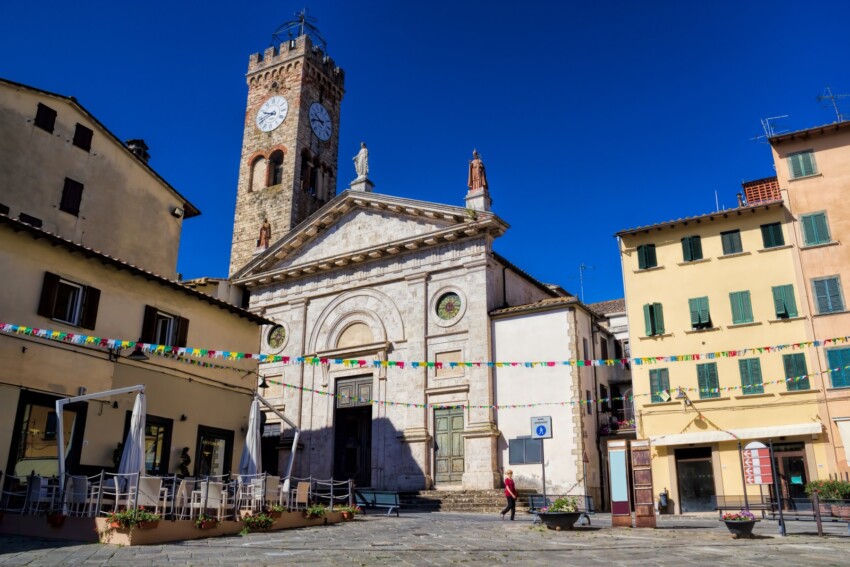
With almost 30,000 inhabitants, Poggibonsi is an important town in the province of Siena. Located in the Upper Elsa Valley, this is a territory well worth exploring, capable of satisfying even the most discerning visitor. What’s more, it sits right on the doorstep of Chianti, one of Tuscany’s most visited areas and a true icon of the region worldwide.
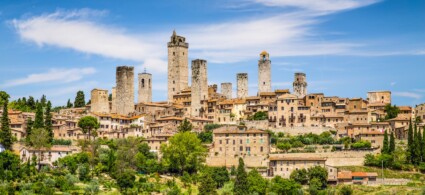
Visiting Poggibonsi, you’ll discover a place that sits pleasantly outside the mass tourism circuit – genuinely authentic, yet still with plenty to see. It’s the surrounding area, however, that truly takes your breath away: from the stunning San Gimignano, with its medieval towers, to the rolling hills of Chianti, simply driving without aim through this glorious corner of Italy becomes a holiday within a holiday.
There are several things to see in Poggibonsi, easily occupying more than a day. Visit them all, then head out on excursions to discover the marvellous surrounding area.
Begin your Poggibonsi tour at the town’s principal place of worship, the Collegiata di Santa Maria Assunta. This is a church built in neoclassical style, dating from the late 1800s and restored in the early 2000s. Today, the interior is divided into three naves separated by imposing columns; you can admire a baptismal font from 1341, and several fine works including Francesco Botticini’s Resurrection. The pipe organ is also particularly beautiful, dating from 1755 and housed within an ornately decorated wooden casing.
One of the few buildings in the Gothic style found in the Elsa Valley, the Convento di San Lucchese originally began life as the parish church of the hamlet of Camaldo. According to legend, it was founded by inhabitants of Fiesole, now part of Florence, who found themselves here after fleeing the fire that devastated their city in 1010.
Whatever the truth behind the Convento di San Lucchese’s story, do pause to admire its exterior, with its typical cottage-style façade open at the top, contrasting with the modern bell tower. To the right stands a cloister.
The interior is equally interesting, featuring a single nave illuminated by large Gothic-style windows. There are several notable works, including numerous frescoes on the walls and within the chapels, and the sculptures Madonna and Child with Saints by Giovanni della Robbia. Originally, the Convento di San Lucchese housed the Madonna Enthroned with Child, Angels and Saints, a work by Taddeo Gaddi from 1355, though it has since been moved to the Uffizi.
Ancient Poggibonsi was known as Poggibonizio; one of the most important remains from this now vanished city is the Fonte delle Fate, a public fountain built in the 13th century and buried at the end of the 1400s to make way for the construction of the Medici fortress of Poggio Imperiale.
It lay underground for more than 300 years, finally coming to light only in 1803 when excavations were being carried out to establish a vineyard. A travertine fountain was discovered, constructed in the typical style of public fountains of the era. It features a façade with a portico of six double arches, supported by broad pillars. In recent times, the work The Sleepers has been installed inside, donated to Poggibonsi by artist Mimmo Paladino, depicting men and crocodiles in a foetal position, as though immersed in sleep.
On the hilltop of Poggio Marturi, on the banks of the River Elsa, stands Castello di Badia. It boasts a tumultuous, centuries-long history, though the building we see today is the result of a complete restoration undertaken towards the end of the 1800s at the behest of Marcello Galli Dunn.
The castle comprises a main U-shaped structure, with an elegant clock tower. Its perimeter is enclosed by walls featuring towers at the corners and elegant crenellations. It also boasts a fine garden, from which there are splendid views across the valley below.
Not far from Poggibonsi’s centre lies the Fortezza di Poggio Imperiale, construction of which began in the late 1400s under the direction of Giuliano da Sangallo. It was built at the behest of Lorenzo the Magnificent, with the purpose of defending the territory under Florentine control.
The fortress sits on a hilltop, called Poggio Imperiale, overlooking Poggibonsi. It underwent recent restoration between September 2014 and May 2015, when several access gates to the building were brought back to life, including the Calcinaia Gate, the Fountain Gate and the Lily Gate. Additionally, a pedestrian pathway was created along the walls. From the bastions, you can enjoy fine views across Poggibonsi and its surroundings: on clear days, you can make out the Chianti hills, the Metalliferous hills and the Apennines.
The Poggibonsi Archaeological Park, situated south of the historic centre, atop the Poggio Imperiale hilltop, is Italy’s only open-air museum dedicated to the Early Middle Ages, the period spanning from 476, the year the Western Roman Empire fell, until the year 1000. It’s a park offering visitors an innovative and interactive approach, thanks to experimental archaeology and the concept of “lived history”.
There are 5 thematic routes available to visitors: archaeological, historical-architectural, geological-morphological, naturalistic-environmental and panoramic-monumental. Within the park, various buildings serve as conference halls, archaeological laboratories, catering services and bookshops. It’s possible to organise medieval-themed events and parties, educational workshops and summer camps for children.
The possibility of utilising the archaeotherapy service is particularly interesting – a psychiatric technique that brings patients into contact with history, archaeology and artistic activities, to stimulate mental faculties and teamwork.
In the following map you can see the location of the main places of interest mentioned in this article.
The current historic centre of Poggibonsi corresponds to the ancient urban layout of Borgo Marturi, which became an essential centre on the Via Francigena pilgrimage route in the 12th century. In 1115 the castle was destroyed by the Florentines, forcing inhabitants to emigrate to the hamlet below, called Poggio bonizio – precisely the root of Poggibonsi – which was of Ghibelline allegiance and was itself destroyed again by Florence in 1270.
In the 16th century Poggibonsi became a municipal town, but subsequently had to submit to the Florentines following Siena’s definitive defeat; the consequences were the destruction of walls and fortifications. Lorenzo de’ Medici became convinced of the idea of building the Grand Fortress of Poggio Imperiale, opening the door to a period of peace and stability.
However, it was in the 20th century that Poggibonsi suffered considerable damage during the Second World War, only to become, by the end of the 1900s, the most important industrial and commercial centre in the Elsa Valley, particularly for its furniture-making and its thriving wine and oil trade.
Being a town of almost 30,000 residents, there’s always something to do in Poggibonsi. Summer brings the lovely Festa della Gradinata (Steps Festival), featuring historical re-enactments and plenty of food stalls, but even throughout the rest of the year, evening entertainment options are plentiful, especially in the town centre: there are several pubs for after-dinner drinks, numerous restaurants and various aperitivo bars.
Via della Repubblica is one of the main meeting places for young people: strolling up and down this street is pleasant, thanks also to the numerous shops lining it.
In Poggibonsi’s centre and immediate surroundings there are few hotels, but there’s no shortage of apartments and bed and breakfast establishments. Moving outside the built-up area, you’ll find plenty of farmhouses – restored ancient country houses offering a holiday surrounded by nature, far from the hustle and bustle of modern life.
The type of accommodation you choose depends on the kind of holiday you want: staying in the centre means having monuments, attractions and services within reach, whilst venturing into the open countryside means relying on your car for all journeys, though in return you can spend your days immersed in idyllic landscapes and surrounded by nature.
Poggibonsi sits roughly midway between Florence and Siena. The Florence-Siena motorway link runs alongside it, so from anywhere in Tuscany, reaching it is neither taxing nor lengthy, particularly since there are two junctions, Poggibonsi North and Poggibonsi South.
From Florence it takes around 40 minutes heading south; from Siena roughly 25 minutes heading north. From the Tuscan coast, for instance from Pisa and Livorno, it takes approximately an hour and a half, taking the FI-PI-LI dual carriageway to the Empoli exit, then heading inland along the SR429, passing through Certaldo.
Reaching Poggibonsi by public transport is also straightforward: the town has a railway station, called Poggibonsi – San Gimignano, served by regional trains to and from Empoli, Siena and Florence Santa Maria Novella.
What's the weather at Poggibonsi? Below are the temperatures and the weather forecast at Poggibonsi for the next few days.
Poggibonsi is located in the province of Siena, positioned roughly halfway between Florence and Siena. San Gimignano lies to the west, whilst to the east begin the rolling hills of Chianti.
 Hotel
Hotel 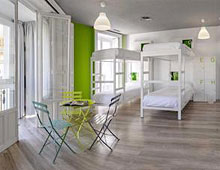 Budget accommodations
  Apartments
  Family Hotel
 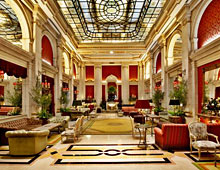 Luxury Hotel
  Resorts