Palazzo Leopoldo Dimora Storica & Spa
Radda in Chianti - Via Roma 33
Book now
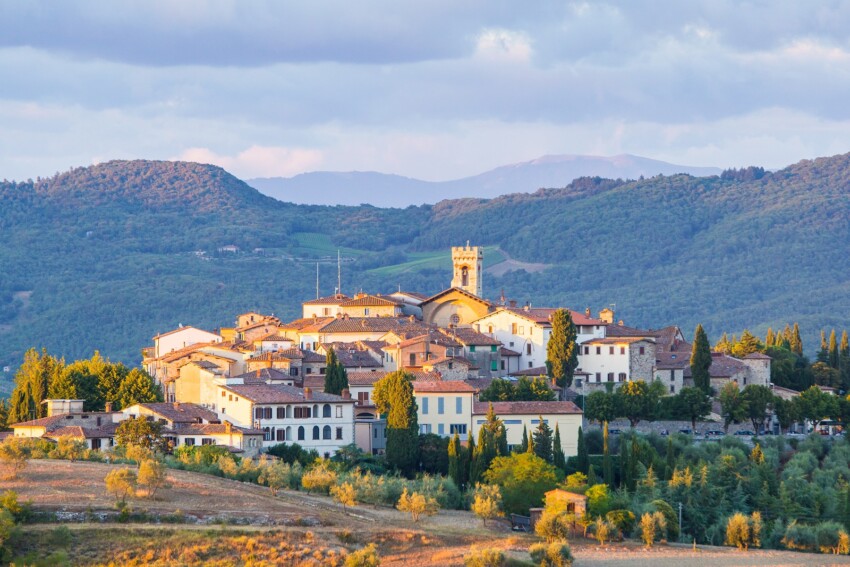
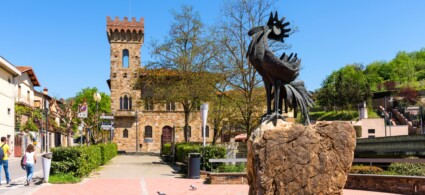
Radda is the village of vineyards. The view from the hilltop where, during the medieval period, Radda was built between the waters of the Arbia and Pesa rivers, sweeps across an incredibly dense patchwork of vineyards. The heart of the village, dominated at the top by what remains of the original castle, is Piazza Ferrucci.
The municipal territory covers an area of 80.56 km², with altitudes ranging from a minimum of 250–300 metres to a maximum elevation of 845 metres above sea level at Monte Querciabella.
The territory is crossed by several watercourses of a torrential nature that lend their names to the surrounding valleys. The Pesa originates here, from the slopes of Pian d’Albola, and the Greve, which rises from Monte Querciabella, both tributaries of the Arno. The Arbia flows only at the edges of the village before merging into the Ombrone a little further on. The terrain is well suited to the cultivation of vines and olives. Wine, above all, is the principal source of income for the local population, who have long been tied to this production, which is celebrated worldwide. More recently, craft production linked to building and woodworking has also gained momentum.
Entirely within the Chianti Classico region of Siena, Radda in Chianti boasts Etruscan origins: traces of this mysterious people have been discovered in the inhabited centres of its territory. The first documented references date back to 800 BC, though the earliest direct mention of Radda Castle is placed around the 11th century. By around 1220, the Castle of Radda, like many Chianti castles, had certainly passed to the Guidi counts.
At the centre of conflicts between Siena and Florence, Radda by the end of the 13th century was under Florence’s jurisdiction, which granted it a Podestà. In 1384 it became the capital of the Chianti League, which also included the territories of Castellina and Gaiole in Chianti. The leagues were autonomous jurisdictions that grouped together the Florentine contado, with administrative functions, their own statutes and specific defence needs.
With the rise of the merchant class, sharecropping spread throughout Chianti, and with it came the dispersal of isolated settlements, the “poderi”, which have characterised the Chianti landscape down to the present day.
Radda preserves part of its ancient city walls and the medieval urban structure with an elongated elliptical plan. At the centre of the village stands the Palazzo del Podestà, built in the 15th century, whose façade is adorned with coats of arms, and the Church of San Niccolò. In the surrounding area worthy of note are the Franciscan Convent of Santa Maria in Prato, which houses a museum of religious art featuring works from the churches of Radda and Gaiole, and the village of Volpaia, whose medieval castle, positioned on the border between Florence and Siena, must have held considerable defensive importance. Here stands an unusual religious building, the Church of Sant’Eufrosino, known as the “Commenda”, dedicated to a bishop of Eastern origin whom tradition holds to have been an evangelist of Chianti.
Of the castles in the Radda territory, only Volpaia achieved significant development, with an extensive circuit of walls with towers and a keep still largely preserved, while other castles have come down to us in very fragmentary form, such as Albola and Monterinaldi, or have been transformed into villas, like Castelvecchi, or farmhouses, such as Castiglione, Il Trebbio and Paternò.
Other rural dwellings retain the tower structures of medieval “case da signore” (manor houses): this is the case with Borraccoli, Camporempoli, Casa Vecchia, Montevertine, Palazzo Pornano, Le Ripe and Il Fornale. Selvole, on the other hand, appears always to have had the characteristics of an unfortified rural village. Among the stately buildings is finally worth mentioning the splendid manor house “Le Marangole”, located not far from the village centre.
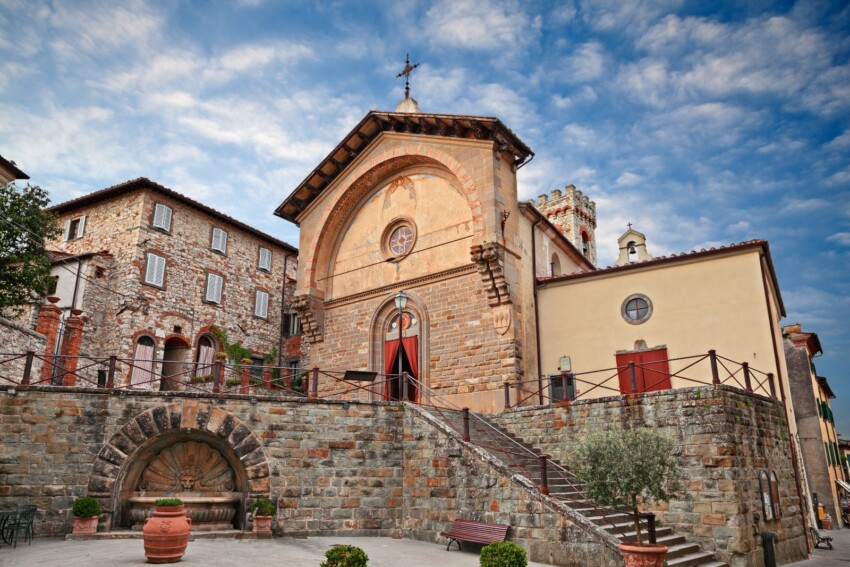
The testimonies of the ancient religious organisation of the Radda territory are interesting and significant, starting with the Parish Church of Santa Maria Novella which, despite considerable alterations in the last century, retains its original layout, as evidenced by its rich Romanesque capitals.
Also noteworthy are the Romanesque remains that several churches still preserve today, such as those in the village of Albola, Bugialla, Livernano, Montemaione and Radda itself, but it is particularly the “canonicas” of San Fedele a Paternò and Santa Maria in Colle (the Badiola), the latter now with a single nave but retaining the arcading of the original basilical layout.
Remains of the Camaldolese abbey of Montemuro, the “Badiaccia”, are still incorporated into buildings of the current village. And it is from a Romanesque nucleus that the magnificent convent of Santa Maria in Prato developed over subsequent centuries, where we can still admire today the famous “Madonna and Child” by Neri di Bicci (1474).
What's the weather at Radda in Chianti? Below are the temperatures and the weather forecast at Radda in Chianti for the next few days.
To see all the facilities and book accommodation in Radda in Chianti use the form below, entering the dates of your stay.
 Hotel
Hotel  Budget accommodations
  Apartments
  Family Hotel
  Luxury Hotel
  Resorts