Hotel Giogliano
Radicondoli - strada di Giogliano 29
Book now
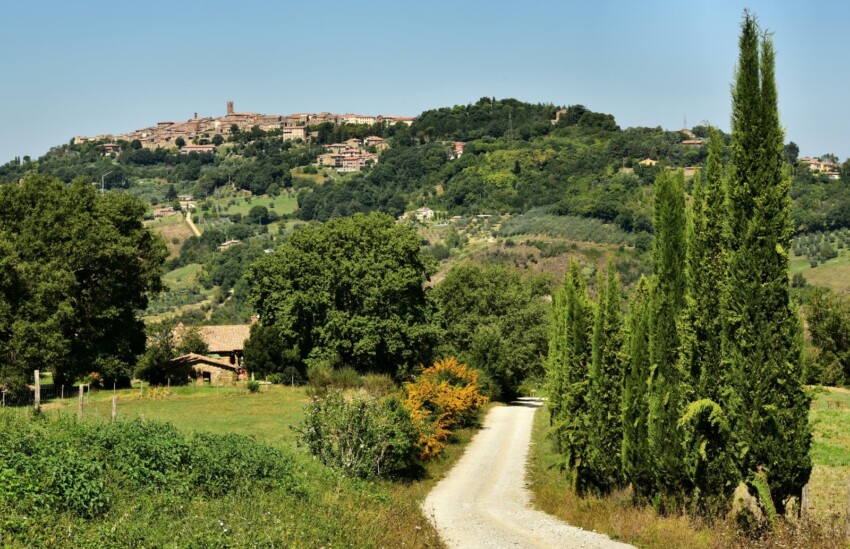
From the 13th century onwards, many open villages serving as church seats and some castles were abandoned, and the population relocated within Radicondoli and Belforte, centres that already from the early decades of the 13th century took on a defined urban structure, equipped within their walls with administrative and religious buildings necessary for the community and enjoyed flourishing economic development linked primarily to wool processing. The urban layout of Radicondoli and Belforte followed the pattern of Tuscan medieval centres surrounded by walls, with a main thoroughfare intersected by one or more cross-streets, at whose ends the access gates opened.
It appears that the castle of Radicondoli was built from scratch between 1209 and 1213 on the hillock known as San Cerbone.
From its inception, Radicondoli belonged to the Aldobrandeschi counts of Sovana and Santa Fiora, and this is indeed confirmed, along with Belforte castle, in a 1216 document dividing the territory amongst members of this powerful family consortium. It subsequently came under the rule of the Republic of Siena in 1230, though a pact of submission and oath of loyalty from all the heads of families – numbering 329 at the time – date back to 1221.
It became the subject of dispute in 1240 between the Sienese republic and Emperor Frederick II. Between 1260 and 1269, occupied by the Guelphs, it was besieged and recaptured by troops under Provenzano Salvani, but in 1301 it was definitively incorporated into Sienese territory. From that date, Radicondoli remained consistently loyal to Siena, and its history became intertwined with the broader destiny of the republic. It nonetheless continued to experience considerable building development between the 14th and 16th centuries, as evidenced by several significant noble palaces. An important event in the settlement process was also the arrival of monastic communities, such as the Augustinian monastery of Santa Caterina delle Ruote founded in 1343 and the Convent of the Observance established in 1424 a short distance from the town centre.
Following the War of Siena, Radicondoli, along with the entire Sienese State, was incorporated into the Grand Duchy of Tuscany; by public deed of 27 November 1554, it swore allegiance to Cosimo I de’ Medici. In 1555, according to Gherardini’s account, its walls were largely demolished by order of the Count of Lattaia, who had occupied the town. The same author provides interesting details about Radicondoli itself, which in 1656 had only 364 inhabitants, listing the public buildings present including the courthouse, hospital, Opera house, Monte Pio granary and Opera granary, and naming the principal palaces belonging to the Loli, D’Elci, Bizzarrini, Berlinghieri and Landucci families.
He also recalls five churches within the town: the Collegiate Church, the Hospital church, those of San Martino, San Donato and Santa Cristina, plus the monastery of Santa Caterina delle Ruote.
After a long period of decline, a moderate revival of productive activities linked to forest resources and demographic reversal (numbering 1,313 inhabitants in 1840) occurred during the 18th and 19th centuries, a period during which numerous buildings were erected within the town and agricultural estates in the territory were expanded and better organised. With the Leopoldine law of 1774, which reorganised the district of justice courts in the province, Radicondoli was designated as the residence of a podestà whose jurisdiction also encompassed the community of Belforte.
The castle of Radicondoli, enclosed by its walls, thus experienced maximum development between the first half of the 13th century and the mid-14th century. The town was centred on a main axis, the “strada maestra” now Via Tiberio Gazzei, connected to two gates – San Martino and San Pietro – no longer in existence, and the perpendicular Via Sedice, which opened south into the only remaining gate, called Porta Olla after the medieval nucleus towards which it faced. The three gates were still in existence in 1656, as confirmed by Bartolomeo Gherardini, auditor of the Sienese state. At the opposite end, another gate presumably opened, likely connected to the pieve of San Simone, though we have no record of this.
Of the city walls, built at the beginning of the 13th century, the elliptical perimeter is almost entirely preserved, whilst little remains of its original masonry structure, which was rebuilt on several occasions.
The Palazzo del Capitano dates from the 13th-14th centuries; this is where the captain of justice resided and it retains elements of its original layout, including portals with full round arches and acute-angled archivolt with stone voussoirs, and traces of filetto masonry. The building was restructured and heighted by one storey in the 16th-17th centuries.
On the house opposite, next to the collegiate church, stood the Loggia del Capitano, which was demolished in 1949. It probably originated as part of the Town Hall, also called “il palazzetto de la loggia” and mentioned in the 1411 Statute.
The uniform frontage of medieval houses is interrupted by public and private palaces and churches.
Amongst the religious buildings, the pieve of San Simone, contemporary with the castle’s formation (1209-1213), retains from its original Romanesque layout only the bell tower, square in plan and built with ashlar blocks arranged in filetto, and a section of the two-coloured lateral wall formed by alternating bands of stone and brick. Located on the piazza at the intersection of the main street and Via Sedice, it originally had a different orientation from today, with its side parallel to Via T. Gazzei and the bell tower near the apse.
This church probably inherited the title of pieve previously held by the old pieve situated outside the town, and in 1356 many churches in the Radicondoli territory depended upon it, along with the monastery of San Caterina and the Hospital within the town. This pieve was subsequently completely rebuilt in its present form between 1589 and 1627, when it was granted the title of Collegiate Church of Saints Simon and Jude.
Developed on a Latin cross plan with a marble façade topped with a triangular pediment framed by lateral scrolls and composed of panels defined by flat pilasters and cornices, it contains important paintings inside, including the panel of the Madonna della Mercede, formerly kept in the Old Pieve, a work by Sienese painter Naddo Ceccarelli, pupil of Simone Martini and Lippo Memmi; the large arched altarpiece depicting the Nativity and the Assumption of the Virgin into Heaven, from the nearby monastery of Santa Caterina delle Ruote, painted towards the late 15th century by Pietro di Domenico, a Sienese painter influenced by Francesco di Giorgio Martini; the canvas depicting the Madonna in Heaven with Child and Angels and Saints by Astolfo Petrazzi of 1664.
Near the pieve there was also a hospital founded in 1291 by Contelda, widow of Guglielmo and of knight Bernardino, where several pious women worked. At this site, the Bishop of Volterra granted permission in 1339 (the episcopal decree dates to 1343) to erect a female monastery of the Augustinian order. The hospital existing here was transferred to two other nearby houses donated by donna Niera as early as 1334. In 1421, as it was in poor condition, it was restored in 1426 by the hospital keeper Simone di Francesco and furnished with three beds. Finally, around 1477 it was suppressed and replaced by another hospital called San Giovanni
located at the entrance of the town near the San Martino gate.
The monastery with the attached church of Santa Caterina was thus built from 1343 onwards, but already in 1378 the church was enlarged and subsequently (in 1528) the adjoining monastery was also enlarged following the donation of a house. The addition of adjoining houses, including one of the Berlinghieris in 1544 and the “casa del Poggiarello” purchased for 200 florins by Count Antonio d’Elci in 1560 for his daughter Clarice upon her entry into enclosure, allowed further expansions of the monastery. Further work was undertaken during the 18th century (1711, 1755-67) until the period when, under the French government’s Suppressions, the monastery was abolished.
However, following varied fortunes, part of the monastery returned to the nuns in 1955, who still inhabit it today. The vast complex displays the complex building phases and aggregation of pre-existing buildings that succeeded one another over the centuries. On the long façade can be seen the remains of arched openings and a 14th-century tower house characterised by two acute-angled arched portals.
The church, which faces onto Via Tiberio Gazzei, presents instead a late Mannerist structure. Built in terracotta, it has an entrance portal with a broken triangular pediment where a small terracotta statuette of Santa Caterina delle Ruote is placed.
At the entrance to the town stands the Church of the Crucifix, where the hospital of San Giovanni Battista was formerly located, documented from 1540 onwards and furnished with one bed for the poor and pilgrims; this was under municipal patronage and administered by a hospital keeper who also served as schoolmaster, as attested by documents from 1641 and 1658.
The present church dates to 1724. It features a brick façade of the aedicule type with lateral pilasters and a triangular pediment. The interior, in Latin cross form, is a single nave covered with barrel vaults supported by pilasters and a dome at the centre of the transept.
Along the same street are also several late Renaissance palaces, mostly dating from the 16th century.
Amongst these is the Palazzo d’Elci, of imposing dimensions, positioned at the eastern end of Via Gazzei in continuity with the monastery of Santa Caterina, as previously mentioned. The palace’s current structure dates to the restructuring that occurred after 1560. The façade is articulated according to the dictates of late Renaissance architectural culture with exposed masonry originally rendered, delimited by rusticated lateral cornices and a rusticated portal at the centre. It develops over three storeys emphasised by stone string courses, above which are arranged rectangular windows with stone frames on the first floor and terracotta on the second.
The present Town Hall also dates to the 16th century. Positioned almost opposite the collegiate church, it presents noteworthy architectural features and has been attributed to Baldassarre Peruzzi, to whom is also ascribed the design of the nearby Villa di Anqua.
Inside the palace are worth noting the spacious entrance hall covered with a barrel vault on carved corbels, doors fitted with stone jambs and architraves already bearing the Berlinghieri coat of arms (now removed), and a fine travertine well leaning against the wall, semicircular with an amphora-shaped parapet and upper niche. The palace was purchased by the municipality in 1988 and, after carrying out some restoration work in 1991, transferred its headquarters here.
Palazzo Bizzarrini. The municipality was previously located in a small brick building, also from the 16th century, corresponding to no. 24 on Via Gazzei, which belonged to Michelangelo Bizzarrini, mentioned in 1583 in connection with his daughter Elena’s entry into enclosure in the nearby Augustinian monastery. Other members of the Bizzarrini family held important positions, including that of auditor of the wheel at the Medici court. In the 19th century, when it housed the municipal seat, it underwent restoration work.
Palazzo Lolini. Another large palace (nos. 67-69) of 16th-century layout belonging to the same Bizzarrini family passed in the 19th century to the Noferi, then to the Borghi in 1901 and finally by inheritance to the Lolini, its current owners. In 1656 Gherardini mentions this palace, owned by Angelo Bizzarrini, amongst those of greatest prominence, whilst in the following century Pecci attributes its ownership to auditor Giuseppe Bizzarrini. Of 16th-century layout, it was completely restructured by the Noferi in the second half of the 19th century, as documented by the date “1889” carved above a window’s architrave and the coat of arms above it. Inside, some rooms, such as the entrance hall, a bedroom and a bathroom, feature late Neoclassical elements and decorations executed by Sienese painter Luigi Cinatti, and a ballroom with an orchestra supported by columns, also bearing monochromatic decoration with floral motifs and ovals containing illustrious figures, attributable to the same painter.
The 19th century also saw the Palazzetto Baronti Marchiola no. 43, characterised by a double arched access portal with an overhanging balcony supported by scroll-shaped stone corbels and openings with moulded frames and architraves on corbels bearing a relief ornamental motif, and the nearby Casa del Popolo nos. 55-59, in brick, which bears on its façade a plaque commemorating Garibaldi.
What's the weather at Radicondoli? Below are the temperatures and the weather forecast at Radicondoli for the next few days.
To see all the facilities and book accommodation in Radicondoli use the form below, entering the dates of your stay.
 Hotel
Hotel  Budget accommodations
  Apartments
  Family Hotel
  Luxury Hotel
  Resorts