Fonteverde Lifestyle & Thermal Retreat
San Casciano dei Bagni - Località Terme 1
Book now
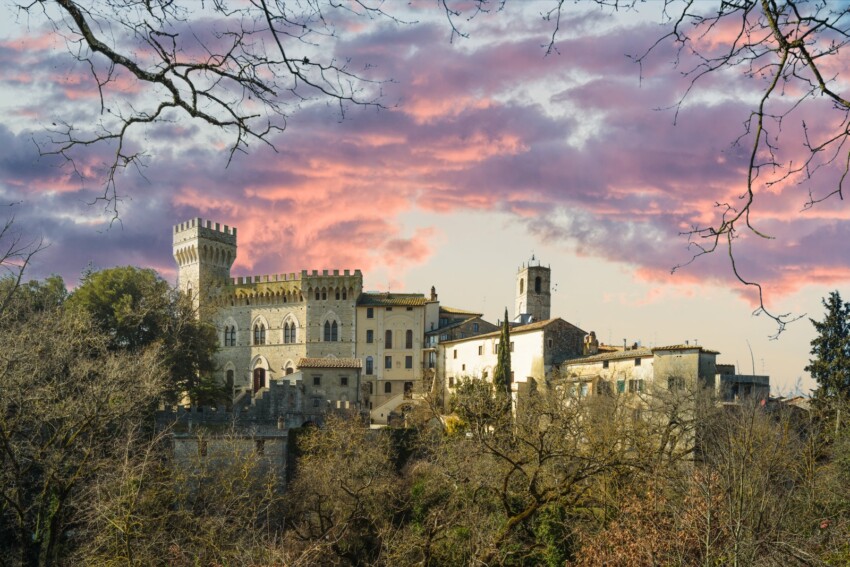
The urban layout of San Casciano dei Bagni naturally guides you through a gentle route that reveals the prettiest corners of this charming town. It’s a circular path, following the centre as it wraps around the hilltop where it sits, culminating at the Collegiata church whose bell tower marks its apex.
The first impression of San Casciano dei Bagni is dominated by the castle with its walls and elegant tower, so perfectly integrated into the surrounding landscape that you’d never guess it was built in the early 20th century. From Piazza Matteotti, like a vantage point, you can admire one of the most beautiful views across the Tuscan countryside.
This is the principal church of San Casciano. Over the centuries, it has undergone significant changes in both its architectural structure and ecclesiastical governance. Originally, it was run by four priests known as the Pensionieri di San Guglielmo, as they were dependent on a convent of Guglielmite monks located near the village of Acerona. The church’s dedication to San Leonardo likely stems from the veneration of this saint at the Acerona convent. In 1618, the church was elevated to the rank of Insigne Collegiata, with a Chapter of seven priests: the Archpriest, who held the highest capitular dignity, and six Canons. The Community held the right to appoint both the Archpriest and the Canons, and also possessed the jus padronato (patronage rights) of the Church of San Leonardo.
Beyond the canonries, to which the Desponsazione di Cristo (Espousals of Christ) was later added, there were also five Benefices, these being under the patronage of several distinguished San Casciano families, who were responsible for appointing the priests who would hold these positions. The 17th and 18th centuries represented the period of greatest splendour for the Collegiata, visited by Italian and foreign bishops and cardinals who came to San Casciano for thermal treatments. The Collegiata di San Leonardo has undergone various modifications to its architectural structure over the centuries. In its original form, the church would have been oriented along the west/east axis, rather than the current south/north, with an entrance on the side now occupied by the Oratorio di Sant’Antonio, as evidenced by the discovery of the original portal on that side. The style employed was unmistakably Gothic, with an abundance of worked travertine elements, as confirmed not only by the portal but also by the remains of cornices and columns. It was later reoriented, probably in the 16th century when the Confraternity of Sant’Antonio was founded and its church built. The bell tower was erected in 1606.
The Church of Sant’Antonio, adjacent to the Collegiata, was the seat of the Confraternity of Sant’Antonio, founded between the late 15th and early 16th centuries. The Confraternity also owned two hospitals, one in the town and another beside the Church of Santa Maria della Colonna at the Thermal Springs, each hospital being run by a manager elected by the Confraternity’s Council. The Church of Sant’Antonio also underwent various architectural modifications, particularly in the 18th century.
In 1741, the staircase connecting it to the Collegiata was relocated; originally it had been situated beside the central altar dedicated to San Cassiano.
In 1748, major works were undertaken that transformed the church’s interior, giving it a Baroque appearance through the creation of a circular apse and false travertine columns. A decade later, master craftsman Pietro Sperone completed the stucco decorations adorning the apse. Inside, a wooden statue depicting the Madonna and Child is preserved.
Originally used as the Palace of Justice, it served as the seat of the municipal administration and the residence of the Podestà. The construction of the adjacent castle modified its original structure. The façade and atrium are adorned with the coats of arms of several Podestà of San Casciano. On the left side of the façade there is a column displaying the units of ancient San Casciano measurement standards. The atrium houses further coats of arms of the Podestà and a 16th-century architrave bearing the municipality’s coat of arms. In the Mayor’s office, an Etruscan terracotta funeral urn is preserved.
The tower probably formed part of the cassero (keep) of the Celle castle. The historic centre retains a distinctive quadrangular town plan with wide, perfectly straight streets and a spacious plaza that seems disproportionate to the town’s current size.
Once the Republic of Siena had definitively secured Fighine, it commissioned Biagio De Stinis in 1446 to expand the castle so that it had a quadrangular plan, with towers at each corner: the old tower (the square one, adapted to new military requirements through the addition of a buttress and the repair of crenellations and machicolations), the master tower, the round tower and the so-called “saracinesca” tower. Although not mentioned in the documents cited above, the latter is documented in subsequent records and likely protected the cassero entrance. Furthermore, an earthwork on the western side was lowered, as it represented the only real danger from artillery attack. A surprise attack by papal troops in 1451 interrupted the works, although they had essentially been completed in their essential outlines. In 1466, the Republic of Siena sent the Master Giovanni Gori of San Quirico to Fighine to complete the works.
The thermal waters of San Casciano were certainly held in high regard in antiquity, as evidenced by the authors of treatises on thermal springs who wrote across the centuries, and confirmed by contemporary studies. Archaeological evidence supports this, though we must rely largely on the memories passed down through generations due to the lack of modern research. Like all thermal spa towns, San Casciano experienced the decline of the Early Middle Ages, suffering a drastic reduction in population and urban development. However, unlike other places, it remained firmly anchored to its identity, preserving both important remains of ancient thermal structures and the memory of water use—documents from the 10th century refer to the place as “ad balneo”. It is therefore logical that when the practice of hydrotherapy resumed in the 13th century, San Casciano found itself in a leading position within Italian thermal spa culture.
Ugolino da Montecatini dedicated considerable space to its “many baths” in his “Tractatus de Balneis” (1417). From the 1590 law concerning the duties of the Operaio delli Buttini, Fonti e Bagni (Commissioner of Fountains and Baths), it is clear that San Casciano and San Filippo are the principal baths of the State of Siena and therefore must be visited three times a year (others only twice).
The true resurgence of San Casciano’s thermal spa tradition occurred in the 17th century and throughout the next. During this period, the town became a destination for stays by Italian and European nobility. Distinguished spa-goers were accommodated in the homes of San Casciano residents, staying for at least two weeks—the minimum treatment cycle prescribed by the therapeutic practices of the time. The 19th century opened with a wave of innovation in the thermal spa sector from France and Germany, ushering in the era of grand, self-contained thermal establishments with all modern comforts, appealing to the emerging industrial bourgeoisie. San Casciano failed to adapt and was soon left behind in the grand circuit of Italian thermal spas.
What's the weather at San Casciano dei Bagni? Below are the temperatures and the weather forecast at San Casciano dei Bagni for the next few days.
To see all the facilities and book accommodation in San Casciano dei Bagni use the form below, entering the dates of your stay.
 Hotel
Hotel  Budget accommodations
  Apartments
  Family Hotel
  Luxury Hotel
  Resorts