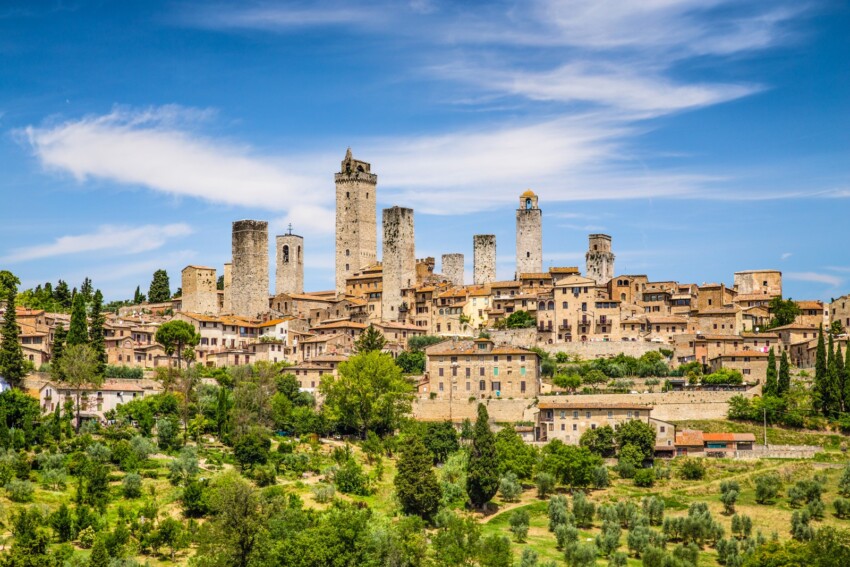
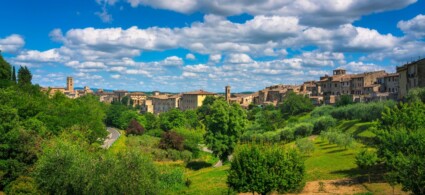
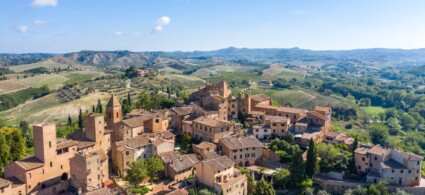
If there’s one medieval town in Tuscany that’s an absolute must-see, drawing thousands of visitors every single day of the year, it’s San Gimignano. Located in Siena province and conveniently positioned for those coming from Florence, it’s a genuine gem. You’ll know instantly that this is somewhere special the moment you catch sight of its skyline in the distance, with its numerous towers seeming to rest majestically atop the hilltop where the town sits.
Make no bones about it: San Gimignano is an absolute paradise for anyone on holiday in Tuscany. And as if that weren’t enough, the surrounding landscape is breathtaking—endless rolling hills and vineyards stretching to the horizon. Which perhaps explains, without much surprise, why it’s absolutely overrun with tourists, filling its streets and little shops a full 365 days a year.
Many arrive from Florence, either independently or on organised tours. But if you decide to spend more than a day here, you’ll discover a different San Gimignano in the evening when the crowds thin out—one of quiet corners and empty little streets, lit by little more than a handful of lights. Give it the time it deserves, and venture beyond the main tourist attractions: you’ll gradually fall in love with it, and won’t want to leave.
Things to do in San Gimignano
Everything worth seeing in San Gimignano is tucked within the small historic centre, designated a UNESCO World Heritage Site. You can move easily between attractions on foot, taking only a few minutes’ walk as you pass the countless medieval towers still standing proudly today. Using the list below, you’ll be able to visit them all without missing a single one.
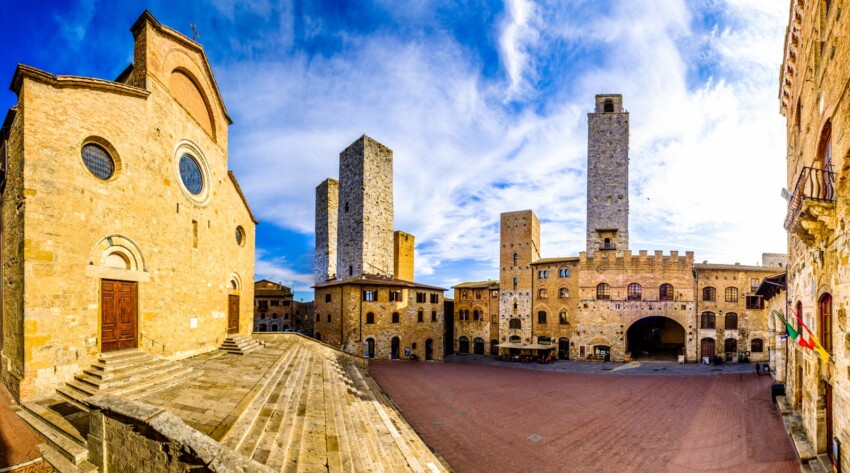
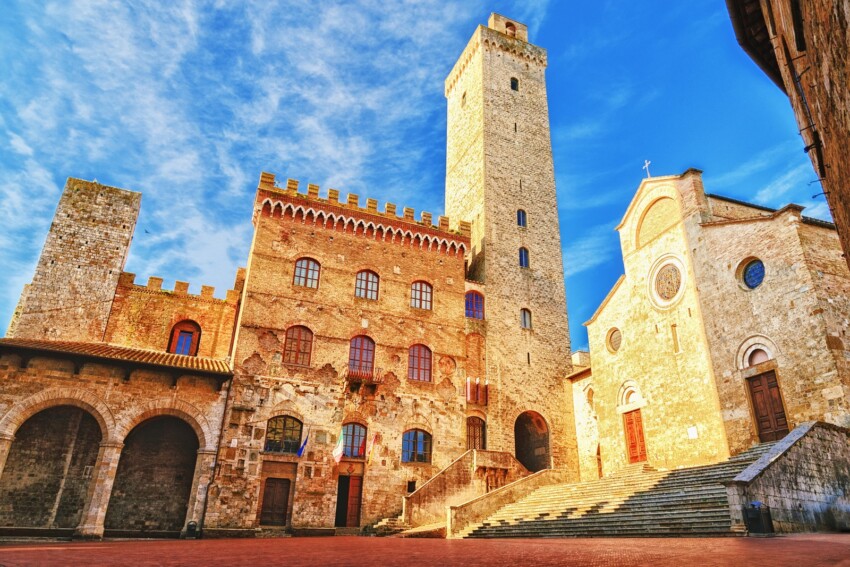
San Gimignano’s cathedral, formally the Collegiate Church of Santa Maria Assunta, is a handsome church located in the heart of the town, perched atop a staircase overlooking Piazza Duomo.
Built in Romanesque style, the church dates back to the 10th century, though what we see today is an “enlarged” version of the original. The expansion work took place in the late 1400s, designed by the renowned architect Giuliano da Maiano. The cathedral suffered significant damage during the Second World War, but fortunately a series of restoration projects have returned it to its former glory.
Externally, the cathedral’s façade is plain and austere, with two entrance doors and three rose windows. However, it’s inside that the Collegiate Church truly shines, thanks to the lavish frescoes covering the barrel-vaulted ceiling and the walls of its three naves, created primarily by the brothers Lippo and Federico Memmi and Bartolo di Fredi. The rose window on the back wall of the central nave is also remarkable—a contemporary 2003 work titled Iridescenze, created by Calabrese artist Marcello Aitiani, who moved to Siena at a young age.
Also noteworthy is the pipe organ, constructed in the 1500s and restored several times since, most recently in 1905, which gave it its current appearance. It’s located in the left side aisle, above a marble choir loft dating to 1450.
2Piazza Della Cisterna, 20, 53037 San Gimignano SI, Italy
Like most tourists visiting San Gimignano, you’ll want to explore the historic centre starting with its main attractions. If so, head straight to Piazza della Cisterna, one of the town’s most beautiful squares. It has a triangular shape and connects to the nearby Piazza del Duomo via an open passage.
In Piazza della Cisterna, among souvenir shops and ice-cream parlours, you’ll find some of San Gimignano’s most interesting monuments, including the Arco dei Becci, an ancient city gate, and several noble palaces including Palazzo Razzi, Casa Salvestrini and Palazzo Tortoli.
The square is overlooked by some of the town’s most famous towers: the twin Ardinghelli towers, the Tower of the Devil and the Pellari Palace tower.
In Piazza Duomo, next to the famous Torre Grossa, stands the town hall, also known as the Palazzo del Popolo or the Podestà’s Palace. Its iconic façade features windows with depressed arches, and above them extends a balcony from which the podestà addressed the crowds.
The civic museum occupies the upper floors of the town hall, showcasing splendid artworks from the Florentine and Sienese schools, created by artists of the calibre of Pinturicchio, Filippino Lippi and Coppo di Marcovaldo.
Among the museum’s most important rooms are Dante’s Hall, which Dante visited in 1300 as an ambassador of the Florentine Republic, the Secret Assembly Hall, originally used by the city’s government, and especially the art gallery on the second floor, displaying numerous artworks including paintings, frescoes and sculptures.
Salvucci Towers
4Piazza delle Erbe, 20, 53037 San Gimignano SI, Italy
Among San Gimignano’s many towers to visit, we’d highlight the Salvucci Towers. These are two twin towers with a square plan, located in Piazza delle Erbe, just next to Piazza Duomo. Their construction dates to the 13th century, and originally belonged to the Salvucci, San Gimignano’s most important Guelph family.
The taller of the two towers hosts a period residence spread over multiple floors, available for booking for stays of one or more nights. When unoccupied, it’s possible to visit it by paying an entrance fee and climbing the 11 storeys of narrow stairs to reach the panoramic terrace, from which you’ll enjoy superb views of the town and its surroundings.
Medieval Fountains
5Via delle Fonti, 25, 53037 San Gimignano SI, Italy
Slightly away from the town’s historic centre, just outside the walls, you’ll find San Gimignano’s medieval fountains, which can be visited for free by following a steep downhill road. The fountains date to the 12th century and are highly evocative, as well as being of considerable architectural interest. They’re characterised by Gothic and Romanesque arches, beneath which you’ll find several basins and a water fountain.
Among all the town’s monuments, San Gimignano’s medieval fountains are among those receiving the fewest visitors, largely due to their location outside the centre. So visit them if you want to spend time away from the tourist crowds in a town with extraordinarily high tourist appeal.
Torture and Inquisition Museum
6Via S. Giovanni, 125, 53037 San Gimignano SI, Italy
Among San Gimignano’s museums, the torture museum stands out for its intensity and uniqueness, alongside the death penalty museum added in recent years. Upon entering, visitors will find themselves transported to the dungeons of the Middle Ages, in a truly terrifying atmosphere, and will be able to empathise with both prisoners and jailers alike. You’ll be able to discover all the torture instruments in an escalating emotional crescendo; a testament to the past that exposes the darkest side of human nature.
Both the torture and death penalty museums can be visited with a single entrance ticket, and are open daily from 10am to 7pm; in winter, opening is restricted to Saturdays and Sundays only.
Map
In the following map you can see the location of the main places of interest mentioned in this article.
San Gimignano Pass
The San Gimignano Pass is the official cumulative ticket allowing you to visit the town’s main attractions with a single ticket valid for 2 consecutive days. It includes admission to the Cathedral with the Sacred Art Museum and all the Civic Museums: Town Hall, Art Gallery, Torre Grossa, Archaeological Museum, Pharmacy of Santa Fina, Modern and Contemporary Art Gallery and the Church of San Lorenzo in Ponte.
If you’re based in Florence and want to reach San Gimignano and other unmissable Tuscan destinations such as Pisa or Siena, join a day tour departing from Florence.
Being one of Tuscany’s most touristy towns, accommodation in San Gimignano is certainly not in short supply. The historic centre is scattered with bed and breakfasts, apartments and small hotels of every category and type, though all are generally of a good standard.
If instead you prefer to stay further from the centre, right in the heart of the Tuscan countryside, you don’t need to travel kilometres away, as just a few hundred metres beyond the walls, the numerous farm stays of the area begin, one after another but well spaced out.
Staying at a farm stay lets you fully enjoy relaxation and peace, surrounded by picture-postcard scenery. San Gimignano’s farm stays often feature a private swimming pool and in-house restaurant, where you can savour the delicacies of local cuisine with zero-mile ingredients. Many also produce oil and wine, two of the area’s most renowned products.
We offer best rates If you find it cheaper we refund the price difference.
Free cancellation Most properties allow cancellation without penalty.
We're available 24 hours a day For any problem call Booking.com.
San Gimignano is easily reached from Florence or Siena by taking the Florence-Siena motorway link and exiting at Poggibonsi Nord. From there, it takes about 20 minutes by car to reach the centre, via the SP1 road.
Coming from Pisa instead, you’ll need to take the FI-PI-LI major road and exit at Pontedera, then continue through the heart of the Tuscan countryside via the SP11, SP64, SP62 and SP69 roads.
San Gimignano is about an hour from Florence, one hour and 20 minutes from central Pisa and roughly 50 minutes from Siena. It’s not possible to reach San Gimignano by train as the town has no railway station. The closest one is in Poggibonsi; from there you’ll need to take a local bus to reach the town centre.
San Gimignano Weather
What's the weather at San Gimignano? Below are the temperatures and the weather forecast at San Gimignano for the next few days.
Tuesday 4
23°
37°
Wednesday 5
21°
40°
Thursday 6
21°
40°
Friday 7
21°
39°
Saturday 8
21°
36°
Sunday 9
21°
38°
Where is located San Gimignano
San Gimignano is located in the province of Siena, not far from the border with the province of Florence. It sits in open countryside, roughly at the centre of a triangle formed by the cities of Pisa, Florence and Siena. Although the distances aren't excessive, journey times are considerably longer since there are no major road networks in the vicinity of San Gimignano—only provincial and regional roads serve the area.
 Hotel
Hotel  Budget accommodations
  Apartments
  Family Hotel
  Luxury Hotel
  Resorts