TRUFFLE'N'BED
San Giovanni dʼAsso - Via di Mezzo
Book now
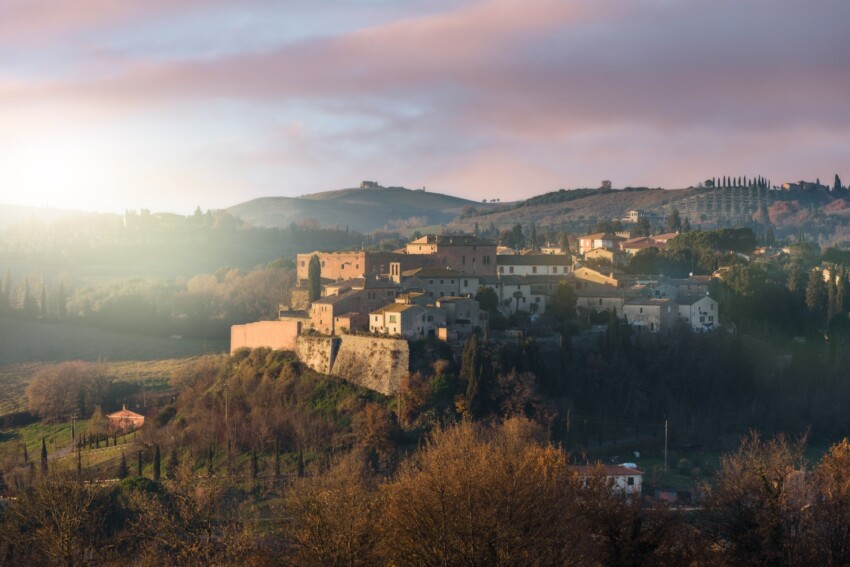
The municipality of San Giovanni d’Asso lies to the south of Siena province, nestled between the Crete Senesi and the Val d’Orcia.
The territory of San Giovanni d’Asso is a rare example of harmonious balance between nature and human settlement. It is remarkably rich in farmhouses, small villages, castles and parish churches, scattered across the entire landscape. The present-day municipality dates from the Risorgimento period (1870); its economy has always been rooted in agriculture, though during the first half of the twentieth century a lignite mine operated at Montisi—a type of coal of strategic importance during the two world wars and the 1930s.
With the turbulent economic and industrial growth of the 1950s and 60s, the municipality experienced a significant population decline, particularly among young people who migrated to major industrial centres. During these same years, the mezzadria system also came to an end (a medieval system of agricultural management where the farmer’s produce was divided with the landowner). Today, the economy of the municipality is based on quality agriculture (oil, wine, cheese) and a rapidly expanding tourism sector. Furthermore, San Giovanni d’Asso is one of the most important international centres for white truffle harvesting.
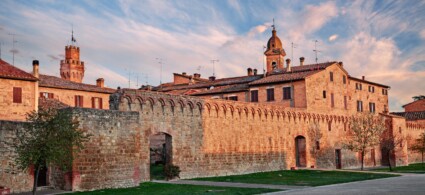
The castle and the village that developed around it most likely date back to the early Middle Ages, during the period of incastellamento (castle fortification). In Etruscan-Roman times, human settlements in this territory were distributed along the Cosona-Lucignano-Pava-Pieve a Salti axis. During this period, the area of Borgo di Sotto also developed, near the springs of Fonti and where the canonica of S. Pietro in Villore stood, a small gem of Romanesque art.
Our first recorded mention of the castle dates to 1151, when the feudal lord Paltonieri di Forteguerra submitted himself and his castles to Siena; several decades later (1178) we learn it was owned by Ugolino Scolari, viscount of Chiusdino, who also made an act of submission to Siena. It subsequently passed to the counts of Civitella, not without conflict with the Scolari family. During this period, the expansion of landownership by noble Sienese families and institutions intensified along the Asso Valley. The economic importance of the area is further underlined by the heavy extraordinary tax of 250 lire that Siena imposed on San Giovanni’s residents in 1208, and by the same city’s attention in regulating the waters of the Asso on the plain between Lucignano and Monterongriffoli at the end of the thirteenth century.
Towards the end of the thirteenth century, we find that a certain messer Pepone, native of the castle, was its owner, and that he sold it in 1296 to the Buonsignori, who took effective possession after various disputes and through the intervention of Siena’s Podestà Uberto Rubaconte. Shortly afterwards, the Buonsignori sold the castle with its pertinences to the Salimbeni, who almost immediately ceded it to Cardinal Riccardo Petroni. We owe to the Cardinal the completion of the castle buildings, the construction of the church of San Giovanni Battista (replacing the small and inadequate one contained within the fortification) and his donation of numerous relics to it.
From this period dates the Palace of the Comune, although the surviving Statutes are from 1492. However, other members of the Petroni family came into serious conflict with the inhabitants of San Giovanni, causing grave damage to the church of San Pietro in Villore, resulting in them being fined by Siena several thousand florins (1314). The Petroni family held possession of the “fief” from 1303 to 1472 when Donna Alessandra, marrying Benedetto Martinozzi, brought it as her dowry to the Lords of Montelifre.
In 1539 Benedetto, son of Giovanni, son of Benedetto Martinozzi, sold the palace, lands and rights over San Giovanni d’Asso to Giulio Pannilini. The Pannilini family retained possession until the early twentieth century. The property passed through various private hands during the twentieth century until the municipality of San Giovanni d’Asso acquired ownership of approximately half of it in 1990 and undertook its restoration.
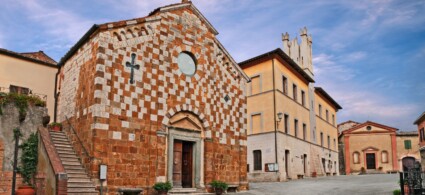
It is difficult to establish exactly when it was founded; but considering the middle Asso valley, the origins of our church date back to the early twelfth century. But at whose initiative? Who provided it with the necessary means to support the communal life of the clergy? The breadth of resources evidenced by what remains of it (the painted cross of the twelfth century preserved in Siena’s Pinacoteca; two precious triptychs of the Sienese school from 1300, one of which by Ugolino di Neri, recently entered the Contini-Bonaccossi donation at Palazzo Pitti in Florence; the twelfth-century church with parts remade in the thirteenth century) “incline us—as Tafi observes—to think rather of a munificent foundation by some pious aristocratic confraternity than of a foundation by ecclesiastical authority or a popular initiative”.
From the fifteenth century onwards, San Pietro in Villore began its decline, specifically from 1492, when the church of San Giovanni Battista within the town was established as the parish church. And just a few years later, in 1577, the transfer of the baptismal font and the title of Pieve from Santa Maria a Pava to San Giovanni d’Asso marked the sunset of the Pieve of Pava as well. The era of the pievi and canoniche had ended. Certainly for the visitor who, after admiring this small gem of art, returns to the chaotic noise of the great city, there will linger in their eyes and heart the barbarous jagged outline of the portal, the slender little columns of the crypt and the bell tower set against the azure sky between the green tips of the cypress trees.
History of the Grancia of Montisi “A beautiful fortress designed as a palace with tower, its outer gates and drawbridge, with cloister in the centre and a fine vaulted cistern, with moats and counter-moats around it and with all those features required of a fortress to render it sufficiently secure…” Thus the Grancia of Montisi is described in a sixteenth-century document that outlines the structure of this historic residence, built by the Ospedale di S.Maria della Scala of Siena at the western edge of the medieval borough of Montisi. Grancia (or Grangia) is the name given to those large fortified farms—equipped with broad granaries, wine cellars and olive presses—which the Ospedale built along the Via Francigena or in its vicinity, with the purpose of storing, guarding and protecting products from the vast territories it owned in the valleys of the Orcia and Arbia, in the Sienese “crete” and in Maremma.
Their formation arose from the need to consolidate various holdings into unified and organic entities, for better rationalisation of agricultural production. The organisational and administrative functions of the individual units were entrusted to friar managers (frati granceri) at least until the fifteenth century. Subsequently, the Ospedale entrusted this task to lay persons. The oldest and most important nucleus of these Grance (Cuna, Serre di Rapolano, Montisi, S.Quirico and Spedaletto) was formed between the late 1200s and the early 1300s, often through the restructuring and enlargement of older buildings and fortresses, as presumably also occurred for the Grancia of Montisi.
What's the weather at San Giovanni d’Asso? Below are the temperatures and the weather forecast at San Giovanni d’Asso for the next few days.
To see all the facilities and book accommodation in San Giovanni d’Asso use the form below, entering the dates of your stay.
 Hotel
Hotel  Budget accommodations
  Apartments
  Family Hotel
  Luxury Hotel
  Resorts