Agriturismo La Sovana
Sarteano - Via Di Chiusi 37
Book now
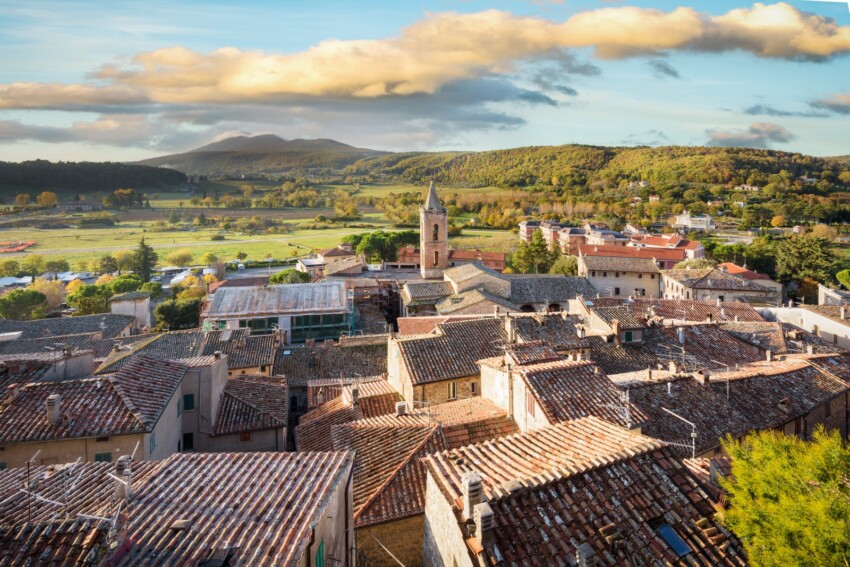
In one of the most beautiful areas of southern Tuscany, between the Valdichiana and the Val d’Orcia, you’ll find Sarteano, whose skyline is dominated by the imposing silhouette of the fifteenth-century Castello that stands out against the verdant expanse of Monte Cetona.
These two striking profiles represent the key to understanding a rich and fascinating territory: history and nature overlapping and intertwining, in one of the few areas of this prosperous and densely populated region where you can still discover unspoilt corners.
Beyond vast open spaces, breathtaking views and well-marked walking trails, Sarteano also offers pleasant walks near the town centre, towards Boccalaciana and Peschiera, where you can explore ancient Etruscan roads, the two so-called vie Cupe, with their evocative cuts in the local travertine, scattered throughout with cavities that once held Etruscan burials.
The small historic centre of Sarteano houses some truly unmissable monuments and museums. Visit them all, then venture out to explore the beautiful surrounding countryside.
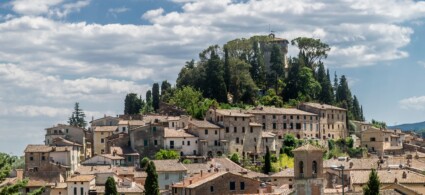
The Sarteano castle rises on a massive travertine rock surrounded by lush vegetation that has contributed to its impregnability over the centuries and today forms a nature park with its centuries-old holm oaks.
The structure, solid and imposing, allows for a visit that evokes the life of the garrison soldiers it once housed, whether walking along the battlements to the corner towers or climbing the steep stairs of the keep to reach the summit, from where you can enjoy a fine panorama.
The park surrounding the castle, composed of centuries-old holm oaks, amplifies the beauty of the place, creating a sense of distance and isolation from the town below that makes the whole scene even more atmospheric, and offering moments of peace and relaxation in the adjacent Park of Peace.
The archaeological museum of Sarteano, located in the sixteenth-century Palazzo Gabrielli, just a short walk from the town’s main square, houses largely artefacts from the numerous Etruscan necropolises of the territory, spanning a period from the ninth to the first century BC.
Of particular interest are the canopic urns from the Orientalizing period, notably the reconstruction of the chamber tomb at Macchiapiana with a double burial and a female canopic urn on a throne bearing the labrys as a symbol of power. Among the finds stand out the fine late Archaic cippo of fetid stone from Sant’Angelo depicting scenes of an Etruscan funeral and the painted ceramics from the fifth and fourth centuries BC from the Palazzina necropolis.
The entire lower floor has just been expanded and fitted out to display recent discoveries from the Pianacce necropolis, with a room entirely dedicated to the full-scale scenic reconstruction of the extraordinary infernal chariot tomb, using innovative digital print techniques on plaster to reproduce the paintings.
The exceptional discovery of the tomb of the infernal chariot, made in October 2003 during the annual excavations at the monumental Pianacce necropolis, a short distance from Sarteano’s centre, was one of the most significant finds in Etruscan studies in recent decades.
The tomb, cut into travertine at a depth of five metres with a dromos access corridor of twenty metres, is decorated with a pictorial cycle in vivid and striking colours that stand out against the white plaster and are remarkably well preserved. But its exceptional nature lies above all in the originality of the iconographic themes depicted. On the right side of the access corridor is depicted a quadriga, composed of two lions and two griffins, pulling a chariot driven by a demon with a sinister appearance, stern face and wild gaze.
This is probably an entirely innovative depiction of the demon Charun, the equivalent of the Greek Charon in his role as guide of souls to the Underworld, but functioning as a charioteer, a role never before attested in Etruscan art.
The Spineta Abbey, whose existence is documented from 1016, is located to the right of the road from Sarteano to San Casciano Bagni, approximately 6 km away. In ancient times this place was covered with brambles and thorns, hence the name Spineto or Spineta given to the area. Vallombrosan Benedictine monks erected an abbey here, which was later entrusted to the Cistercians: the spaces left free by woods and brambles were cultivated under the monks’ guidance; wheat, spelt and animal fodder were sown, and vines and olives were planted.
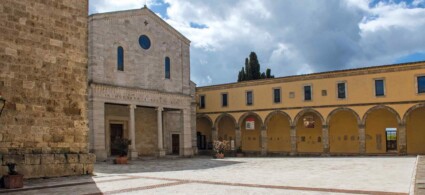
The Church of the Holy Trinity, attached to the convent, features a simple Romanesque façade clad in limestone. The bell-wall, dating from a later period, stands next to the quadrilateral drum that encloses a small dome. Through the eighteenth-century portal you enter the interior, consisting of a single nave closed off by three apses.
Along two of the main streets in Sarteano’s historic centre, Via Sant’Angelo and Corso Garibaldi, you’ll find a range of accommodation options housed in beautifully restored historic buildings. These are period residences, apartments and bed and breakfasts, ideal for fully immersing yourself in the life of a typical Tuscan village. There’s also a 3-star hotel just south of the centre, complete with a swimming pool.
However, as is common in these parts of Tuscany, most of Sarteano’s accommodation is not in the centre itself, but in the surrounding area. The territory is scattered with farm stays, farmhouses and country cottages, perfect for escaping the hustle and bustle of modern life and revitalising body and spirit. There are many farm stays in Sarteano, but they’re all lovely, housed in beautifully restored old farmhouses and equipped with all facilities.
Sarteano is just 6 kilometres from the A1 motorway exit at Chiusi-Chianciano Terme, making it easily accessible from all Tuscan cities. Once you exit the motorway, simply follow the SP478 provincial road heading south, and you’ll reach your destination in less than 10 minutes.
Its proximity to the motorway means Sarteano is never too far from major Tuscan cities. From Florence it takes one hour and 20 minutes, from Arezzo 50 minutes, from Pisa and Livorno two hours and 15 minutes, while from the provincial capital Siena it takes an hour. From all the cities mentioned, the route is always the same: take the A1 motorway, exit at Chiusi-Chianciano Terme and continue on the SP478 to your destination.
You can also reach Sarteano easily by public transport. There’s no railway station, but those travelling by train can get off at Chiusi-Chianciano Terme station, in Chiusi Scalo, and then continue by bus on the FT5 suburban line operated by Autolinee Toscane heading towards Montepulciano, a journey of just 20 minutes. The line makes 4 stops in Sarteano, two along the SP21, one on Via Trieste and one in Piazza della Libertà.
What's the weather at Sarteano? Below are the temperatures and the weather forecast at Sarteano for the next few days.
Sarteano lies in the province of Siena, straddling the Valdichiana and Val d'Orcia valleys, just a short distance from the town of Chiusi.
 Hotel
Hotel  Budget accommodations
  Apartments
  Family Hotel
  Luxury Hotel
  Resorts