Borgo San Luigi
Monteriggioni - strada delle cerreta 7
Book now
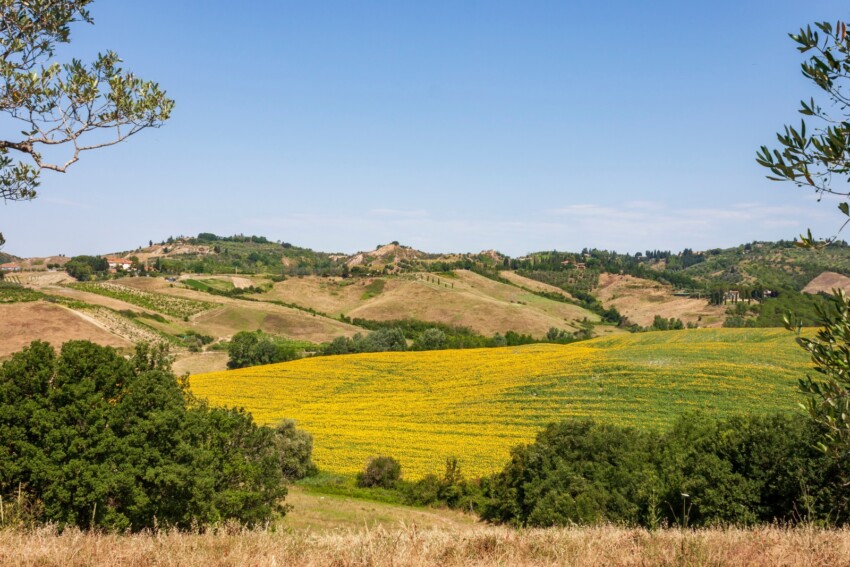
This itinerary, known as the Sentierelsa, begins at Gracciano, south of Colle di Val d’Elsa, at the San Marziale bridge and follows the riverbed for 2 km until it reaches the hamlet of San Giorgio.
The entrance is located to the left as you leave Colle di Val d’Elsa, beyond the San Marziale bridge.
Here you’ll immediately spot, visible even from the bridge’s pedestrian walkway, the Steccaia and the Callone Reale – two remarkable feats of hydraulic engineering that were vital to the city. Since medieval times, these structures have been used to channel part of the Elsa river’s water.
The water could thus be harnessed for irrigation, and served as a driving force first for mills, then for paper mills and foundries, and for various industrial purposes.
The Steccaia specifically holds back and diverts part of the Elsa’s water through a system of moveable panels inserted into stone blocks to form a weir – essentially a barrier to the river’s free flow – whilst the Callone Reale is a sluice gate that controls the volume of water flowing into the canal that runs towards the city, known locally as the gora.
The exact construction date of this hydraulic system is unclear; some sources place it in the tenth century.
We do know with certainty, however, that it was restored in 1606 under the patronage of Ferdinando I dei Medici, Grand Duke of Tuscany, as recorded on a plaque set up by the Medici family just below the Callone.
After 200 metres, you’ll come across the Diborrato waterfall: a 15-metre drop with a plunge pool over 10 metres deep, which served as a bathing spot for locals in the last century.
Following the path downwards, situated beneath the waterfall, are the Grotte dell’Orso (Bear Caves), named for their vague resemblance to a bear’s shape.
The path veers away from the river for about 100 metres before rejoining it in an area marked by an enormous flat boulder.
You’ll then reach the Gore Rotte, where another park entrance is located, complete with small bridges and walkways in Tibetan style.
The trail continues for roughly another 1 km to reach San Giorgio, where a river crossing has been built. Below this area lie the Conchina, Masso Bianco, Nicchia and Spianata dei Falchi – names given in the 1930s and 1940s when locals called this stretch “Colle’s seaside”.
The path is characterised by stone steps, wooden railings, small crossings and safety barriers, with numerous signboards highlighting the distinctive features of each location.
A wealth of vertebrate and invertebrate wildlife can be observed along this route.
In the river’s waters you may spot the freshwater mussel (Unio mancus), a bivalve mollusc that can reach 10 cm in length and lives embedded in the mud or sand of the riverbed.
Among the submerged vegetation, you’ll find river shrimp (Palaemonetes antennarius), a small crustacean up to 5 cm long that feeds on algae and aquatic plants.
Rather more elusive is the river crab (Potamon fluviatile), another crustacean with a carapace measuring up to 10 cm.
Countless insects populate the watercourse, particularly their larvae: dragonflies (Odonata), caddisflies and mayflies.
The riverbanks of the Elsa are also home to numerous vertebrates, and you’ll have a good chance of spotting some, along with the many fish species present.
The chub (Leuciscus cephalus) is the most common fish in the Elsa and extremely abundant in this river, as are barbel (Barbus sp.) and carp (Cyprinus carpio), which here can weigh up to 30 kg.
The stream goby (Padogobius nigricans) is perhaps the most unusual fish you’ll encounter in the Elsa, whilst amphibians are also well represented, including the southern crested newt (Triturus carnifex) and the common newt (Triturus vulgaris).
The common toad (Bufo bufo) and the Mediterranean tree frog (Hyla intermedia), Italy’s only tree-dwelling amphibian, are frequent visitors, as are the edible frog and the agile frog (Rana dalmatina), named for its impressive leaping ability.
You may occasionally see two harmless snakes swimming across the surface: the grass snake (Natrix natrix) or the tessellated water snake (Natrix tessellata).
Many bird species frequent these river valleys, drawn by the abundance of shelter and food, including the impressive grey heron (Ardea cinerea), with its nearly 2-metre wingspan, and the little egret (Egretta garzetta), both visible only in winter.
You may also spot the mallard (Anas platyrhynchos) and the common moorhen (Gallinula chloropus), the grey wagtail (Motacilla cinerea), also called the tail-flipper, and finally the kingfisher (Alcedo atthis), easily recognisable by its striking plumage – blue-green on the back and orange on the underside.
The only aquatic mammal currently found in the Elsa is the nutria (Myocastor coypus), a large rodent imported to Italy after the Second World War and originally farmed for its fur, measuring roughly 1 metre long and weighing around 10 kg.
The nutria became established following catastrophic floods that destroyed breeding farms along various rivers, inadvertently releasing the animals into the wild.
To see all the facilities and book accommodation in Sentierelsa Trail use the form below, entering the dates of your stay.
 Hotel
Hotel  Budget accommodations
  Apartments
  Family Hotel
  Luxury Hotel
  Resorts