Casa Di Campagna In Toscana
Sovicille - Strada Dell'aeroporto 1
Book now
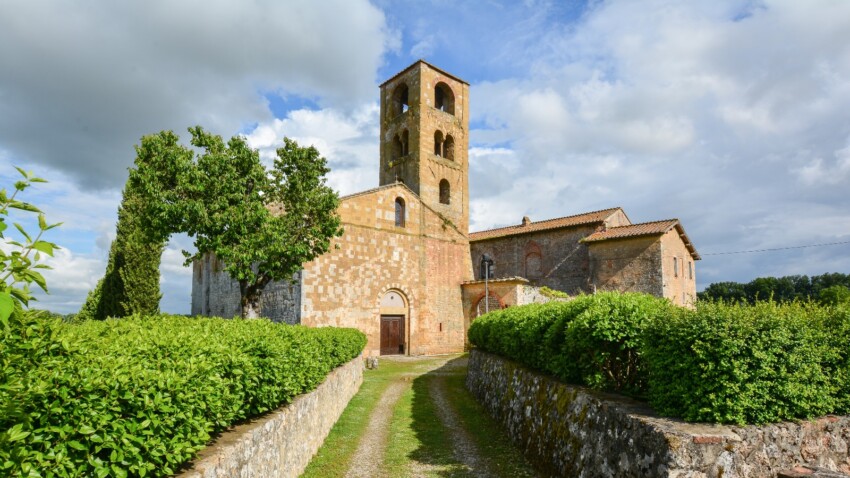
Sovicille lies approximately 10 km west of Siena, along the route towards Massa Marittima and Follonica.
The municipality’s territory ranges between 200 and 618 metres in altitude, covering a total area of 14,376 hectares, making it one of the most extensive among the Province’s 36 municipalities. The most populated hamlets are San Rocco a Pilli and Rosia.
From a distance, Sovicille appears as a small island nestled amongst woodland. As you approach the village, the imposing Palazzo Nuti-Palmieri, now Lechner, immediately strikes the eye, with its elegant staircase descending towards the park. The sweeping curves of this eighteenth-century palazzo reveal that it was built upon the existing city walls that once encircled the settlement. The final defensive circuit (dating from 1479) remains clearly visible today, both within the palazzo itself and in stretches of wall that survive to the west, as well as in other buildings constructed directly upon these fortifications.
The elliptical layout of Sovicille’s historic centre points to Etruscan origins. Indeed, this civilisation, and later the Romans, founded their settlements on hilltop ridgelines for defensive purposes and to avoid flooding and malaria. According to some historians, the name Sovicille may derive from “Suavis locus ille” (that delightful place), though the more widely accepted theory traces it to the Greek sukon-siconio (fig flower), known as sofficum in Latin. Many fig trees flourished in this location, and the earliest recorded name for this ancient stronghold appears in a document from the Siena State Archives dated 1004: Suffichillum.
Sovicille’s historic centre has retained the dimensions it had in the fourteenth century without expanding further, having endured wars, fires and numerous plague outbreaks throughout the centuries. The most devastating was the Black Death of 1348, which claimed countless lives between May and August, a tragedy shared with Siena itself.
Upon entering the village and observing the curved line of Via Roma and the ancient stonework of the palazzo at number 27 (now home to the local tourism board), you can clearly see that the buildings on the right correspond to the original defensive wall of the medieval fortress. The palazzo at number 30 was erected in the seventeenth century as the prefect’s residence. The coat of arms on the left side of this palazzo belonged to the Niccolini and Fortini families, among the first magistrates sent to Sovicille following the collapse of the Sienese Republic (1555).
At number 26, the building with its rounded arches, now closed, dates to the sixteenth century. At the beginning of Via Valfonda stands a loggia, fortunately intact, from the early sixteenth century, designed by Baldassarre Peruzzi.
Upon reaching the square, you’ll notice its rectangular layout, suggesting that the Roman fortification was reused during the early medieval period by the Lombards, who typically constructed four towers at the corners of a quadrilateral with ancient roads (cardo and decumano) intersecting at right angles. These streets have naturally disappeared, though one can be traced in the alleyway beside the church (now blocked by a building) and in the Porta Senese to the east, currently in private hands.
Traces of the ancient towers survive in documents and the bell tower’s foundation. In 1864, the last tower was demolished where the present Town Hall now stands. The oldest palazzi are the one to the north with thirteenth-century remnants (a supporting column visible inside the bar), the one adjacent to the Town Hall, and the large one opposite. Nearby stands a palazzo with enclosed loggias dating to the eighteenth century, likely rebuilt following Peruzzi’s designs.
Beneath the square lie tunnels carved into the rock during the medieval period, used for escape during sieges. Before the 1920s, where the War Memorial now stands was a well-cistern supplying water to the village. The square’s shops, until mid-twentieth century, were stables for donkeys and mules, as Sovicille was a village of charcoal makers, woodcutters and cart drivers.
The ancient church dedicated to San Lorenzo Martire stands in the Castle’s main square. It is already mentioned in the Municipal Statutes of 1237.
It was certainly built upon part of the fortress’s ancient defensive wall; indeed, the lower section of the Romanesque-style bell tower was constructed on the foundations of an old tower. The church remained subordinate to the Pieve del Ponte allo Spino until the early fourteenth century, after which it was elevated from a simple castle chaplaincy to the status of a Pieve.
The building features a single nave and exhibits modest Neo-Gothic characteristics; it was restored at the end of the nineteenth century when the church’s orientation and entrance were relocated. The most significant artefact is the lintel of the small entrance door on the church’s left side, possibly pre-medieval or even Byzantine in origin, likely transferred from the Pieve del Ponte allo Spino during renovations in the early thirteenth century. It bears a relief carving depicting a sort of “ludo venatorio” (hunt of evil monsters), featuring an armed knight, a man with a quiver and an archer battling a dragon. This chaplaincy was originally dedicated to Saints Lorenzo and Agata.
Inside, we find a beautiful fresco attributed to Giorgio di Giovanni, a follower of Beccafumi (1538–1559), depicting the Madonna and Child surrounded by Saints Christopher and Onofrio on one side and Lucy and Martin on the other. The canvas in the right chapel shows the Madonna and Child between Saints John the Evangelist, Michael the Archangel, Catherine of Alexandria, Agata, Lorenzo, Peter and Cherubim in the upper section, attributed to Alessandro Casolani (1552–1553/1607). The canvas in the left transept is attributed to a follower of Riccio. The altar and presbytery are of yellow marble (Broccatello) from Montagnola. At the entrance on the left, we can admire a fresco with marble inlay work, executed by masters Rolando Montagnani and Paolo Angeli and donated to the church.
This image represents the Patron Saint of both the municipality and the church itself: San Lorenzo Martire.
This populous hamlet of Sovicille municipality has expanded considerably in recent decades along the hillside slopes topped by the parish church bell tower.
The village originally developed along an ancient Etruscan road connecting Siena to Poggio Civitate and Roselle (GR).
Records of an old cart road date back to 1270, when the present-day village consisted of scattered houses along this track, which at certain points allowed the passage of carts travelling to and from Siena, transporting goods and agricultural produce from the Piano della Selva (Piano del Padule).
In 1561, following the wishes of nineteen local residents, the present-day San Rocco confraternity was founded, subsequently lending its name to the entire district.
Perched on the highest part of San Rocco stands the Church of San Bartolomeo, which has had a rather turbulent history.
Of medieval origin, it is already recorded in 1389. In 1635, a baptismal font was added, elevating it to the status of a Pieve. Built on unstable terrain, it has suffered numerous closures for worship and corresponding restoration work.
In 1824, the noble D’Elci family, owners of the nearby Villa di Cavaglioni and extensive estates, commissioned a rebuilding of the Church to designs by architect Agostino Fantastici.
A further well-executed restoration was required in recent years, and the Church is now open for worship once again.
This Pieve is documented as early as the twelfth century and held considerable importance throughout the territory. By the late sixteenth century, it was a vicariate encompassing Sovicille, Torri, Orgia, Pentolina, Stigliano and Brenna. During the fourteenth century, it underwent major alterations when the building’s layout was reversed: the present façade now corresponds to the end wall of the original Romanesque structure.
The church today presents a basilica plan of rectangular form, divided into three naves by four broad arches supported by square pillars, rendered slightly cruciform by angular cuts. Within, the baptismal font, created by a Sienese artist and completed in 1332, occupies the right side of the doorway. Its front section depicts the Baptism of Christ among five angels. On the right side altar, we can admire a panel by Guidoccio Cozzarelli: the Madonna Enthroned with the Christ Child, San Sebastiano and Sant’Antonio Abate, executed in the fifteenth century. The roof is timber-framed.
The façade, characterised by fine masonry work in a row-laid pattern of cavern-like limestone, still retains its three Romanesque windows with double splays, which originally illuminated the presbytery. The most significant element is the bell tower, which flanks the church midway along the right side. It is well preserved, although the crenellated crown is a later addition. It consists of a series of storeys with single, double, triple and quadruple openings, each storey marked by rows of corbelled arcading.
The Lombard model is evident, and this bell tower ranks among the finest in Tuscany, despite being among the latest Romanesque bell towers in the Siena area.
The municipal territory extends from Montagnola Senese to the Merse river valley. The landscape is highly varied: wooded in the hilly zones running from Poggio di Siena Vecchia to Poggio la Torretta, densely cultivated in the flat areas between Ampugnano and Orgia. The region boasts ancient human settlements, evidenced by prehistoric finds: Stone Age at Personata, in the Piana dello Spino and at Brenna; Bronze Age at Cetinale, Partena, Poggio di Siena Vecchia and Montarrenti; Iron Age at Cetinale, in the Rosia area, and again at Poggio di Siena Vecchia. Etruscan settlements are numerous: La Valle del Luco, Poggio alla Piana, Ancaiano, Cetinale, Partena and Toiano. Roman-period evidence appears at Stigliano, Rosia, Palazzone, Caggio di San Rocco a Pilli, Poggio Luco near Malignano, Barontoli, Simignano, Toiano and Sovicille. Traces of Byzantine and Lombard settlements exist at Filetta, Caggio di Sovicille and Orgia.
Between the twelfth and thirteenth centuries, various churches were constructed, and following the formation of city-states (Siena 1130), the Diocese of Volterra retained the Pieves of Pernina, Molli, San Giusto a Balli and the chaplaincy of Trecciano.
The Pieves of San Lorenzo Martire, located within the old fortress, San Maria del Ponte allo Spino, Rosia and Recenza came under the Diocese of Siena.
In the same period, tower houses, castles, cloth-fulling mills and mills were constructed.
Sovicille boasts Tuscany’s highest number of medieval hamlets (approximately 55), some now vanished, others reduced to farmhouses, and others still preserved unchanged to this day (the Palazzaccio di Toiano is a typical example). Small villages such as Tonni, Toiano and Tegoia are particularly striking because they remain frozen in time, as though the centuries have not touched them.
At the end of the fifteenth century, one of the greatest painters and architects of the Italian Renaissance, Baldassarre Tommaso Peruzzi, was born in Ancaiano; his work is readily visible throughout the municipal territory.
During the period of decline following the fall of the Sienese Republic (1555), economic, artistic and architectural development stagnated until the mid-seventeenth century.
The Church of Ancaiano and the Villa di Cetinale date to the late seventeenth century; subsequently, other villas were constructed: at Toiano, Sovicille, San Rocco a Pilli and Ucciano.
What's the weather at Sovicille? Below are the temperatures and the weather forecast at Sovicille for the next few days.
To see all the facilities and book accommodation in Sovicille use the form below, entering the dates of your stay.
 Hotel
Hotel 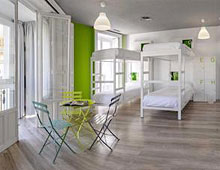 Budget accommodations
  Apartments
  Family Hotel
 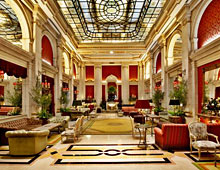 Luxury Hotel
 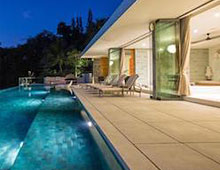 Resorts