Podere Alberello
Torrita di Siena - Loc. Alberello 71
Book now
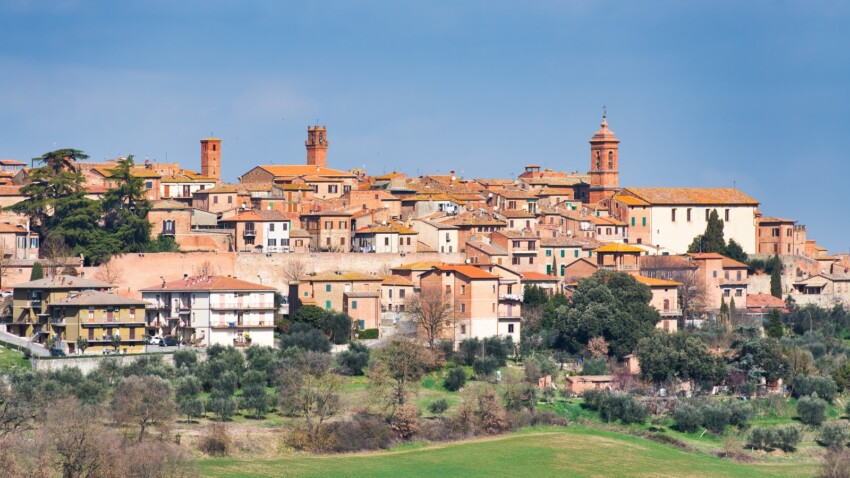
Perched on a hilltop at 325 metres above sea level, Torrita is a charming town in the Valdichiana Senese. The historic centre of Torrita di Siena, enclosed within medieval walls dating back to the 12th century, of which several sections remain visible, offers visitors characterful corners and noteworthy works of art.
Walking through the town’s narrow streets, you’ll find yourself wrapped in an atmosphere blending history and legend—consider the names Via Ghino di Tacco, Via dei Pecorai and Via della Lupa. Entering through Porta Nova, your first stop is Piazza Matteotti, the town’s cultural and religious heart. Here you can admire the Palazzo Pretorio (now the Town Hall), dating from the 13th century, its tower rising prominently after numerous restorations over the centuries, the Teatro Comunale and the Church of SS. Flora and Lucilla.
The piazza marks the intersection of roads leading to the four town gates and still features the ancient cistern (or well) that once supplied water to the entire town. Next to the Town Hall stands the Teatro Comunale “degli Oscuri”, established by its namesake Academy in the 18th century. Inside, you’ll find a bust honouring opera singer Giulio Neri, born here in 1909—a cherished memory among the townspeople.
The Romanesque church of S. Flora and Lucilla is the oldest within the castle walls, dating to 1300 and housing numerous notable works of art. The most significant is undoubtedly the bas-relief lunette “The Blood of the Redeemer”, attributed to Donatello. Also noteworthy are a triptych by Taddeo di Bartolo, a 14th-century Sienese painter; a crucifix dated 1444 from the Florentine school; a canvas depicting the Madonna and Child with apostles Andrew and John by Benvenuto di Giovanni; and “The Vision of Blessed Ambrogio Sansedoni”, from the Church of Madonna delle Fonti, attributed to Francesco Volpi and dated to the 18th century.
Continuing along Via Ottavio Maestri, you’ll encounter the church of S. Croce, built in 1642 in Baroque style, which houses a canvas by Sienese painter Francesco Rustici, called Il Rustichino. The Church of San Martino e Costanzo was constructed in 1631 as a Latin cross and contains the “great bell” dating to 1454.
Along nearby Via della Lupa, on sunny days you can enjoy a splendid view of the Valdichiana: a fertile plain once marshland, reclaimed by Leopold II of Tuscany under architect Fossombroni’s direction. Via della Lupa leads to Porta Gavina, perhaps the most notable of the four gates for its architecture and the 12th-century wooden door, recently restored.
Via Cesare Battisti leads to Porta a Pago, opening onto the north side of the walls. Its name derives from “pagum”, the ancient village that once stood on the opposite hilltop, though other sources link it to the toll levied on incoming goods.
Climbing Via Dante Alighieri, you return to Piazza Matteotti, from where Via Ghino di Tacco, Vicolo dei Fabbri and Vicolo dell’Ospedale reveal lesser-known yet characterful corners, such as finely crafted arcades and buildings that have remained unchanged over time.
To exit the medieval walls, you reach Porta a Sole, where wooden houses for soldiers defending the castle likely first stood. Beyond opens the space called “Gioco del Pallone”, a gathering place for tamburello players and venue for the local “Palio dei Somari” festival.
At the far end of the “Gioco” stands the small oratory dedicated to Madonna delle Nevi, built in 1525 to honour Mary during a grave plague. A copy of Donatello’s Lunette adorns the entrance door, as the original was once housed here; inside is a fresco attributed to Girolamo Benvenuto del Guasta depicting the Assumption of Mary.
Along the road to Sinalunga stands the Church of Madonna delle Fonti, built in 1665 to commemorate a miracle at a spring water source nearby. Following the cypress-lined road to the cemetery, you’ll find Torrita’s oldest church, Madonna dell’Olivo, once dedicated to S. Costanzo, the town’s patron saint. Some sources suggest the building was erected on the remains of an ancient temple dedicated to Ceres, goddess of field fertility.
Torrita di Siena was the birthplace of several historical figures, including “Frà Jacopo da Torrita” and “Ghino di Tacco”.
The former is certainly Torrita’s most illustrious figure. A Franciscan friar, he revived the art of mosaic in the 13th century and was also a painter. He is remembered by the street leading to the Collegiata and a medallion in the Municipal Council chamber where his portrait hangs.
In the “Encyclopedia of Christianity” published in 1947, Jacopo da Torrita is noted: “Jacopo da Torrita took his name from his birthplace”. He is remembered for his late-13th-century works, particularly the Marian mosaics in Santa Maria Maggiore in Rome, where he completed restoration work in the apse with his own modifications. Other testimony to his skill includes various roundels painted in the second transept of the Upper Basilica in Assisi.
Ghino di Tacco was born in Torrita to the Cacciaconti Monacheschi Pecorai family, one of Siena’s noble families. His father Tacco, along with sons Ghino and Turino, committed theft and robbery and set fire to the castle of Torrita; he was condemned for seriously wounding Jacopino da Guardavalle. Ghino was expelled from Siena’s territory and took refuge at Radicofani, a strategic point between Papal territory and the State of Siena.
Determined to avenge his father’s judge, he rode to Rome with four hundred men, entered the tribunal and beheaded Benincasa of Arezzo, placing his head on a pike; he then returned to Radicofani where he enthusiastically pursued the “art of robbery”.
Memorable was his treatment of the Abbot of Cluny, captured while travelling to the thermal waters of San Casciano dei Bagni to cure stomach trouble. The abbot was imprisoned and fed bread and dried fava beans, which miraculously cured his ailment. Grateful, the abbot interceded with Pope Bonifacio VIII for Ghino’s reconciliation. The Pope was convinced and appointed him Knight of S. Giovanni and Prior of the Santo Spirito hospital, a title granting a vast estate. The place of his death is uncertain—some say Rome, whilst Benvenuto da Imola claims he was murdered at Sinalunga.
What's the weather at Torrita di Siena? Below are the temperatures and the weather forecast at Torrita di Siena for the next few days.
To see all the facilities and book accommodation in Torrita di Siena use the form below, entering the dates of your stay.
 Hotel
Hotel  Budget accommodations
  Apartments
  Family Hotel
  Luxury Hotel
  Resorts